E-Paper



Covid-19: Modi flags crowding in hills as 3rd wave trigger
The Prime Minister’s remarks came at a time when tourist hot spots have recorded large crowds, forcing some to cap the number of guests permitted at hotels and guest houses.

 Prefer HTon Google


The crowds at hill stations and markets where people are not wearing masks or following Covid-19 protocols are a matter of concern, Prime Minister Narendra Modi said on Tuesday, calling the scenes that have played out in several parts of the country as “not right”.
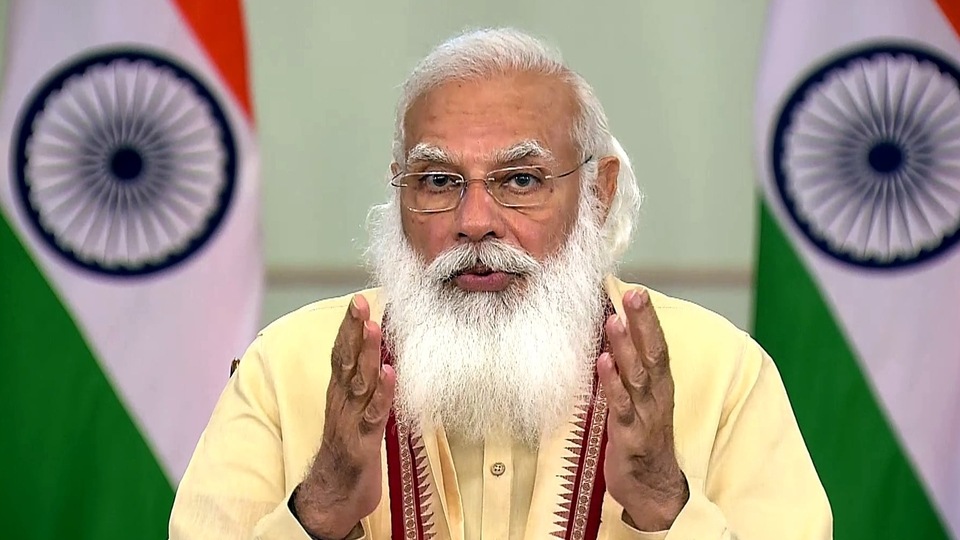
Modi made the remark during a meeting with the chief ministers of the North-East states, where cases have increased in recent weeks while most other parts of the country have shown a drop in new infections.
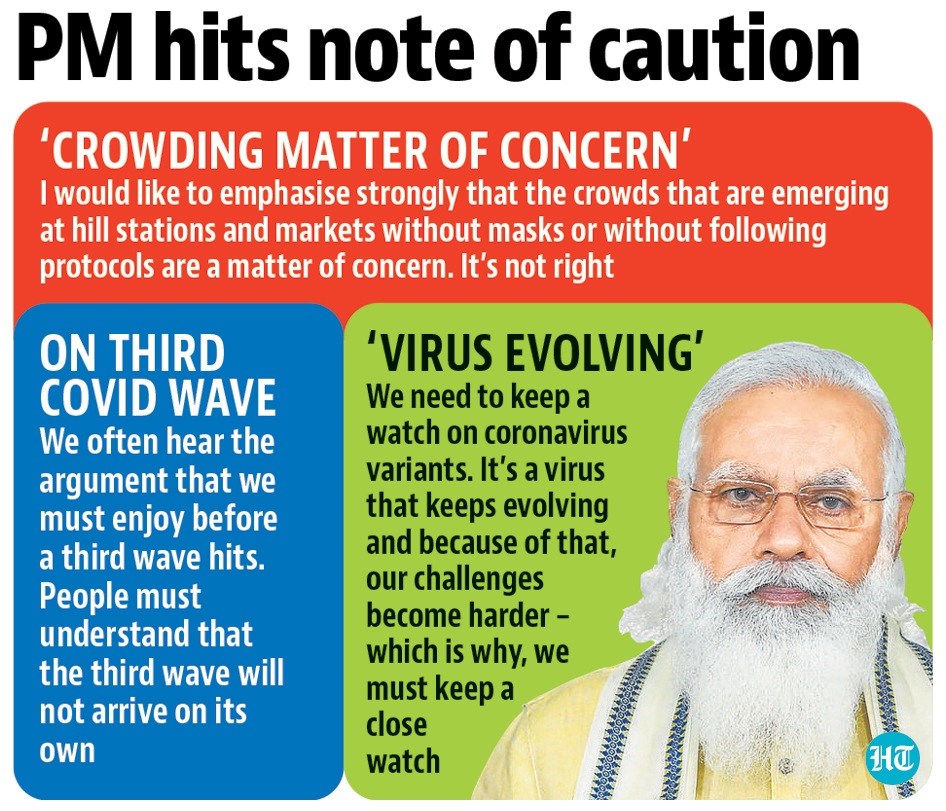
“I would like to emphasise strongly that the crowds that are emerging at hill stations and markets without masks or without following protocols are a matter of concern. It’s not right,” he said, according to a transcript of his speech shared by the government.
“We often hear the argument that we must enjoy before a third wave hits. People must understand that the third wave will not arrive on its own,” Modi said, adding that questions must be asked on how we can together stop the next wave of infections.
The Prime Minister’s remarks came at a time when tourist hot spots have recorded large crowds, forcing some to cap the number of guests permitted at hotels and guest houses.
At a press briefing later on Tuesday, a health ministry official said people are violating Covid protocols across the country. “Be it Chennai, Delhi, Chandigarh, or the state of Maharashtra, there is a section that does not observe Covid safe behaviour. The third wave may be caused because of this behaviour,” said Lav Aggarwal, joint secretary, Union health ministry.
“We talk about the third wave as if it’s a weather update. What we fail to understand is that adhering to Covid appropriate behaviour or lack of it is what will prevent or cause any future waves,” he added.
Overall, India’s headline Covid numbers have fallen roughly 16% in the last fortnight. The seven-day average of new cases was around 49,000 on June 27, coming down to around 41,000 on July 11. But six states — five in the North-East and Kerala — have bucked this trend, with cases as well as positivity rate being high.
Modi raised this concern when he met the chief ministers of Nagaland, Tripura, Sikkim, Meghalaya, Mizoram, Arunachal Pradesh, Manipur and Assam via video conferencing. All of these regions are reporting a rise in new cases.
The PM said it was important to catch signs of an outbreak early. “We need to keep a watch on coronavirus variants. It’s a virus that keeps evolving and because of that, our challenges become harder – which is why, we must keep a close watch.”
Assam chief minister Himanta Biswa Sarma said the state was following a micro-containment strategy, an approach the PM endorsed. Sarma, officials in Guwahati said, told Modi that he was confident that Assam’s positivity rate would be brought down to below 1% soon. Assam has been recording around 2,500 new cases and around 25-30 deaths daily for more than two weeks now.
Meghalaya chief minister Conrad K Sangma said at the meeting that the state did not record a wave when the nation was going through one, and it used the opportunity to augment infrastructure. “We got to prepare the required infra, augment oxygen generation capacity and others in advance,” the CM said, while expressing concern over growing numbers in rural areas.
Manipur chief minister N Biren Singh thanked the PM for the support and cooperation to the states. Manipur has been recording around 800 new cases daily and 10-15 deaths. The state has around 7,500 active cases.
Tripura chief minister Biplab Kumar Deb briefed Modi about the Covid vaccination progress and steps taken to control Covid. Tripura, with a positivity rate of over 5%, will take the required steps to reduce the positivity rate as well as number of cases, he said, according to officials.
Arunachal Pradesh chief minister Pema Khandu informed the PM that during the past week the state recorded case fatality ratio of 0.57%, which is lowest among all north-eastern states.
Nagaland chief minister Neiphiu Rio highlighted pandemic control measures by citing the total lockdown that began in May, and said the state has now begun its first phase of “unlock”.
The situation in the North-East was also flagged by government officials, who were speaking at the routine health briefing on Tuesday. “It is important that there must be no slacking of efforts if cases remain at high level in any geography, no matter how limited,” said Aggarwal.
He added that 55 districts in the country currently have more than 10% positivity rate.
“The only way to stop the pandemic in its tracks is by ensuring that people follow Covid-appropriate behaviour that includes wearing a mask, maintaining physical distancing and observing good hygiene, along with vaccination,” said Jugal Kishore, head, community medicine, Safdarjung Hospital.