E-Paper



Cyclone Biparjoy makes landfall on Gujarat coast after sustaining for 222 hrs
Biparjoy sustained for 222 hours with winds of at least cyclone strength (62 kmph), the longest in the history of north Indian ocean cyclones.

 Prefer HTon Google


Trees and electricity poles were uprooted as cyclone Biparjoy made landfall in Gujarat’s Kutch district, bringing winds sustaining at 115-125k/hr as thousands of rescue workers stood by while close to 100,000 residents were already moved out of their homes.
Also Read | Cyclone Biparjoy: About 100 trains cancelled, 39 short-terminated | How to check status
A system roughly 300km wide, with the eye of the storm alone spread across a 50km diameter, Biparjoy brought with it storm surges 2-3m high and winds that gusted up to 140k/hr. The storm was expected to sustain at the “very severe cyclone” strength till landfall was complete, which was expected by midnight on Thursday.
“The landfall process started around 6.30pm with the wall cloud of Biparjoy on Jakhau coast. The entire process will be completed by midnight,” said Manorama Mohanty, director of India Meteorological Department (IMD), Ahmedabad centre.
Also Read | Watch: Cyclone Biparjoy brings high tides, gusty winds in coastal Gujarat ahead of landfall
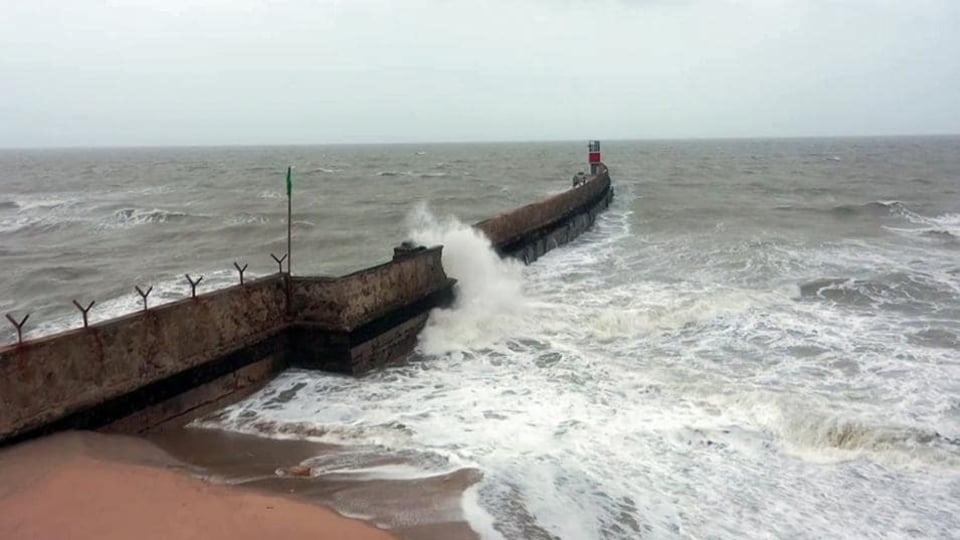
Jakhau and Mandvi towns of Kutch bore the brunt of the storm, with temporary sheds and hoardings collapsing due to the howling winds, while many low-lying localities were flooded following the incessant rain. Officials said conditions were likely to remain treacherous in these and adjoining regions till Friday morning, with the heavy downpour extending to parts of Rajasthan.

“It will weaken gradually at night and by tomorrow (Friday) morning, it is expected to have wind speed of a cyclone (65 to 75 kmph). At the moment coastal areas of Saurashtra and Kutch are recording very high wind speed of 115 to 125 kmph. The tidal waves will also reduce in height over next 6 to 7 hours. Heavy to extremely heavy rain will continue. On June 16 and 17 we are expecting very to extremely heavy rain over Rajasthan,” said M Mohapatra, director general, IMD.
Having originated in the Arabian Sea, Biparjoy is unprecedented for several reasons: It sustained for 222 hours with winds of at least cyclone strength (62 kmph), the longest in the history of north Indian ocean cyclones, and underwent rapid intensification on two occasions, especially the first when its winds went from 55k/hr to 139k/hr in strength.
“Biparjoy is also the second strongest or more intense cyclone to develop over Arabian Sea in June jointly with a 1998 cyclone clocking maximum winds of 194.4 kmph as per JWTC and 166.68 kmph as per IMD. The strongest June cyclone in Arabian Sea was Gonu in 2007 with wind speed of 268.54 kmph,” said said Vineet Kumar Singh, researcher, Typhoon Research Center, Jeju National University, South Korea.
“We will soon prepare a report on the records Biparjoy made,” said a senior IMD official.
Such rapid intensification of cyclones over the Arabian Sea is unusual and dangerous, experts said, adding that Biparjoy was fuelled by extreme energy from the ocean, with an unusually warm Arabian Sea and wind conditions helping nurture it for over 220 hours.
While the true damage from Biparjoy will only become clearer by the weekend, the preparation for the storm was a demonstration of a massive logistical mobilisation of relief and rescue resources that India has now become known for. Close to 100,000 people were evacuated and multiple squads of federal and state disaster personnel, along with the three wings of the military have been placed on standby. But as the climate crisis raises the likelihood of natural disasters such as cyclones, India will need to build long-term resilience to storms and superstorms, and ensure that not only are people pulled to safety quickly, but economic losses are minimised.
On Thursday, the first injuries to be reported were of three people who were hurt at Devbhoomi Dwarka district when a tree fell nearby, officials said.
At Okha a tug sank after it drifted away from the anchor and a Coast Guard vessel at Kankai jetty in Okha harbour drifted away due to the storm, said a senior Gujarat government official. Also, a vessel MV Hai NAM 81 reported engine trouble at Kandla port in Kutch and began drifting towards Dwarka. “The vessel is about 7 nautical miles away from Dwarka and all efforts are on to rescue everyone on board. A support tug could not be sent immediately for assisting the vessel due to the weather conditions,” the official said.
Dwarka, Okha, Naliya, Bhuj, Porbandar and Kandla along Gujarat coasts received heavy rainfall since Thursday morning. The coastal area witnessed strong winds of up to 50 kmph, the IMD said. Jhakhau port where the cyclone made a landfall is mainly a fishing habour with three private jetties, including two for handling clinker.
Once a cyclone enters land, however, it begins to break up, but not before leaving a trail of destruction. A similar unusual Arabian Sea cyclone that hit India’s west coast in 2021, cyclone Tauktae, claimed the lives of 57 people in the first day of its landfall.
Tauktae too was a rare storm since most cyclones develop off India’s east coast in the Bay of Bengal.
Experts attribute this to a warming of the Arabian sea. Sea surface temperatures here have increased by 1.2 to 1.4 degrees Celsius in recent decades, compared to four decades ago, according to a paper in Elsevier’s Earth Science Reviews published last year.
According to a 2021 paper published in Nature, there is a significant increasing trend in the intensity, frequency, and duration of cyclonic storms (CS) and very severe cyclonic storms (VSCS) observed over the Arabian Sea during the study period, 1982 to 2019.
“Cyclone Biparjoy is expected to have a severe impact on Gujarat, with the total economic impact to be around ₹1,000 crore. The event will also impact solar plants significantly. At least 3 major seaports in Gujarat will be highly affected by strong winds and cyclone-induced flood, with Jakhau being most impacted due to the landfall nearest to it,” said Pushpendra Johari, SVP-Sustainability, RMSI, a GIS and geospatial technology company.
Biparjoy is also expected to cause damage to standing plantations in various districts, potentially resulting in a significant economic loss to farmers. RMSI has estimated the potential loss to be in the range of ₹400-600 crore for agriculture.