...
...
Next Story

Dalai Lama says time would come when Ladakhis will be able to visit Lhasa

Dalai Lama's remarks hold immense significance amid China's attempts to impose its hegemony in Tibet through concepts like "sinicization of Tibet" and "Fortress Tibet" and Xinjiang region. The Forbidden City had witnessed the 1959 uprising leading to the revered leader leaving Tibet and seeking refuge in India.

Published on: Aug 24, 2022, 22:23:07 IST
Advertisement

Addressing a large gathering on banks of Indus River in Leh, the 14th Dalai Lama on Tuesday expressed hope that Ladakhis would be able to visit Lhasa once again. "Times are changing, and that a time would come when Ladakhis would be able to visit Lhasa again,” the Tibetan spiritual leader said evoking thunderous applause from the audience.“Before I retired from political responsibility, we adopted the Middle Way Approach according to which we are seeking a mutually acceptable solution to the issue of Tibet. This means that we are seeking genuine autonomy rather than complete independence, primarily concerned with preserving our identity, language and rich Buddhist cultural heritage in all Tibetan speaking areas," he said.“I am very glad that people of the Himalayan region, from Ladakh in the west to Arunachal Pradesh in the east, are also making a valuable contribution to protecting and preserving the Nalanda Tradition, rooted as it is in reason and logic. It is because of this logical, reasoned approach that many scientists today are able to take an interest in Buddhist psychology with its methods for training the mind and emotions. I’d like to commend you for your efforts," he added.
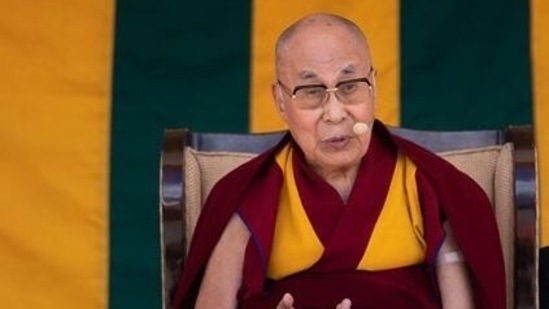
The Dalai Lama addresses the audience at Sindhu Ghat in Leh, Ladakh, (Tenzin Choejor/Dalai Lama's official website)

Dalai Lama's remarks hold immense significance amid China's attempts to impose its hegemony in Tibet through concepts like "sinicization of Tibet"and "Fortress Tibet" and Xinjiang region. The Forbidden City had witnessed the 1959 uprising leading to the revered leader leaving Tibet and seeking refuge in India. On August 7, the Dalai Lama in his address to the Tibetans in Ladakh had recalled the circumstances which had forced him to leave his homeland for shelter in India.

Dalai Lama had said that the people of the Himalayan region shared the same Buddhist cultural heritage with the Tibetans. “Because of their steadfast courage, Chinese communists are questioning their policy with regard to Tibetans. Among scholars and scientists, there is a great deal of interest in learning from our tradition, particularly with regard to what we understand about the mind and emotions, and the means to tackle destructive emotions,” he said. The Dalai Lama expressed hope that things will change for the better in China before long.

There have been reports of violent attacks against Tibetan Buddhists and alleged religious rights violations by the Jinping regime in its effort to turn China into a bigger player in the world. A report by Tibet Rights Collective said that China wants to strengthen its control over Tibet and its ‘misappropriation’ of Buddhism is an effort towards its end.

 
ABOUT THE AUTHOR
Shishir Gupta

Shishir Gupta is Executive Editor at Hindustan Times and one of India's top journalists covering national security, strategic affairs, foreign policy and geopolitics. Over the past three decades, he has extensively reported on India's military, diplomatic and security landscape, covering every major conflict and national security challenge, from the 1999 Kargil War and the 2020 East Ladakh standoff to Operation Sindoor in 2025. He has also covered major terror attacks, including the IC-814 hijacking, the 26/11 Mumbai attacks and the 2025 Pahalgam terror strike, along with numerous Pakistan-backed terrorist incidents in the Kashmir Valley and across India. He has reported on national and state elections for more than three decades. A recognised authority on strategic affairs, Gupta has covered India's nuclear programme since the Pokhran-II (Shakti series) tests in May 1998 and has written extensively on global nuclear issues, Indian diplomacy and the country's expanding global outreach. He has also reported widely on international conflicts and terrorism, with a special focus on the Indian subcontinent. Gupta has interviewed Prime Minister Narendra Modi more than four times, including Modi's first interview with the print media after becoming Prime Minister in May 2014. His other interviews include three with the Dalai Lama, as well as conversations with Benjamin Netanyahu, Amit Shah, Yogi Adityanath, S. Jaishankar, Nirmala Sitharaman and Piyush Goyal. He is the author of Indian Mujahideen: The Enemy Within (Hachette, 2011) and Himalayan Face-off: Chinese Assertion and Indian Riposte (Hachette, 2014). He was awarded the Chevening-Wolfson Joint Scholarship at Wolfson College, University of Cambridge, UK, in 1998 and participated in the International Visitor Leadership Program (IVLP) of the US State Department in 2006. He received the Ben Gurion Prize from Israel in 2011 and the K. Subrahmanyam Prize for Strategic Studies in 2015 from the Manohar Parrikar Institute for Defence Studies and Analyses (MP-IDSA). Since 2024, he has hosted Point Blank, Hindustan Times' weekly YouTube show on global geopolitics.

Get the latest India News, breaking headlines and real-time updates from across the country. Stay informed about politics, government policies, crime, weather major national developments and Karnataka Bandh LIVE.
SHARE THIS ARTICLE ON
Hindustantimes wants to start sending you push notifications. Click allow to subscribe