
 E-Paper



Delhi: Air quality improves; ‘very poor’ after 5-day ‘severe’ pollution
A minimum temperature of 10.2°C, two degrees below normal, was recorded in the national Capital on Thursday compared to 11.2°C a day earlier and 12.3°C on Tuesday


Delhi’s air quality improved to the “very poor” category on Thursday, ending a five-day streak of “severe” pollution levels even as the minimum temperature continued to dip and touched the season’s low. Factors such as reduced fog intensity and increased wind speed helped improve the air quality.
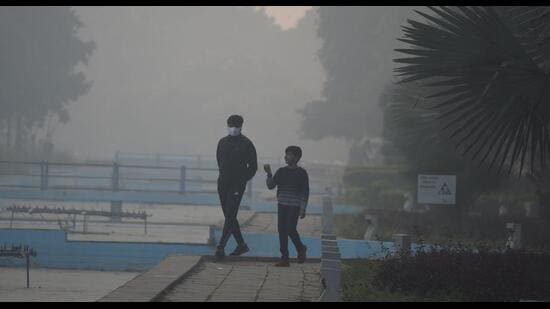
An average Air Quality Index (AQI) of 376 (very poor) was recorded at 9am on Thursday, an improvement from Wednesday’s 4pm reading of 419 (severe), Central Pollution Control Board (CPCB) data showed. At 9am, 11 out of 38 air quality stations were in the severe category. The remaining were in the “very poor” zone. Delhi’s Wazirpur (436) recorded the highest AQI followed by Jahangirpuri (435). Two stations were offline.
CPCB classifies AQI between 0-50 as “good”, 51 and 100 as “satisfactory”, 101 and 200 as “moderate”, 201 and 300 as “poor”, 301 and 400 as “very poor”, and over 400 as “severe”.
The AQI touched 494 on Monday, the joint second highest ever. It had been “severe” since November 16. On November 15, the average AQI was 396 (very poor).
A minimum temperature of 10.2°C, two degrees below normal, was recorded on Thursday compared to 11.2°C a day earlier and 12.3°C on Tuesday. It has dropped nearly 6°C in four days.
A drop in temperature negatively impacts air quality by slowing down winds, making the dispersion of pollutants difficult. But day-time temperatures were rising again as fog weakened over northwest India.
On Thursday, shallow fog reduced visibility up to 500 metres. The India Meteorological Department said dense fog was not reported anywhere in the country at 8:30am.
Weakened fog intensity allows sunlight to penetrate the surface during the day, increasing surface winds and raising mixing height, an invisible layer of the atmosphere within which pollutants get trapped. On Monday, this did not happen and Delhi’s AQI was 494. Dense fog persisted throughout that day and did not allow the sun’s rays to reach the surface.
Private forecaster Skymet meteorology vice president Mahesh Palawat said the fog has become shallow and the daytime is sunny again. “Wind speed is also not as slow as it was earlier.”


