E-Paper



Delhi’s air quality plummets to ‘severe’ zone 1st time this season
Experts said the haze since Monday is not fog, as it remained persistent through the day, indicating pollutants were accumulating

 Prefer HTon Google


A haze of toxic pollutants shrouded Delhi on Tuesday as the air quality plummeted to the “severe” category for the first time this season. Delhi’s 24-hour rolling average air quality index (AQI) was 421 at 7am, the highest this year.
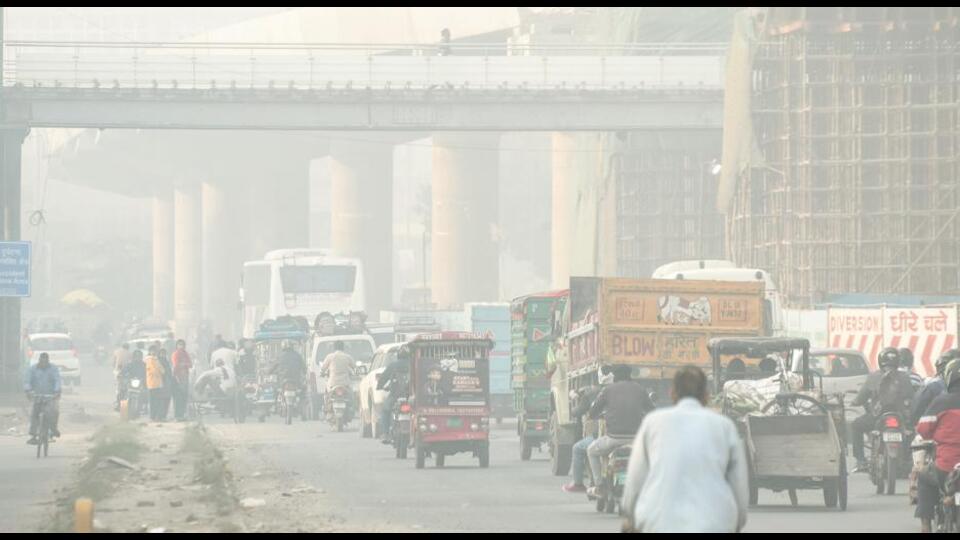
A drop in wind speed and the mercury has led to stagnation, preventing pollutants from dispersing. The average AQI was 362 (very poor) at 4pm on Monday, compared to 370 on Sunday.
Experts said the haze since Monday is not fog, as it remained persistent through the day, indicating pollutants were accumulating. On Monday morning, the visibility dropped to 1,000 metres, which improved to 1,500-2,000 metres in the evening.
The sharp deterioration in the air quality came a day after pollution data went missing for around 10 hours, between noon and 10 pm, due to a server issue. The day’s national bulletin, typically released around 4pm, was issued after 11pm.
It was visibly one of the most polluted days of the season, but the AQI remained stuck at 345 at noon, with no subsequent updates issued after that, until it was updated again at 10pm when it was 391. By midnight, the AQI touched 398 and crossed 400 at 1am on Tuesday. The previous “severe” air day was December 23, 2024, with an AQI of 406.
Data from the Central Pollution Control Board (CPCB)’s Sameer app showed that at 7am on Tuesday, 34 out of the city’s 39 active stations recorded “severe” AQI. Several were in the higher end of severe. Bawana recorded an AQI of 462, Wazirpur 460, Mundka, and Punjabi Bagh 452.
An AQI of 51 to 100 is classified as “satisfactory”, 101 and 200 as “moderate”, 201 and 300 as “poor”, 301 and 400 as “very poor”, and over 400 as “severe”.
Measures under the Graded Response Action Plan (Grap) Stage-3 were expected to come into effect with the deterioration in the air quality. The Commission for Air Quality Management (CAQM) was set to meet over it later in the day. Stage-3 comes into effect if the AQI crosses or is expected to cross 400.
Private BS-3 petrol and BS-4 diesel four-wheelers in Delhi, Gurugram, Faridabad, Ghaziabad, and Gautam Budh Nagar are banned under Stage-3. There are also curbs on private construction and demolitions, and restrictions on the use of stone crushers, mining and associated activities. Other restrictions include a prohibition on non-essential diesel-operated BS-4 medium goods vehicles and a ban on BS-4 and lower diesel-operated light commercial vehicles registered outside Delhi, except for those carrying essential goods or providing essential services.
Schools up to Class 5 in Delhi and its neighbouring districts will have to mandatorily shift to “hybrid” lessons. Stage-3 also mandates the governments of Delhi and neighbouring states to stagger timings for public officers and municipal bodies in the capital, Gurugram, Faridabad, Ghaziabad, and Gautam Buddh Nagar.
On Monday, CAQM decided against invoking the Stage-3 restrictions amid missing data. “CAQM continues to closely monitor the overall air quality scenario in Delhi-NCR and Adjoining Areas and remains in constant coordination with the concerned agencies of NCR state governments, pollution control boards of NCR, and urban local bodies to ensure effective and timely implementation of statutory directions. The Commission is regularly reviewing sector-specific actions and compliance to sustain the improvement trend,” CAQM said in a statement.