E-Paper



Dependence on other countries India’s main enemy, says PM Modi
At an event in Gujarat's Bhavnagar, PM Modi said that India must become self-reliant for peace, stability and prosperity in the world.

 Prefer HTon Google


Prime Minister Narendra Modi on Saturday said India’s biggest adversary is its dependence on other nations as he raised the pitch for self-reliance, calling for indigenous production of items across sectors, from “chips to ships”.
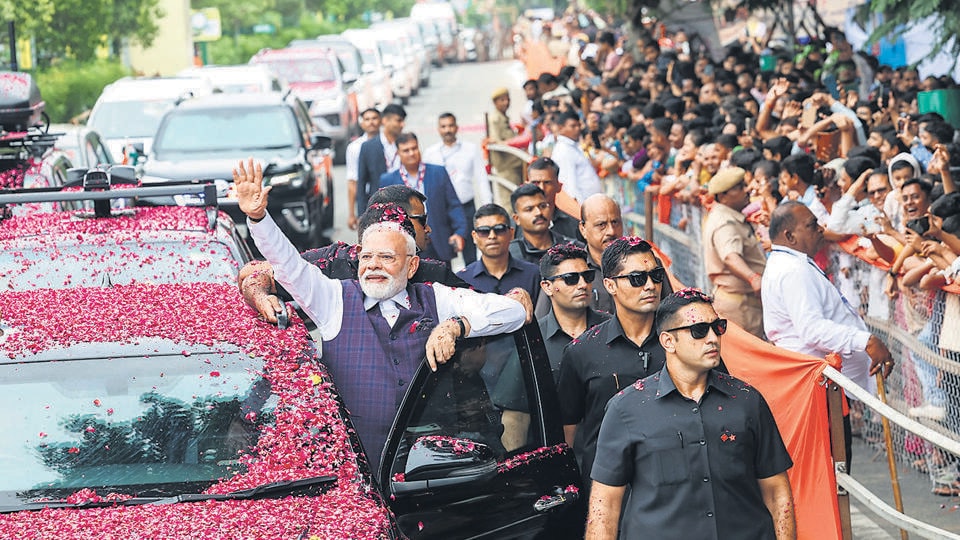
Addressing an event in Gujarat’s Bhavnagar, from where he unveiled maritime and development projects worth over ₹34,200 crore in different states, Modi said that reliance on others will hurt the country’s self-respect.
“…Dependence on other countries is our biggest enemy. And together we must defeat this enemy of India, this enemy of dependence. For peace, stability and prosperity in the world, the country with the world’s largest population must become self-reliant,” he said.
The remarks come against the backdrop of economic tensions with the US, including trade hurdles, tariff disputes and President Donald Trump’s latest move to impose a $100,000 fee on H-1B visas, which is set to significantly affect Indian tech professionals. His comments were in line with a pitch he made earlier, in which he called on citizens to adopt the spirit of “swadeshi” and support locally made products, stressing that true service to the nation lies in promoting indigenous goods amid global economic uncertainties.
ALSO READ | ‘Our biggest enemy is…’: PM Modi's big remarks amid H1-B visa move, Trump's tariffs
“We cannot leave the future of 1.4 billion countrymen and the coming generation to others. We cannot leave the resolve for the country’s development on others,” Modi said.
In his 37-minute speech, he said that self-reliance was the only solution to deal with global headwinds and ensure the country’s development. “If India is to develop by 2047, it must become self-reliant; there is no alternative. The citizens must have a single resolve: whether it’s chips or ships, we must make them in India,” he said.
Modi also criticised the Congress for what he called decades of economic mismanagement that stifled India’s potential. He said that despite the country’s vast capabilities, successive Congress governments failed to harness them by trapping the economy in a licence-quota raj, encouraging import-heavy globalisation without strengthening domestic production and indulging in large-scale corruption.
“These policies of the Congress governments caused great harm to the country’s youth. These policies prevented India’s true strength from being revealed,” he said at the “Samudra se Samruddhi” (From the ocean to prosperity) event.
Citing the shipping sector as a key example of “the harm caused by flawed policies” of Congress governments, he said India, once a leading maritime power, had seen a sharp decline “due to years of neglect.”
ALSO READ | How Opposition bashed Modi govt over Trump's H-1B move after big tariff setback
“India was a great maritime power for centuries. Even 50 years ago, we used ships made in India, and over 40% of our trade was carried out using Indian vessels,” he said. “But over time, the shipping sector fell victim to the Congress party’s poor policies. As a result, our share of trade using Indian ships dropped from 40% to just 5%,” he said. Modi said that India pays nearly $75 billion —approximately ₹6 lakh crore — every year to foreign shipping companies for services, which could have been used for country’s development.
Gujarat Congress spokesperson Manish Doshi said that the Prime Minister was spreading lies about Congress to deflect from current issues.
“Everyone knows that the License Raj was ended by the Congress government in 1991, ushering in groundbreaking economic reforms. It was these very reforms that integrated India into the global economy and laid the foundation for liberalisation. How globalisation brought prosperity to our nation is a matter of historical record—one that the BJP conveniently overlooks while cherry-picking narratives for political gain,” Doshi said.
Among the projects inaugurated by Modi were the Mumbai International Cruise Terminal at Indira Dock, new container and cargo facilities at ports in Kolkata, Paradip, Kandla, and Ennore, a multi-cargo terminal at Tuna Tekra, coastal protection works in Chennai and Car Nicobar, and ship repair centres in Patna and Varanasi.
India’s maritime sector is now moving towards next-generation reforms, he said, and announced all major ports in the country will be freed from multiple documents and fragmented processes.
“The implementation of the ‘One Nation, One Document’ and ‘One Nation, One Port’ processes will simplify trade and commerce,” he said.
He said a series of reforms have been initiated in the maritime sector, and five maritime laws have been introduced in a new form. The PM said a historic decision has been taken to strengthen the maritime sector, with large ships now accorded the infrastructure status.
“Ship-building companies will now find it easier to secure loans from banks and will benefit from reduced interest rates. All benefits associated with infrastructure financing will now be extended to these ship-building enterprises,” Modi added.
He said the government is working on three major schemes to make India a major maritime power. “These initiatives will ease financial support for the shipbuilding sector, help shipyards adopt modern technology, and improve design and quality standards. Over ₹70,000 crore will be invested in the coming years,” he said.