New Delhi: People’s confidence for the protection of liberties rests in the judiciary, Chief Justice of India Dhananjaya Y Chandrachud asserted on Saturday even as he rued how “adequate morality” of dominant groups creep into lawmaking to perpetuate biases against weaker and vulnerable sections of the society.
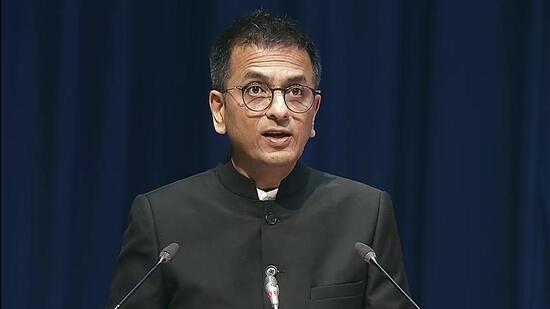
Delivering the Ashok Desai Memorial Lecture in Mumbai, the CJI defined “adequate morality” as the morality of men, the upper castes, and able-bodied persons. Desai was a former Attorney General and a senior advocate who passed away in 2020.
Justice Chandrachud was speaking on the topic, “Law and Morality: The Bounds and Reaches”, when he highlighted the need to adopt the progressive values enshrined in the Constitution and enforcement of constitutional morality to counter the impulses of adequate morality or public morality.
Also Read | Collegium clears five new names for Supreme Court
“Even after the framing of the Constitution, the law has been imposing ‘adequate morality’, that is, the morality of the dominant community. In our parliamentary system of democracy, laws are passed by the vote of majority. Therefore, the discourse around public morality often finds its way into the law enacted by the majority,” he said.
The CJI’s statements come at a time when several states, including Uttar Pradesh and Karnataka, have come up with stringent laws against religious conversions for marriages — often described as “love jihad” legislation. These laws have been criticised by several groups and experts, and also challenged before the constitutional courts on the grounds of being an outcome of an authoritarian politics emanating from majoritarianism and religious bias.
{{/usCountry}}The CJI’s statements come at a time when several states, including Uttar Pradesh and Karnataka, have come up with stringent laws against religious conversions for marriages — often described as “love jihad” legislation. These laws have been criticised by several groups and experts, and also challenged before the constitutional courts on the grounds of being an outcome of an authoritarian politics emanating from majoritarianism and religious bias.
{{/usCountry}}Also Read | Personal liberty to get priority under new CJI Chandrachud
On Saturday, lamenting that differential moral concerns or biases often creep into law, the CJI flagged that such biases reflect categorical preference for and against certain people within our community.
Justice Chandrachud illustrated his statement by citing ban on books, plays and restrictions on dance bars in Maharashtra’s establishments that were not three stars or above.
“Under the garb of protecting morality, the state tried to use the repressive power of law to restrain freedom of expression which is a constitutionally guaranteed right. Thus, even in societies governed by rule of law, we find that morality has always influenced how the law is interpreted and enforced,” he said.
About the ban on dance bars, the CJI pointed out that the state, by exempting hotels that are three-star and above from the purview of the ban, reinforced the morality of the dominant community that the members belonging to the lower strata are sexually perverted.
“The morality of the dominant groups plagued the Indian system yet again...To counter the social morality of dominant groups that are imposed under the garb of common morality, there is a need to shift the conversation towards the values enshrined in the Constitution,” he added.
The CJI also addressed the role of the judiciary in protecting the rights of the citizens against all violations.
“Trust us to be guardians of the liberties of our citizens. There is no case which is small enough or big enough for any court in the nation… Because it is in us that the confidence of the citizens, the due process of law and protection of liberty rests,” he stressed.
Justice Chandrachud’s remarks on protection of liberty come a day after a bench led by him ordered the immediate release of a man sentenced to a total of 18 years in jail under nine separate cases of electricity theft in Uttar Pradesh.
The Supreme Court exists to answer the cry of the citizens whose liberty has been taken away and thus, no case is small for the highest court of the land, the CJI had said on Friday.
“It is in the seemingly small and routine matters involving grievances of citizens that issues of moment, both in jurisprudential and constitutional terms, emerge,” he had added.
Justice Chandrachud’s emphasis on the apex court hearing all types of cases had come two days after Union law minister Kiren Rijiju said in Parliament that the Supreme Court should not hear bail pleas when pendency of cases is high.