
 E-Paper



Edgbaston jinx broken with a win for the ages
India mirrored a defensive mindset in their team selection by overlooking wrist spinner Kuldeep Yadav. Gill, as captain, was reactive rather than proactive

 Prefer HTon Google


India have shrugged a monkey off their back. At Edgbaston in the west midlands of England, where they had never won a test match — indeed lost seven in eight previous appearances here — they finally made amends with an overwhelming 336-run triumph over England, who were bowled out for 271 in the final innings on Sunday. The five-test series stands tantalisingly at 1-1 after two matches.
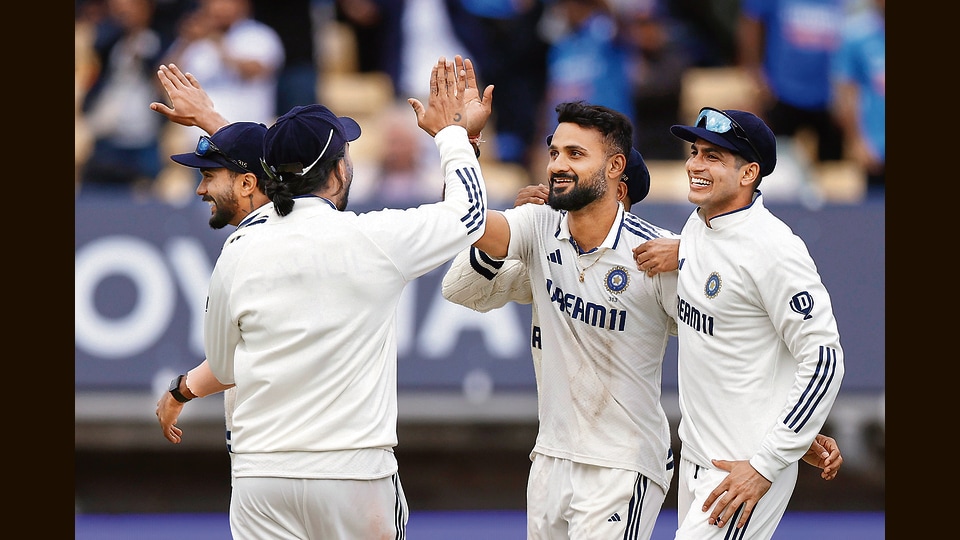
After rain robbed 10 overs from the allotted 90, the morning began with a rendition of Jerusalem, William Blake’s poem, which hopes for a better England, set to music. This was matched with the blowing of a conch shell and beating of a dholak by Indian supporters in a spirit of cheerful competition.
As the stands – with lush green trees behind them - filled up to a fullish attendance, Ollie Pope played on to Akash Deep operating from the Birmingham City End. Harry Brook, centurion in the first innings, followed him soon after to the pavilion, now a modernised glass-front edifice at a venue established in 1882, leg before wicket to one that seamed in.
Indeed, before conclusion of the first period of play, England had lost another wicket, with Ben Stokes misreading a straighter ball from Washington Sundar, which also trapped him LBW. Thus ended the most resistant of the English partnerships – between the skipper and Jamie Smith – that of 70 runs for the sixth wicket.
In the first England essay, wicket-keeper-batsman, Smith, had followed in the footsteps of Prince Kumar Sri Ranjitsinhji, later the Jamsaheb of Nawanagar (now Jamnagar), when he blazed to hundred runs in a session. Ranji was the first England batsman to accomplish the feat -- at Old Trafford in 1896, that too on his debut.
Smith was again untroubled, this time judiciously blending aggression with caution. He was sailing towards another ton, when a bouncer from Akash landed in the hands of deep square leg. Smith’s 88 off 99 balls, with four sixes, was another exhibition of his talent as a batsman, a hallmark of the modern-day glovemen.
While Mohammed Siraj, not undeservingly, ensnared six wickets in England’s first outing, it was the relative newcomer Akash who was more threatening, with early dividends in both innings. Drafted into the side only because premier paceman Jasprit Bumrah was rested to manage his workload, Akash’s journey is part of cricketing folklore. Much against his late father’s wishes, he migrated from Sasaram in Bihar to Kolkata to quench his thirst for cricket. Groomed in club cricket in the city’s famous maidan, he has fulfilled his dream to the fullest by acquitting himself with honour for his country at the highest level of the game.
His ability to skim the ball off the surface is suited to English conditions; his aptitude to swing and seam the leather is an added attribute. He finished with a 10-wicket haul, a match-winning six for 99 in England’s second venture.
India mirrored a defensive mindset in their team selection by overlooking wrist spinner Kuldeep Yadav. Gill, as captain, was reactive rather than proactive. When Smith and Brook launched a lacerating counter attack in the first innings, compiling 303 for the sixth wicket after England were tottering at 84 for five, Gill went on the defensive, decreasing the close-in cordon; edges streaked through the gaps. In the second England innings, too, there were far too few fielders in catching positions in the given circumstances.
Ultimately, it was of no consequence. The end justified the means. Both Gill and head coach Gautam Gambhir came up trumps.
In 1952, all-rounder Vinoo Mankad was summoned from the Lancashire League for national duty at Lord’s. He responded to the call-up by posting 72 and 184 and capturing five for 196 in a marathon spell of 73 overs with his left-arm spin. The match has been enshrined in history as “Mankad’s test”. Regardless of Akash’s sterling display with the ball, Edgbaston 2025 will remain memorable for the majesty of Gill’s batsmanship.
The Indian run machine of yesteryear, Sunil Gavaskar, recorded centuries in both innings of tests three times, including a hundred and double hundred at Port of Spain in 1971. Gill in this test not merely surpassed him in terms of match aggregate, but batted with a staggering invincibility. His monumental 430 runs in the game was second only to Graham Gooch’s 456 at Lord’s against India in 1990.
Gill has admittedly been lucky with the English weather in his first two tests this summer; yet, he gets in line with and to the pitch of the ball unerringly and rarely chases deliveries outside the off-stump. He is destined for dizzy heights.
A downpour denied India on the only other occasion they were poised to win at Edgbaston, in 1986. Fortunately, for the tourists, history did not repeat itself.


