Employment generation under the Centre’s flagship rural jobs programme has slowed sharply during what is typically its busiest period of the year, with official data tabled in Parliament showing significantly fewer workdays generated than during the corresponding period last year.
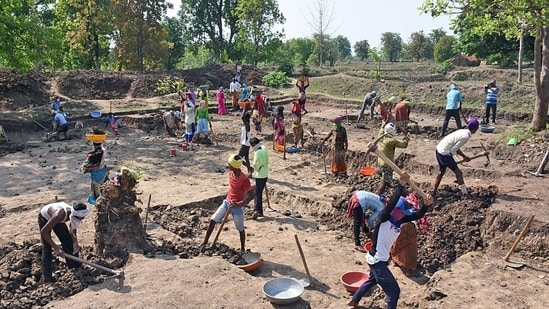
An analysis of a reply tabled in the Rajya Sabha on Tuesday and a government release from July 25 last year showed that the Mahatma Gandhi National Rural Employment Guarantee Scheme (MGNREGS) and its successor, the Viksit Bharat–Guarantee for Rozgar and Aajeevika Mission (Gramin) (VB-G RAM G), generated 703.2 million persondays as of July 31. This is around 34% lower than the 1.07 billion persondays generated by July 21 last year, despite the current year’s data covering an additional 10 days.
The first four months of the financial year typically account for a large share of annual employment generation under the programme. Last year, by July 21, 1.07 billion persondays—46.3% of the year’s total 2.31 billion persondays—had already been generated.
Also Read: Regularise MGNREGA employees, ensure job security, Sond writes to Chouhan
{{/usCountry}}Also Read: Regularise MGNREGA employees, ensure job security, Sond writes to Chouhan
{{/usCountry}}Persondays refer to the total number of days of work performed by all workers combined. One person working for one day equals one personday.
The slowdown comes during the transition from MGNREGS to VB-G RAM G, which came into effect on July 1.
“The reason for this may be the fact that VB-G RAM G was started only on July 1 and there may be uncertainty about how the funds would work out. That may be one reason why workdays are lower,” said Himanshu, associate professor of economics at the Centre for Economic Studies and Planning, Jawaharlal Nehru University.
He said the decline appears concentrated in states that have traditionally generated the largest share of employment under the scheme.
“Most of the biggest states have shown lower number of days—the biggest shortfalls. They either were not prepared or are being hesitant as they have to fit the bill of 40% of the total cost,” he said. The 60% of the cost will be funded by the Centre.
Among the states recording major shortfalls are Bihar, Uttar Pradesh and Madhya Pradesh. Bihar generated 73.98 million persondays by July 31 this year compared with 223.22 million during the whole of FY2025-26. Madhya Pradesh generated 28.03 million persondays against 190.70 million, while Uttar Pradesh generated 38.59 million against 240.61 million.
The slowdown has coincided with below-normal rainfall in several agrarian states. The India Meteorological Department (IMD) data show Bihar recorded a 40% rainfall deficit between June 1 and August 4, while Jharkhand reported a 32% deficit, East Uttar Pradesh 32% and East Madhya Pradesh 22%.
“It is very distressing as some of the largest shortfalls are in bigger agrarian states which are probably suffering the worst of the rainfall deficits and therefore delayed sowing such as Bihar, Jharkhand, MP, etc. Demand must have increased year-on-year. This is a double whammy for the poor,” Himanshu said.
The Centre, however, maintained that the programme remains demand-driven and that employment is generated only when rural households seek work. A senior rural development ministry official said, “More than 99% of households demanding employment have been offered work under VB-G RAM G.”
The ministry also said several states have notified up to 60 days of peak sowing and harvesting periods under the new law, which may have reduced demand for wage employment. It added that attendance monitoring through face authentication under the National Mobile Monitoring System (NMMS) has strengthened transparency and eliminated non-genuine attendance records.
“The trend, however, has not been uniform across the country, with West Bengal, Telangana, Andhra Pradesh, Manipur, Mizoram and Ladakh recording higher persondays generation in July 2026 than in the corresponding period last year,” the ministry said in its response to HT question.