The charts that matter
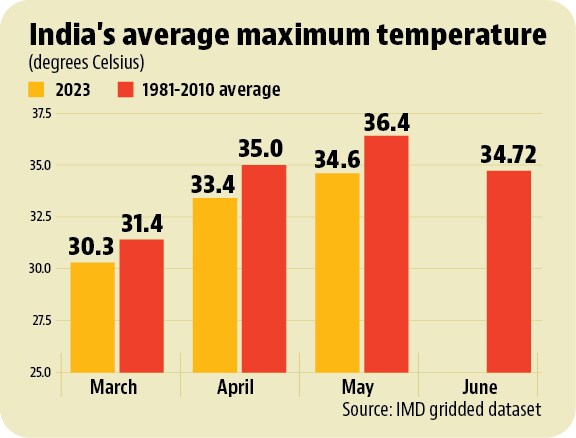 Four out five months in 2023 have been cooler than normal so farIMD uses the average of the temperature during the 1981-2010 period (called the “normal”) to check deviations in temperature. This year India’s average maximum has been below normal in all months except February. The average maximum in March, April and May was at least one-degree Celsius cooler than normal and also went further below normal each month. April and May cooling was so high that they will not be the second hottest and hottest month this year (as is the case by IMD’s normal benchmarks) even if India’s average maximum is normal in June. For June to remain the third hottest month after May and April this year, as it usually is, it will have to be at least 1.29 degrees cooler than normal or the 25th coolest June month since 1951.
- Extreme summers have become more common since 2000sThe relatively pleasant weather so far this summer might appear at odds with global warming. However, extreme climatic variations include both cooler and warmer than usual summers. An examination of deviation in maximum temperatures during the March-May period – the IMD treats this as the official summer season and June-September period is considered to be the monsoon season – shows this clearly. The ten-year rolling average of deviation in maximum shows that the number was moving smoothly before the 2000s. From the 2000s, it rose sharply to its highest ever values (March-May period was the hottest in 2010) before falling to lowest ever values in just around a decade (the coolest in 2020). As is expected, this trend is also true for the month of May on a standalone basis too.
- Intra-summer temperature variations have also become extremeIt is not just the case that March-May has been erratically hot and cool from one year to the next. Temperatures now vary dramatically from one week to the next even within a very hot or cool summer. An HT analysis of week-on-week changes in maximum temperature between March and May since 1951 shows that temperatures show higher variation on a weekly basis in the recent period. For example, 22.8% of the weekly changes in maximum during March-May 2023 feature in the top 10% weekly changes of maximum ever. This is the highest share any one-year March-May period has had in top 10% weekly changes of maximum. The pattern broadly holds for recent years as well. Such short-term volatility in temperatures is bound to put more strain to adjust to the outside environment and also cause problems for weather-sensitive production activities such as that of electricity.
- Will a cooler summer derail the monsoon?The heating of the landmass that is the Indian subcontinent is essential for generating the atmospheric conditions that pull that moisture-heavy monsoon winds which bring rains in India. Experts are already suggesting that a cooler summer this year could be a factor behind a delayed onset of monsoon. To be sure, the monsoon getting delayed by a few days is not as big a problem as the rains becoming significantly deficient. The latter is bound to adversely affect agricultural output in the kharif season, especially paddy and sub-par reservoir levels throughout the country. However, there is no correlation between average summer temperature and overall monsoon rain.
All Access.
One Subscription.Subscribe NowAlready subscribed? Login
One Subscription.
Get 360° coverage—from daily headlines
to 100 year archives.
E-Paper
Full
Archives
Archives
Full Access to
HT App & Website
HT App & Website
Games
Follow India news real-time updates and the latest news covered on Hindustan Times, featuring today's critical updates on Sonam Wangchuk LIVE and more across India.
Follow India news real-time updates and the latest news covered on Hindustan Times, featuring today's critical updates on Sonam Wangchuk LIVE and more across India.
Advertisement
{{/htLoading}}{{#usCountry}}