E-Paper



School enrolment fell by 1.1mn in 2024-2025: Govt data
India's school enrolment dropped by 1.11 million in 2024-25, mainly in early education, due to declining birth rates and a shift to private schools.

 Prefer HTon Google


School enrolment across India fell by 1.11 million students in 2024-25, with the steepest decline concentrated in the early years of education, according to the latest government data.
Total enrolment slipped 0.45% from 248 million in 2023-24 to 246.9 million in 2024-25, the education ministry’s UDISE+ data showed. The foundational stage—covering pre-primary to Class 2—lost 1.1 million students, while the preparatory stage spanning Classes 3-5 shed nearly 1.4 million, together accounting for 2.5 million of the total decline.
Higher classes bucked the trend, with middle stage enrolment (Classes 6-8) rising by 570,000 and secondary stage (Classes 9-12) growing by 810,000 students.
Demographic shift behind decline
The drop reflects India’s changing demographics as birth rates fall, according to ministry officials. The country’s total fertility rate (TFR) declined from 2.8 in 2006 to 2.0 in 2022, according to Sample Registration System (SRS) data.
“The decline may largely be attributed to demographic shifts with falling birth rates in primary school-age population. It could also be explained by children attending pre-primary standalone private institutions,” an education ministry official said, asking not to be named.
United Nations population projections released in 2024 indicate India’s 5-14 age group population began declining in 2012, with the 5-9 age bracket shrinking since 2010. This trend has contributed to school enrolment declines across most states between 2018-19 and 2023-24, as previously reported.
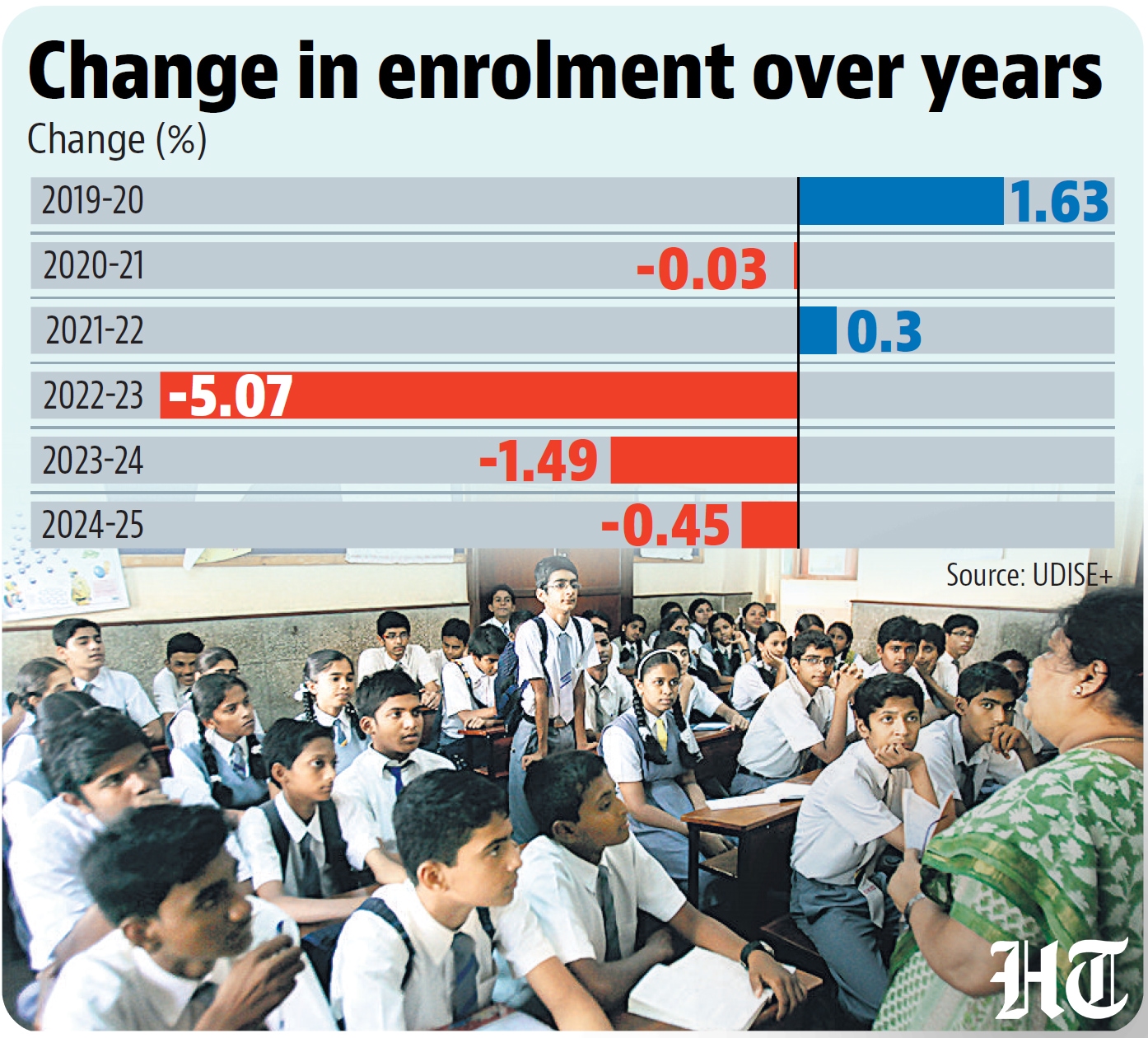
The current 0.45% decline is smaller than the 5.1% drop in 2022-23 and 1.49% fall in 2023-24, but higher than the 0.03% decline in 2020-21.
The 2020-21 decline in pre-primary enrolment was likely a result of the Covid-19 pandemic and the resulting lockdown, which would have discouraged parents from sending children to school for the first time.
At least some of the subsequent decline at levels higher than pre-primary (even 2020-21 saw a decline in pre-primary, primary, and secondary levels, but without any decline in overall enrolment) can also be on account of the Covid-19 pandemic affecting incomes of parents, if not the Aadhaar seeding of the database or demographic changes.
To the extent that the decline in income of parents was a reason for declining enrolment, post-pandemic economic recovery can also explain the growth in all levels other than primary in 2024-25.
Data quality improvements
The ministry partly attributes enrolment changes to improved data accuracy through Aadhaar seeding, which increased from 75.5% in 2022-23 to 79.4% in 2023-24 and 89.4% in 2024-25, helping establish student uniqueness in databases.
Rise in girls’ enrolment
While girls’ enrolment rose by 32,925, a sharp decline of 1.15 million boys drove the net fall. Girls now represent 48.3% of total school enrolment, up from 48.1% the previous year.
The ministry described this as reflecting “efforts to promote gender equity and expand access for girls”. Women also comprise 54.2% of India’s 10.1 million teachers, up from 53.3% when the workforce numbered 9.8 million.
Marginalised communities worst hit
Scheduled Caste students saw the steepest community-wise decline, losing over 810,000 enrolments, followed by Other Backward Classes (370,000) and Scheduled Tribes (250,000). Muslim student enrolment rose modestly by 138,000, though overall minority community numbers still fell by 57,592.
Migration patterns explain much of the drop among marginalised groups, according to Anurag Shukla, Anurag Shukla, an education expert who teaches across Indian universities including Tata Institute of Social Sciences (TISS), Mumbai.
“Families from marginalised communities often move to cities seeking work. Their children travel with them, leading to school dropouts,” Shukla said, citing high-migration states like Uttar Pradesh and Bihar.
Private schools gain ground
The data revealed a continuing shift towards private education. Private school enrolment jumped 5.8% from 90 million to 95.8 million students, while government schools declined 4.6% from 127.4 million to 121.5 million. Government-aided schools also fell 3.1% to 24.7 million.
“Since the 2010s, families with means increasingly opt for private schools, reflecting preference for perceived better quality,” Shukla explained.
Mixed progress on access goals
Gross Enrolment Ratios showed varied trends. The foundational stage slipped marginally from 41.5% to 41.4%, while preparatory stage coverage declined from 96.5% to 95.4%. However, middle stage ratios improved from 89.5% to 90.3%, and secondary stage ratios made the sharpest gain, climbing from 66.5% to 68.5%.
The National Education Policy 2020 aims for 100% gross enrolment at secondary level. Ministry officials noted that current calculations use outdated 2011 Census population figures as denominators. “Once 2026 Census data is released, these baselines will be revised, and GER figures are likely to show an upward shift,” an official said.
Infrastructure improvements
Despite enrolment challenges, school infrastructure continued improving. Among India’s 1.47 million schools covered by UDISE+, 93.6% have electricity connections, 99.3% drinking water facilities, and 98.6% toilets. However, only 64.7% have computers and 63.5% internet access.
The Union Budget 2025-26 has proposed broadband connectivity for all government secondary schools. “Our main focus will be on this in coming years,” a ministry official said.