New Delhi: Authorities and wildlife experts in India and Namibia are trying to work out a solution to a logistical challenge in transporting eight cheetahs from the African nation by air, people familiar with the development said on Friday.
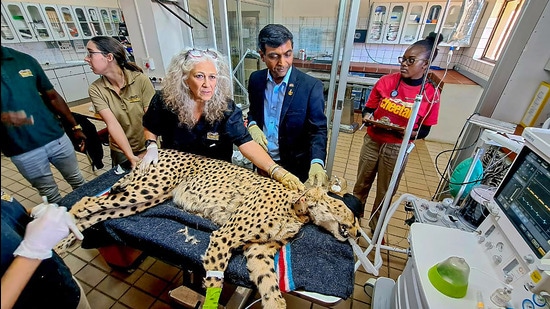
The animals are likely to be transported in a cargo airline under frequent monitoring by veterinarians and animal keepers to ensure the cheetahs arrive in India without any exigencies during the over 10-hour flight, senior officials in the Union environment ministry said.
This is one of the main reasons for delay in their arrival. “We need a cargo where animals can be monitored by vets frequently. Therefore, it requires not only space for animals/crates but four to six caretakers as well,” said a senior official from environment ministry who did not wish to be named. “We are exploring all possibilities to choose the best and safest transport.”
The translocation project is being managed by the National Tiger Conservation Authority (NTCA) as part of the Cheetah Translocation Project (CTP) under the Union environment ministry. Under CTP, the ministry aims to breed the animals in an enclosure in Kuno National Park in Madhya Pradesh before releasing them into the wild.
The animal will return to a wild enclosure in India 69 years after the last recorded cheetah was hunted down in Chhattisgarh in 1952.
{{/usCountry}}The animal will return to a wild enclosure in India 69 years after the last recorded cheetah was hunted down in Chhattisgarh in 1952.
{{/usCountry}}To be sure, the animals being translocated are African cheetahs and not Asiatic cheetahs that went extinct in India, experts have said. So essentially, India will be introducing a genetic sub-species and not the Asiatic cheetahs.
According to senior officials, eight in Namibia have been kept in quarantine preparing for their travel. The Union government on July 20 signed a memorandum of understanding (MoU) with Namibia for cheetah relocation. The agreement will remain in force for an initial period of five years and thereafter, it will be renewed for successive five-year periods, unless either party terminates the agreement.
The MoU with South Africa for 12 cheetahs is yet to be signed because of delay in several formalities in the African nation.
“The MoU is in final stages. It is under process with the government of South Africa; it requires approvals at several levels as per their rules and procedures,” the senior official cited above said.
Though the initial plan was to transport the 12 cheetahs from South Africa and eight from Namibia together in the same chartered flight, but there were frequent delays in finalising the agreement with South Africa. For Namibia, while most of the paperwork is complete and health investigation of identified cheetahs is also done, authorities are still discussing the safest way to transport them.
“The air transport arrangements are in process. The Indian government is taking the lead. It will be a cargo-type aircraft,” said an official in Namibia.
On August 17, HT reported that four male and as many female cheetahs have been identified to travel to India from Namibia.
“Health examinations on all eight identified cheetahs have been completed. The biggest challenges we are facing at the moment are around logistics,” said a spokesperson for the Cheetah Conservation Fund team in Namibia. “Potentially, all the cheetahs could go to India at the same time. CCF is working with teams from India, South Africa and Namibia to coordinate the ground and air movement from Windhoek to India and then to Kuno.”
Kuno National Park, spread across over 344 square km in Sheopur and Morena districts of Madhya Pradesh, was selected as a habitat for the introduction of the African cheetah by a Supreme Court mandated expert committee in January 2021.
While authorities at Kuno were concerned over the presence of three leopards in the 5 square kilometer enclosure readied for cheetahs to quarantine for a month, wildlife experts said the two wild animals can coexist.
“African cheetahs have evolved to thrive with other carnivores. In Namibia, they live with Spotted Hyena, which are social animals that move in packs; lions and leopards,” said Bilal Habib, senior scientist at the Wildlife Institute of India. “So, leopards in Kuno are nothing to be concerned about. African Cheetahs can adapt.”
A second senior official from the environment ministry said they are still trying to ensure that the cheetahs travel to India in August, but it may get delayed considering logistical challenges.
“The animals will be brought either to Jaipur or Gwalior airport by a chartered flight from Namibia. They will then be transported to Kuno by helicopter,” the official added, wishing not to be named.