The Capital set yet another record of single-day new infections for the year, as 1,254 new cases of Covid-19 were reported on Wednesday, even as health experts urged the Delhi government to reintroduce some curbs on social gatherings and public places to prevent the outbreak from again spiralling out of control with the festive season days away.
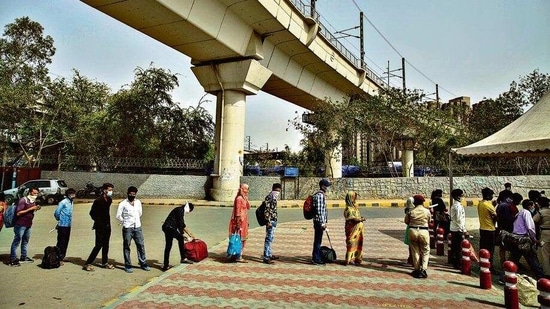
The seven-day average of new cases, or case trajectory, has now more than doubled in just one week, clearly marking the start of Delhi’s fourth wave of Covid – on average, 886 new cases were reported every day in the past week, against 428 cases a day a week ago.
The Delhi Disaster Management Authority on Tuesday banned public celebrations during Holi, Navaratri and Shab-e-Baraat. Experts on Wednesday also called for barring or restricting non-essential activities.
“There are some essential activities like going to hospitals or going to banks. All other activities should be stopped,” said Dr GC Khilnani, former head of pulmonology at All India Institute of Medical Sciences (AIIMS) and the chairman of the PSRI Institute of Pulmonary and Critical Care.
Wednesday’s case-spike was Delhi’s highest in 96 days, with the city last adding more infections (1,418) on December 18.
{{/usCountry}}Wednesday’s case-spike was Delhi’s highest in 96 days, with the city last adding more infections (1,418) on December 18.
{{/usCountry}}The Covid-19 test positivity rate also maintained its steady rise, climbing to 1.52% on Wednesday. While the World Health Organization (WHO) recommends a number below 5% for an infection to be considered under control, the positivity rate in the Capital has risen consistently over the past two weeks, which experts have warned could be an indicator that cases may skyrocket soon.
“Large weddings and get-togethers are not essential. Going to restaurants and pubs is not essential. These should be restricted before cases spread further. Yes, there will be economic consequences, but it will save lives,” said Dr Khilnani.
He also urged people not to take the infection lightly, adding that hospital beds reserved to treat Covid-19 patients had begun to fill up again.
“There is a belief among people that cases now are mostly mild. This is absolutely not true. We are seeing many severe patients who have to be admitted to the intensive care unit and be given high oxygen support. At our hospital, wards that had been declared non-Covid had to be opened up again because of the surge in cases,” he said.
The number of hospitalisations in Delhi crossed the 1,000-mark on Wednesday for the first time since January 21, with city hospitals treating 1,063 persons with Covid-19 as on Tuesday night. The number of active cases has inched closer to 5,000, with 4,890 in the city currently infected.
Dr T Jacob John, former head of the virology department at the Christian Medical College in Vellore, said, “A total lockdown may not be possible and isn’t necessary. However, sensible restrictions will help. If everybody wears a mask in public, 50% of the problem is gone. If they can avoid crowds where they are touching other people, 20% of the problem is solved. So, instead of closing shops and supermarkets, the people there must be trained to ensure hand hygiene before people go in and after they come out. They need to check the customers for masks and social distancing.”
Travel from neighbouring states could also be adding to Delhi’s caseload, he warned.
“Delhi has a huge floating population. Many come to Delhi to find work. It is also a hub for international travel. Being the Capital, all official work is also done here. This movement adds to the number of cases. I have seen instances where one person in the family travelled to a neighbouring state and everyone else in the family got the infection later on,” said Dr Khilnani.
The Delhi Disaster Management Authority on Tuesday directed the administration to conduct random tests at airport, railway stations and interstate bus terminals on people coming from affected states such as Maharashtra.
Experts also called for expediting vaccinations to stem the rise in cases. “We need to increase the pace of vaccinations. This will help curb deaths among the old and those with comorbidities,” said Dr John.