
Sign in

Rafale’s deep-strike cruise missile gets an upgrade for targets in mountains

Rafale carries a beyond-visual-range air-to-air missile Meteor with a range of more than 100 km, the potent SCALP cruise missile and the Hammer precision-guided ammunition.

Updated on: Dec 17, 2020, 12:56:48 IST
Hindustan Times, New Delhi | By
Share
Share via
  • facebook
  • twitter
  • linkedin
  • whatsapp
Copy link
  • copy link

Faced with the prospect of an adversary on both western and eastern fronts, the Indian Air Force (IAF) has got the French manufacturer to re-calibrate the software of Rafale fighter jet’s SCALP long-range air-launched cruise missile to ensure that the subsonic weapon hits targets up to 4,000 metres above sea level. The subsonic missile with a range in excess of 300 kilometres and a 450-kilogramme warhead is part of the weapon suite on Rafale Omni-role fighter of the IAF.
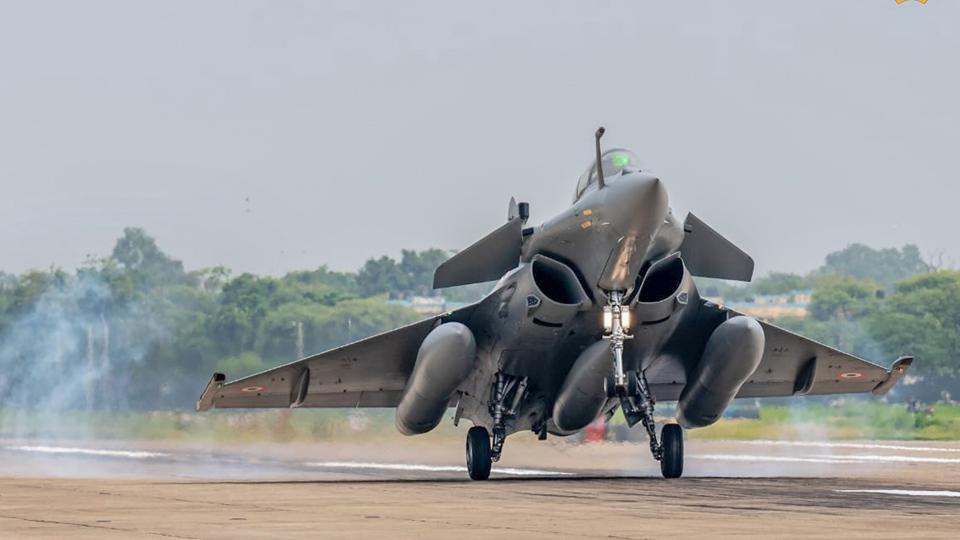
The Indian Air Force had asked missile manufacturer MBDA to tweak the software of the air-launched long range, conventionally armed, deep strike weapon, to be able to hit targets located at up to 4,000 metres above sea level (PTI)

In simple terms, it means that the IAF’s Rafale can demolish targets located in mountains and high plateaus at 4,000 metres instead of the previous calibration of 2,000 metres. The tweaking of the software has been done by the missile manufacturer MBDA in consultation with the top brass of IAF.

ALSO WATCH | 2nd batch of 3 IAF Rafale aircrafts arrive in India from France

While the next batch of three Rafale fighters are expected to arrive after 2021 Republic Day, there are plans that the aircraft will be refuelled mid-air by India’s close ally UAE air force using Airbus 330 multi-role transport tankers as they fly towards Ambala air base. As of now, seven Rafales are being used for training IAF pilots in France. The complete fleet of 36 aircraft is scheduled to reach India by the end of 2021. One squadron of this potent fighter will be based at Ambala, the other at Hasimara airbase, which is perched on the Siliguri corridor.
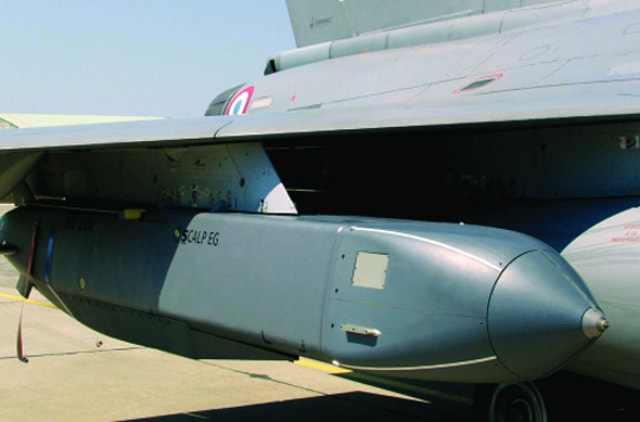
Storm Shadow / SCALP can operate in extreme conditions and offers IAF a highly flexible, deep-strike capability based around a sophisticated mission planning system. (Photo courtesy: MBDA )

Rafale carries a beyond-visual-range air-to-air missile Meteor with a range of more than 100 kilometres, the potent SCALP or storm shadow cruise missile and the Hammer precision-guided ammunition. The SCALP missile is used to target command, control, communications, air bases, ports, power stations, ammunition storage depots, surface ships, submarines and other strategic high-value targets.

Also Read: Indian Rafale fighter jet adds Hammer stand-off weapon to its lethal arsenal

Although both China and Pakistan have developed air-launched cruise missiles, the SCALP is a unique weapon that has a fire-and-forget mechanism. Once launched from the fighter, the cruise missile drops to a terrain-hugging role between 100 to 130 feet from the ground to avoid detection by the enemy radars and jamming systems. Before approaching the target, the missile again goes up to a maximum height of 6,000 metres and then drops perpendicularly on the high-value target. The primary charge first penetrates the target, the secondary charge then blows it to smithereens.

With IAF having to defend on both the fronts and mountainous terrain on either side, airpower will have a very significant role to play in the worst-case scenario. The infantry, apart from the airborne special forces, will be used to defend both the Line of Control (LoC) and the Line of Actual Control (LAC). The SCALP’s range will be crucial to degrade enemy’s fight power.

  • Shishir Gupta
    ABOUT THE AUTHOR
    Shishir Gupta

    Shishir Gupta is Executive Editor at Hindustan Times and one of India's top journalists covering national security, strategic affairs, foreign policy and geopolitics. Over the past three decades, he has extensively reported on India's military, diplomatic and security landscape, covering every major conflict and national security challenge, from the 1999 Kargil War and the 2020 East Ladakh standoff to Operation Sindoor in 2025. He has also covered major terror attacks, including the IC-814 hijacking, the 26/11 Mumbai attacks and the 2025 Pahalgam terror strike, along with numerous Pakistan-backed terrorist incidents in the Kashmir Valley and across India. He has reported on national and state elections for more than three decades. A recognised authority on strategic affairs, Gupta has covered India's nuclear programme since the Pokhran-II (Shakti series) tests in May 1998 and has written extensively on global nuclear issues, Indian diplomacy and the country's expanding global outreach. He has also reported widely on international conflicts and terrorism, with a special focus on the Indian subcontinent. Gupta has interviewed Prime Minister Narendra Modi more than four times, including Modi's first interview with the print media after becoming Prime Minister in May 2014. His other interviews include three with the Dalai Lama, as well as conversations with Benjamin Netanyahu, Amit Shah, Yogi Adityanath, S. Jaishankar, Nirmala Sitharaman and Piyush Goyal. He is the author of Indian Mujahideen: The Enemy Within (Hachette, 2011) and Himalayan Face-off: Chinese Assertion and Indian Riposte (Hachette, 2014). He was awarded the Chevening-Wolfson Joint Scholarship at Wolfson College, University of Cambridge, UK, in 1998 and participated in the International Visitor Leadership Program (IVLP) of the US State Department in 2006. He received the Ben Gurion Prize from Israel in 2011 and the K. Subrahmanyam Prize for Strategic Studies in 2015 from the Manohar Parrikar Institute for Defence Studies and Analyses (MP-IDSA). Since 2024, he has hosted Point Blank, Hindustan Times' weekly YouTube show on global geopolitics.Read More

Get the latest India News, breaking headlines and real-time updates from across the country. Stay informed about politics, government policies, crime, weather and major national developments.