In Western democracies, incumbents mostly lose power either because of high inflation or high unemployment. In addition to these two variables, Indian politicians have to also contend with the country’s vast agriculture sector.
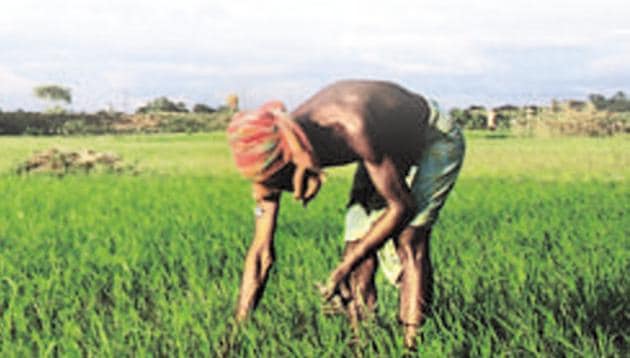
What makes it difficult to ignore any persistent farm crisis, such as the current one, is simply that there are just too many people dependent on a farm-based livelihood: nearly half the population.
Experts feel that short-lived solutions, like farm-loan waivers, can make a bad problem worse, since they don’t address underlying issues.
Anger among farmers began flaring up in 2017, most notably during the deadly protests in Madhya Pradesh’s Mandsaur which became one of the biggest crises facing chief minister Shivraj Singh Chouhan in the final leg of his term. A year-and-a-half later, Chouhan lost power, albeit by a narrow margin, as more and more mass protests took place across the country.
This year, the first of such protests was the “long march” of at least 30,000 farmers to Mumbai in March. Similar rallies converged in the national capital later in the year, and by winter, the results from the state elections in December crystallised the perceived political fallout of that anger. The Bharatiya Janata Party lost three key heartland states as the opposition Congress rode to power with a promise to waive farmers’ loans within 10 days of forming government.
Gunning, as they do, for higher GDP growth, policymakers ignore two vital facts: farm growth can cut poverty twice as fast as industrial growth, and, a 1% increase in farm output raises industrial production by 0.5% and national income by 0.7%. India’s industrial growth, hence, is structurally tied to rural growth — at least for now.
{{/usCountry}}Gunning, as they do, for higher GDP growth, policymakers ignore two vital facts: farm growth can cut poverty twice as fast as industrial growth, and, a 1% increase in farm output raises industrial production by 0.5% and national income by 0.7%. India’s industrial growth, hence, is structurally tied to rural growth — at least for now.
{{/usCountry}}The farm sector’s resilience has become a reason for its failure. Farmers are producing ever more, overcoming “problems of scale” posed by small-sized land parcels. For instance, in 2009, despite India facing its worst drought in three decades, the country’s farmers managed to produce a million more tonnes of foodgrains than they did in 2007, which was a normal year.
Droughts no longer stoke Malthusian horrors. The Bengal famine (1943) is estimated to have killed four million. Even then, famines had to do more with sharp increases in food prices, rather than an absolute lack of food, as Nobel laureate economist Amaryta Sen argued. “Starvation is the characteristic of some people not having enough food to eat. It is not the characteristic of there being not enough food to eat,” Sen wrote (Poverty and Famines, 1981).
While subsidies helped ignite a Green Revolution, they were never balanced with public investments for sustainable growth. Policymakers took the Green Revolution for granted for far too long, not realising the technology had run its course. Yields had begun falling by mid-1980s.
This fall could have been made good by higher investments. The rate of growth for farm investment in the 1980s and 1990s was a lowly 8-12%. This trend continued up to the 10th Five-Year Plan. With such low spends, farm growth hobbled at 2.4% or so. Investments in other sectors by contrast were up over 35%. The 10th and 11th five-year plans (2002-07 and 2007-12) saw some improvements in the rate of farm investment.
India’s net irrigated area still languishes at slightly more than 40%. The government has already tapped the easy areas; the ones most fertile and better irrigated. So, the scope for horizontal expansion is limited. The way to go now is to ‘expand vertically’. In other words, higher productivity will require huge investments.
The real problem is still the same: too many subsidies, but too little investment. If one looks at overall public resources being spent on agriculture, three-fourths appear to be still going primarily into subsidies, while only a fourth goes into investment. So, despite loan waivers, politicians may soon find farmers hollering on the streets again.