E-Paper



Fossil fuel phaseout: COP28 chief says ‘we respect’ climate science
The strategy of the Presidency to keep the 1.5°C goal alive was guided by science, Sultan Al Jaber said in Dubai, a day after The Guardian reported that he questioned the scientific basis for calls to phase out fossil fuels

 Prefer HTon Google


President of the COP28 summit Sultan Al Jaber on Monday said he respected the science around the climate crisis and that there were attempts to undermine the work of the UAE as this year’s conference host, seeking to clarify remarks from a day before that many saw as having undermined consensus around the need to cut back the use of fossil fuels.
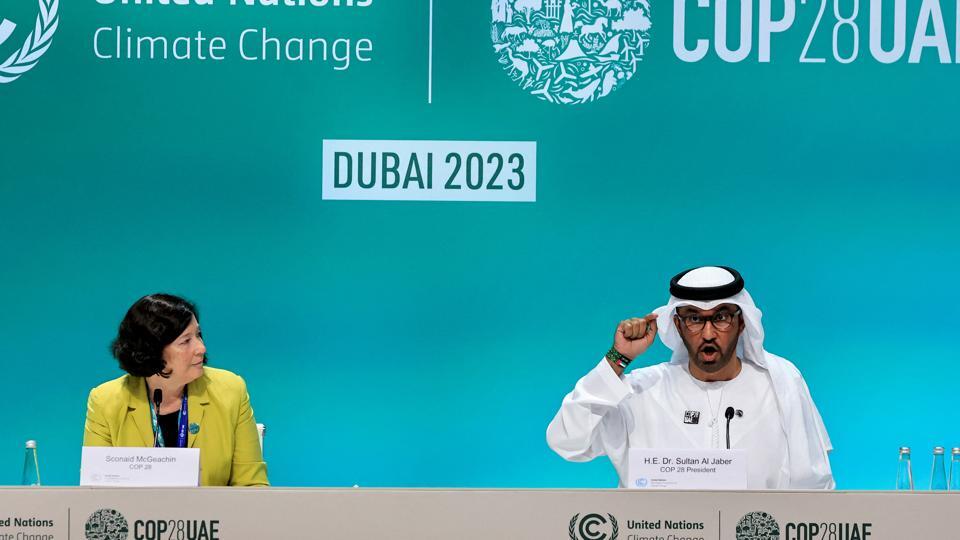
The strategy of the Presidency to keep the 1.5°C goal alive was guided by science, Jaber said at a press conference in Dubai, a day after The Guardian reported that he questioned the scientific basis for calls to phase out fossil fuels.
“I honestly think there is some confusion, misinterpretation and misrepresentation. Let me introduce myself to you. I am an engineer and an economist by background… it is my conviction in science and my passion for science that has enabled me to progress in my career. Science has been central to progress in my career. I respect and trust numbers and figures. Science has guided my life,” Jaber, who is also the group chief executive officer of state oil giant Abu Dhabi National Oil Corporation (ADNOC), said.
On Sunday, during a conversation with Mary Robinson, the chair of the Elders group and a former UN special envoy for climate change, Jaber said there is “no science” indicating that a phase-out of fossil fuels is needed to restrict global heating to 1.5°C and that phase-out of fossil fuels would not allow sustainable development “unless you want to take the world back into caves”.
During the interview, Jaber also told Robinson, “You can take the lead. I will make sure that it (fossil fuel phaseout) is on the agenda. You come from a developed country and developed countries can lead like they always do and lead by example.”
Robinson is the former president of Ireland.
On Monday, Jaber along with Jim Skea, chair of the Intergovernmental Panel on Climate Change (IPCC), said that phasedown and phaseout of fossil fuels is “inevitable”. “I have said over and over that the phasedown and phaseout of fossil fuels is inevitable. In fact, it is essential. This transition is essential. The transition needs to be orderly, fair, just and responsible and well managed,” he said.
“I have invited parties to come to me with language on fossil fuels. With regards to timeline, I respect science and IPCC reports,” he added.
“Science has guided our strategy as the COP28 Presidency. The science says we must get to net zero emissions by 2050 and we must reduce emissions by 43% by 2030 in order for us to keep 1.5°C within reach. My job in this mission is to keep laser focused on my north star which is keeping 1.5°C within reach. That will not change,” Jaber said, adding that there are repeated attempts to “undermine our message and our work as COP28 Presidency”.
“I am quite surprised at the constant attempt to undermine this message. There are repeated attempts to undermine our message and our work as COP28 Presidency,” he said.
Skea sided with Jaber. “Oil use by 2050 is reduced by 60%; natural gas is reduced by 45%... I can say Dr Sultan has been attentive to the science and understood it,” he said.
On Monday, the COP28 Presidency said that governments, businesses, investors and philanthropies have announced over $57 billion across the climate agenda in just the first four days of the summit. After an historic agreement to operationalise a fund for climate impact response on day one, announcements have poured in across the entire climate agenda, including on finance, health, food, nature, and energy.
On climate finance, the UAE has launched a $30 billion catalytic fund, ALTÉRRA, with an emphasis on unlocking private finance across the Global South. Around $725 million has already been pledged for the Loss and Damage fund by various countries. In addition, $3.5 billion has been announced to replenish the Green Climate Fund, $2.7 billion has been pledged for health, $2.6 billion has been committed for food systems transformation among others.
Negotiators at the Conference in Dubai are grappling with contentious issues around phasing out coal, other fossil fuels, and climate finance. There is little clarity on the final text of the agreement at this stage. Observers are concerned about the lack of funding for climate action, with rich countries relying on the private sector rather than public.