E-Paper



Fragmented women voters become key battleground for Tamil Nadu polls
Women voters make up over 51% of the electorate in Tamil Nadu, with around 56.7 million voters, outnumbering men by roughly 1.2 million.

 Prefer HTon Google


Despite having a significant number of women constituents in Tamil Nadu, the contours of elections have witnessed a shift with analysts believing that the majority of them do not make one cohesive vote base.
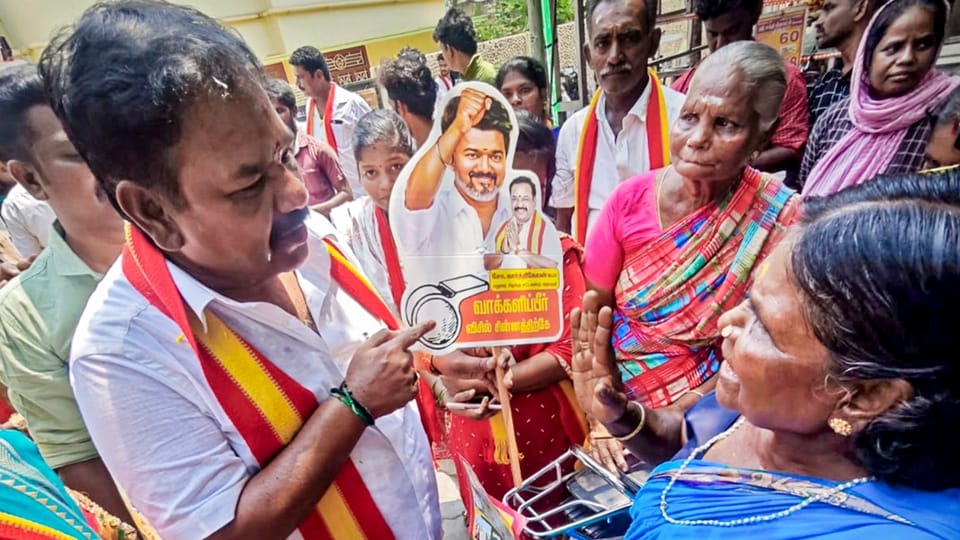
At the heart of the state’s forthcoming assembly elections are women voters, who make up over 51% of the electorate, with around 56.7 million voters, outnumbering men by roughly 1.2 million. So do they in 215 of the state’s 234 assembly constituencies.
However, experts found fault lines in the women vote base, with majority of them arguably divided on the lines of caste, class, religion. “Women constitute the majority voters in Tamil Nadu. However, they are not one cohesive vote base today. They are divided on the lines of caste, class, religion etc. Jayalalithaa was the only one who could unite them and get them to vote for the AIADMK,” said psephologist Arun Krishnamurthy.
Notably, major political parties, including chief minister MK Stalin’s Dravida Munnetra Kazhagam (DMK), the Edappadi K Palaniswami-led All India Anna Dravida Munnetra Kazhagam (AIADMK) and actor-politician Vijay’s Tamilaga Vettri Kazhagam (TVK), exhibit a dearth of dominant woman leaders.
Instead, the poll contest raises a more complex question of who can best understand and capture the evolving aspirations of women voters in the State?
From consolidation to fragmentation
In 2021, a convergence of factors helped the DMK secure a comfortable victory. The absence of J Jayalalithaa and the AIADMK’s internal leadership struggles created the conditions for a shift. The DMK-led alliance paired this with targeted welfare promises aimed at women, allowing it to make inroads into a voter base that had historically favoured the AIADMK.
“In 2021, a major part of the AIADMK’s women voters went to the DMK because one, they had no other option in the absence of Jayalalithaa and the infighting in the AIADMK leadership. DMK’s welfare promises designed specifically for women was another factor. However, the shift of the women voters from the AIADMK to the DMK was not organic and now, with the new alliance, or the TVK’s entry, one must account for the women voters splitting and going away from the DMK,” Krishnamurthy said.
Emotion, leadership and the welfare baseline
Political leaders and analysts say the women’s vote in Tamil Nadu resists simple categorisation. Instead, they continue to anchor their political choices around welfare-driven promises.
Chennai-based author and activist Shalin Maria Lawrence said that women’s voting behaviour is both issue based and leadership driven, shaped by a search for reliable leadership with an emotional connect.
Parties such as the Naam Tamilar Katchi (NTK) and TVK have drawn some women, particularly in rural areas, by foregrounding concerns around safety and violence, issues that mainstream Dravidian parties have addressed only recently.
“There is also a growing sense of fatigue with welfare-centric politics, with concerns that subsidies are crowding out deeper policy interventions. Caste continues to shape participation, with reports of Dalit women considering electoral boycotts in response to caste violence. Meanwhile, representation remains constrained,” Lawrence said.
Many women, she noted, hesitate to contest even local body elections, reflecting entrenched socio-economic and cultural barriers and a political imagination that still struggles to see women as independent leaders rather than loyal vote banks.
DMK’s welfare plank
The DMK has anchored its campaign in welfare delivery. Key schemes include free bus travel for women and the Kalaignar Magalir Urimai Thittam (KMUT), which provides ₹1,000 per month to one woman per family.
As per DMK leaders, schemes such as KMUT or free bus services for women are conscious decisions made by the party for structural empowerment of women in the state.
On the ground, these schemes have deepened the DMK’s connect with women, particularly among lower-income households. But the response has not been uniformly positive. “The party is very conscious of its welfare advantage. It has made the effort to understand what women voters want and has made the welfare promises this time with the aim of retaining the voters,” a senior DMK leader said.
The eligibility criteria for KMUT have generated dissatisfaction, especially among women whose applications were rejected on technical or data linked grounds. The government’s decision to transfer ₹5,000 to over 13 million beneficiaries earlier this year, described by CM Stalin as a “summer package,” strengthened support among recipients but sharpened resentment among those excluded.
The result is a dual effect of consolidation among beneficiaries and disaffection among those left out.
AIADMK’s attempt at reclamation
Having lost a significant women share in 2021, the AIADMK has positioned itself as the natural reclaimer of that base.
Its strategy includes promising a higher monthly allowance of ₹2,000 and reviving schemes such as Thaalikku Thangam (gold for marriage). Yet, structural challenges persist. The party’s campaign on women’s safety has lacked consistency and its ability to sustain pressure on the ruling government has remained uneven.
Vijay and the politics of disruption
Into this competitive space enters Vijay, whose appeal cuts across traditional political categories.
“He is someone many have grown up watching on screen. There is a sense of familiarity and charm,” Krishnamurthy said.
That familiarity has translated into traction among women, as well as youth and first time voters. “He is clearly making a dent in the women’s vote of both the AIADMK and the DMK,” he added.
TVK has attempted to position itself as a broad based alternative, targeting women, youth, Scheduled Castes, and minority communities. But personal controversies and limited grassroots organisation have also raised concerns.
Women, work, and the politics of everyday life
Tamil Nadu’s industrial economy relies heavily on women workers, particularly in textiles, electronics, and manufacturing. The state accounts for nearly 43% of India’s women factory workforce. Yet, much of this work remains low-paid, labour-intensive, and precarious, with limited upward mobility.
Veteran journalist and political analyst T Sigamani termed this a “structural paradox.”
“Women voters in Tamil Nadu approach governance, welfare and political choice as deeply intertwined, judging governments through everyday delivery of public services, safety, and cost of living. They view welfare both as economic support and as recognition of their role within the household and the State,” he said.
“This produces a voting pattern that blends emotional trust in leadership with pragmatic calculations of stability and benefit,” Sigamani said.
A view from the ground makes it clearer.
Bama Faustina Soosairaj, writer, activist and Dalit feminist, pointed to the changing nature of women’s work. Women now move beyond agriculture into corporate offices, IT parks, factories and labour sites, often far from home, while domestic responsibilities remain unchanged.
“In this context, even modest welfare interventions acquire significance. A monthly cash transfer of ₹1,000 gives women direct access to money. Free bus travel removes the cost of commuting to work. These are very little things but matter a lot for women, especially rural women,” she said.
According to both Bama and Sigamani, the practical reasoning behind women’s political choices is that “welfare functions not as charity, but as an enabler of autonomy, mobility and survival.”
The representation paradox
Despite their centrality to electoral strategy, women remain underrepresented in political structures.
In 2021, only 12 women won the assembly elections, just 5%, the lowest since 2001.
In 2026, the DMK has fielded 18 women candidates, the AIADMK 20 and the TVK 23, while the NTK stands apart with 117 candidates, maintaining its 50% policy.
A senior political functionary acknowledged that candidate selection remains shaped by entrenched notions of “winnability.” Parties often field women in unwinnable or reserved constituencies, treating representation as token rather than substantive.
Parties understand the electoral importance of women voters but hesitate to nurture strong women leaders, “wary of creating another figure with the political dominance of Jayalalithaa,” he said.