On May 17, 2015, at a specially convened session of the Mongolian Parliament, Prime Minister Narendra Modi linked Buddhism, democracy, and the Asian century. “The path of righteousness is based on the freedom of mind, liberty of thought, liberty of action, and liberty of speech,” he said. “These are the foundations of democracy. It is defined by the recognition of interdependence, acceptance of diversity, and belief in co-existence. So if we follow the Right Path of the Master, it will also be natural to walk on the path of democratic values.”
In a beautifully crafted and politically loaded speech aimed at Buddhism-practicing countries of the region, the Prime Minister said, “The convergence of Buddhism and democracy provides us a path to build an Asia of peace and cooperation, harmony and equality.”
The fourth Dalai Lama was born in Mongolia and the 14th Dalai Lama lives in exile in India along with the heads of the other three main schools of Tibetan Buddhism. During his visit to Mongolia, the PM also visited the Gandan monastery in Ulaanbaatar, whose past ruler in the 16th century bestowed the title of Dalai Lama to Sonam Gyatso, the third of the temporal and spiritual heads of Tibet and Gelugpa school of Buddhism, respectively.
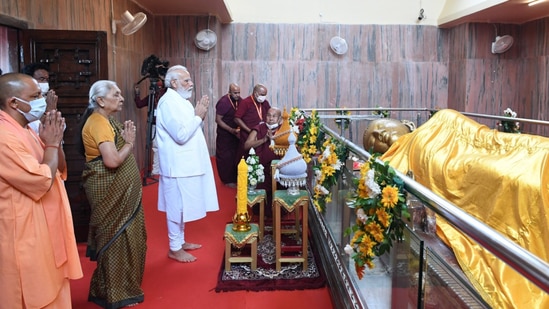
Six years later at the Mahaparinirvana Temple at Kushinagar on October 20, PM Modi weaved a tapestry of thoughts that placed India at the center of the Buddhist world of peace and prosperity while linking all the Buddhism practicing countries together in the presence of their chief diplomats at the function.
In one stroke, the PM not only consolidated rightful India’s Buddhist legacy but also countered attempts made by China through its proxies, including Pakistan, to circumvent the reality by giving prominence to Lumbini in Nepal, where the Lord was born, and to the Gandhara Buddhist heritage that now lies in Pakistan, where there are hardly any Buddhists left.
{{/usCountry}}In one stroke, the PM not only consolidated rightful India’s Buddhist legacy but also countered attempts made by China through its proxies, including Pakistan, to circumvent the reality by giving prominence to Lumbini in Nepal, where the Lord was born, and to the Gandhara Buddhist heritage that now lies in Pakistan, where there are hardly any Buddhists left.
{{/usCountry}}By inaugurating the Kushinagar airport on October 20, 2021, the PM not only placed India more firmly on the global map of Buddhist tourism and philosophy but also through it is now trying to develop the back of beyond and largely neglected region of eastern UP bordering Nepal.
Archeological excavations in the past century have pointed that Lord Buddha may have lived the first 29 years of his life in Piprahwa in the Siddarthnagar district of UP. He spent most of his life in nearby Shravasti post-Enlightenment at Bodh Gaya in Bihar, gave his first sermon at Sarnath near Varanasi, and attained Mahaparinirvana in Kushinagar.
While developing road and hospitality infrastructure in and around the Buddhist circuit itself will add to the economic development of the region, it also cements ties between India and countries like Japan, South Korea, Singapore, Mongolia, Myanmar, Vietnam, Cambodia, Lao PDR, Sri Lanka, Nepal and Bhutan where the message of righteousness, peace, and harmony of the Master has taken deep roots. It is through this common shared Buddhist heritage that India can join hands with democratic countries to counter the emergence of dark forces in Asia. The message from Kushinagar may take time to register, but PM Modi has already laid the foundation.