E-Paper



Governors must act according to Constitution: Justice Nagarathna
Supreme Court Judge BV Nagarathna on Saturday expressed worries about the current trend of governors being sued by state governments for refusing to sign bills and grant necessary approvals, emphasising the significance of governors acting in line with the Constitution

 Prefer HTon Google


Supreme Court Judge BV Nagarathna on Saturday expressed worries about the current trend of governors being sued by state governments for refusing to sign bills and grant necessary approvals, emphasising the significance of governors acting in line with the Constitution.
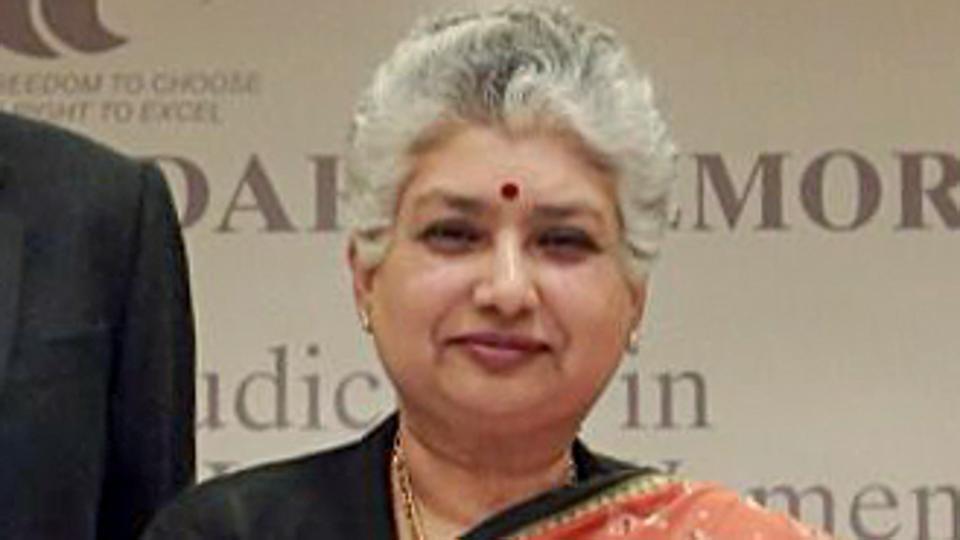
“The governors must discharge their duties in accordance with the Constitution so that this kind of litigation before the law courts reduces. It is quite embarrassing for the governors to be told to do or told not to do a thing. Hence, the time has come where they would be now told, I suppose, to discharge their duties in accordance with the Constitution,” said the judge, who is poised to become the first woman Chief Justice of India (CJI) in 2027.
Addressing the introductory session of “Courts and The Constitution Conference” organised by NALSAR University, Hyderabad, justice Nagarathna remarked on the emerging trend where governors have become subjects of litigation due to their failure to consider bills for assent or provide opinions on bills. She expressed her discomfort with this trend, stating that it is not conducive to the constitutional framework to bring the actions or omissions of Governors before constitutional courts.
“The recent trend has been that the governor of a state is becoming a point of litigation because of either omission by not considering the bills in assenting or giving opinion on the bills or other kinds of actions which the governors would take. I feel this is not a healthy trend under the Constitution to bring the actions or omissions of the governor of a state for consideration before constitutional courts. I think I must appeal that the office of the governor, though it is called a gubernatorial post, it is a serious Constitutional post,” she said.
The judge’s remarks came at a time when the country has witnessed several instances of standoffs between state governments and their governors, leading to legal battles that have culminated in interventions by the Supreme Court. These conflicts have often arisen when state governments seek the clearance of bills or other approvals from the governors, marking the tensions inherent in India’s federal structure and the delicate relationship between state governments and governors, who serve as representatives of the President at the state level.
Such confrontations recently unfolded in states like Punjab, Tamil Nadu and Kerala, which filed writ petitions in the Supreme Court against the refusal of their respective governors to grant assent to bills passed by the legislatures. They argued that the governors were exceeding their constitutional authority and obstructing the functioning of democratically elected state governments.
The Supreme Court has previously intervened in such matters, urging governors to expedite their decision-making process. In most instances, the Supreme Court upheld the primacy of democratically elected governments and ruled in favour of the state governments. It reaffirmed that governors must act in accordance with the aid and advice of the council of ministers and cannot arbitrarily withhold assent to bills passed by the state legislatures. The highest court has occasionally also chastised governors for their inaction on bills and questioned their justification for holding off until state governments file petitions.
Last week, the Supreme Court expressed displeasure at Tamil Nadu governor RN Ravi for refusing to re-induct MLA K Ponmudi as a minister, despite his conviction being suspended by it. Ravi on March 22 reinstated Ponmudi as a minister, hours after he apologised to the Supreme Court over his earlier refusal to swear in the Dravida Munnetra Kazhagam (DMK) politician.
Lone dissenting voice in January 2023 demonetisation judgment:
In her address, justice Nagarathna also talked about her dissenting opinion in the demonetisation case judgment that had affirmed by 4-1 the Union government’s policy of taking currency notes of ₹500 and ₹1,000 denominations out of circulation. Justice Nagarathna shared her empathy for the challenges faced by ordinary citizens following the decision to withdraw high-value currency notes.
She expressed concern for individuals like laborers who relied on daily cash transactions for essential needs. Despite the government’s intention to curb black money, she questioned its efficacy, noting that 98% of the demonetised currency returned to the system.
“We all know what happened on November 8, 2016. 86% of the currency was 500 and 1,000 notes, which I think the central government lost sight of. Imagine a labourer who had to get his notes exchanged for daily essentials. 98% of the currency came back, so where are we in black money eradication,” wondered the judge, adding “common man’s predicament” prompted her to dissent from the majority verdict.
Justice Nagarathna further flagged the importance of inadequate preparation and communication in relation to the demonetisation decision.
“The manner in which demonetisation was done, was not correct. There was no decision-making process, which was in accordance with the law. The haste with which it was done...some people say even the then finance minister did not know about it. The communication went on one evening and the demonetisation happened the next day. If India wanted to go from paper currency to plastic currency, surely, the demonetisation was not also a reason for that, I thought,” she said.
In her dissenting judgment, justice Nagarathna had held that demonetisation may have been a “well-intentioned proposal” to sanitise the economy and society of tainted money but the way the Union government implemented the decision through a notification in November 2016 made the move “unlawful” and contrary to the procedure established by law.
Regarding recent judgments, Justice Nagarathna acknowledged a perceived dilution by the Supreme Court in a ruling requiring the Enforcement Directorate to provide written grounds for arrests in money laundering cases. On the topic of medical termination of pregnancy, she commented on the nuanced nature of reproductive rights, cautioning against polarising the debate between pro-life and pro-choice ideologies. She stressed the importance of considering each case’s unique circumstances and the psychological impact on women.
Summing up the Supreme Court’s trajectory in 2023, Justice Nagarathna described it as a transformative journey. She emphasized the court’s pivotal role in dispensing justice and urged all stakeholders to reaffirm their commitment to the Constitution.
Other distinguished speakers at the event included retired Supreme Court judge S Ravindra Bhat, Telangana high court chief justice Alok Aradhe, Supreme Court of Nepal judge Sapana Malla, and Pakistani Supreme Court judge Syed Mansoor Ali Shah.