
 E-Paper



Govt bans JKLF over terror links
J&K police and other enforcement agencies have named the JKLF in as many as 37 first information reports.


The central government on Friday banned the Jammu and Kashmir Liberation Front (JKLF), led by Yasin Malik, for allegedly funnelling funds into militancy and fomenting terrorism, in a move condemned by both separatist and political groups in the troubled Kashmir valley.
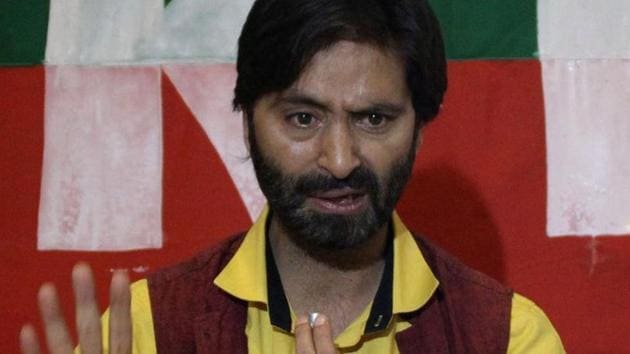
The ban was announced by Union home secretary Rajiv Gauba in New Delhi after a meeting of the Cabinet Committee on Security (CCS), headed by the Prime Minister, the highest decision-making body on security-related issues.
“JKLF led by Yasin Malik has spearheaded the separatist ideology in the valley and has been at the forefront of separatist activities and violence since 1989, Murders of Kashmiri Pandits by the JKLF in 1989 triggered their exodus from the valley. Yasin Malik was the mastermind behind the purging of Kashmiri Pandits from the Kashmir Valley,” Gauba said, explaining the ban.
“JKLF has many serious cases registered against it. This organization is responsible for the murder of four Indian Air Force personnel, the kidnapping of Dr. Rubaiya Sayeed, the daughter of the then Home Minister Mufti Mohammed Sayeed in December 1989.” he said.
When asked what was the immediate trigger for the ban, Gauba chose not to answer. He said: “The central government has followed the policy of zero tolerance against terrorism and has acted strongly against terrorists.”
J&K police and other enforcement agencies have named the JKLF in as many as 37 first information reports. JKLF was banned under the Unlawful Activities (Prevention) Act 1967. Its proscription followed a ban imposed on the Jamaat-e-Islami (J&K) by the Centre in February.
“The banning of JKLF is a clear message against the separatists and the Hurriyat who are linked to stone-throwing incidents in the valley. The JKLF aligned itself with the Hurriyat, and even though it has no mass following there is some sentimental connect with a section of people in the valley,” said Avinash Mohananey, a former official of the Intelligence Bureau ,who has served in J&K and Pakistan.
The home secretary said a review of security of J&K-based separatists would continue. The government has withdrawn the security detail of several separatist leaders following the February 14 Pulwama terror attack in which 40 paramilitary troopers were killed.
“Apart from the long history of violence, the Centre has noted with concern Malik’s move of not facing the law,” a senior home ministry official said, referring to the Malik’s plea in court to shift the hearing of cases against him from Jammu to Srinagar.
Malik is at present lodged in Kot Balwal jail in Jammu, and is likely to face trial in the three-decade-old kidnapping of Rubaya Sayeed, and gunning down of four IAF personnel in Srinagar.
In Srinagar, moderate Hurriyat Conference leader Mirwaiz Umar Farooq said the ban will not change the reality over Kashmir issue. “Strongly denounce the ban on JKLF after JeI. Such anti- Kashmir tactics will not change the reality of the Kashmir issue nor the urgency to resolve it,” Mirwaiz tweeted.
Javeed Mir, one of the earliest members of the JKLF, who along with Malik, Ashfaq Majeed and Hameed Shiekh took to arms and became household names in the early nineties in Kashmir, linked the ban to upcoming general elections.
“We think government of India is targeting separatists and youth here with an eye on coming elections. It is being done for petty political benefits,” Mir, 58, who has given up militancy, said.
Former chief minister and People’s Democratic Party president Mehbooba Mufti also denounced the ban.
“Yasin Malik renounced violence as a way of resolving J&K issue a long time ago. He was treated as a stakeholder in a dialogue initiated by then PM (Atal Bihari) Vajpayee ji. What will a ban on his organisation achieve? Detrimental steps like these will only turn Kash(mir) into an open air prison,” she tweeted.


