The Union government on Thursday opposed a plea in the Supreme Court seeking an income-based sub-quota within reserved categories, contending that the constitutional architecture of reservations for Scheduled Castes (SCs), Scheduled Tribes (STs) and Other Backward Classes (OBCs) is founded on historical and social disadvantage and cannot be restructured solely on the basis of economic criteria.
The Centre also opposed extending the “creamy layer” principle to SCs and STs, arguing that Supreme Court precedent has consistently confined the doctrine to Other Backward Classes (OBCs).
ALSO READ | As long as there is social discrimination, reservation will continue: Mohan Bhagwat
What Centre said in its counter
In a counter affidavit filed through the department of social justice and empowerment, the Centre argued that the petitions seek judicial directions to redesign the country’s reservation policy – a matter that squarely falls within the executive and legislative domain and cannot be commanded by the Supreme Court through a writ of mandamus.
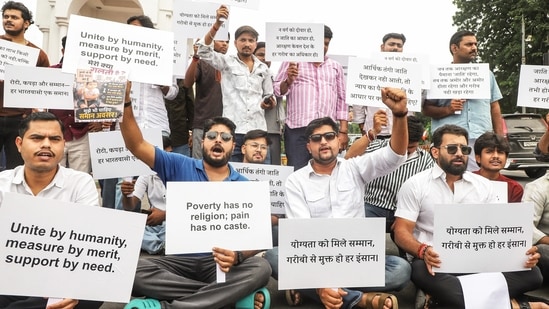
The affidavit has been filed in a batch of petitions by Ramashankar Prajapati, advocate Ashwini Upadhyay, Samta Andolan Samiti and others, who have sought directions to the Centre to introduce income-based preferences within the SC, ST, OBC and Economically Weaker Sections (EWS) categories. They have also sought sub-classification within these categories so that economically weaker persons receive priority in the distribution of reservation benefits.
{{/usCountry}}The affidavit has been filed in a batch of petitions by Ramashankar Prajapati, advocate Ashwini Upadhyay, Samta Andolan Samiti and others, who have sought directions to the Centre to introduce income-based preferences within the SC, ST, OBC and Economically Weaker Sections (EWS) categories. They have also sought sub-classification within these categories so that economically weaker persons receive priority in the distribution of reservation benefits.
{{/usCountry}}Rejecting the demand, the Centre maintained that the constitutional scheme under Articles 341, 342 and 342A does not permit alteration of the notified lists of SCs, STs and Socially and Educationally Backward Classes (SEBCs) merely on the basis of income.
The identification of SCs, STs and SEBCs based on historical and social criteria such as caste, tribe and social backwardness, and not solely on economic status, maintained the affidavit.
Economic disadvantage not sole criterion: Centre
The government explained that the criteria governing these categories have evolved through constitutional provisions, recommendations of commissions such as the Kaka Kalelkar and Mandal Commissions, judicial pronouncements and parliamentary enactments. While economic disadvantage is one of the relevant considerations in identifying backward classes, it is not the sole or determinative criterion, particularly in the case of SCs and STs whose inclusion is rooted in centuries of discrimination, untouchability, social exclusion and geographical isolation.
The affidavit emphasised that Parliament alone has the constitutional authority to amend the Presidential lists of Scheduled Castes and Scheduled Tribes under Articles 341(2) and 342(2), and that the courts cannot direct the executive to alter the constitutional framework governing reservation.
On creamy layer, the affidavit relied on the judgments in Indra Sawhney (1992), EV Chinnaiah (2005), M Nagaraj (2006) and Ashoka Kumar Thakur (2008), and contended that exclusion based purely on economic advancement would dilute the very concept of social backwardness on which reservations for SCs and STs are founded.
According to the government, the court in the Indra Sawhney case developed the creamy layer principle only in the context of OBC reservations, while the Ashoka Kumar Thakur verdict expressly clarified that the doctrine does not automatically extend to SCs and STs. It further argued that the Chinnaiah judgment held that any exclusion from the SC list can only be effected by Parliament and not through judicial orders or executive action. Likewise, the Centre submitted that the Nagaraj judgment did not lay down that creamy layer exclusion applies to SCs and STs.
The affidavit, however, pointed out that outside the sphere of reservations in education and public employment, many welfare schemes for SCs, STs and OBCs already employ means tests and income criteria to ensure that benefits reach the most deserving sections.
It argued that introducing income-based preferences within reservation would require an extensive empirical study of socio-economic data relating to beneficiaries across reserved categories, and cannot be undertaken through judicial directions in proceedings under Article 32.
Govt calls petitions ‘misconceived’
Describing the petitions as “misconceived”, the Centre submitted that they raise no enforceable constitutional or fundamental rights issue warranting the Supreme Court’s intervention. Instead, it said, the petitioners are effectively seeking directions to compel the government to frame a particular policy -- a course that falls outside the scope of judicial review.
The Centre urged the Supreme Court to dismiss the petitions. The batch of matters is likely to come up for hearing on August 18.