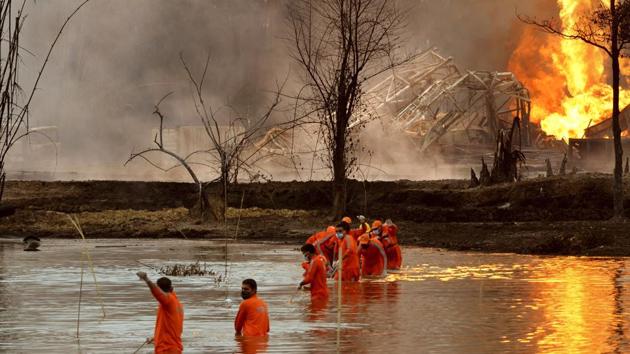
Flooding caused by incessant rains since Wednesday and the collapse of a bridge are hampering efforts underway to control the raging fire at a natural gas well in Upper Assam’s Tinsukia district.
The bridge, located on the Doomdooma-Baghjan road, nearly eight kilometres (km) from the Oil India Limited (OIL) gas well in Baghjan oilfield collapsed on Wednesday because of heavy rains that led to the flooding in the area.
“The bridge is on the route of Baghjan oilfield, where the gas well that caught fire is located. It was being used to transport machinery and equipment needed to douse the fire,” said Nandita Roy Gohain, circle officer, Doomdooma.
“We have provided an alternate route to ferry the equipment, but transportation work is getting affected. Flooding caused by incessant rains is a major deterrent,” she added.
The gas well at Baghjan had a blowout – an uncontrolled release of gas and oil --- on May 27 during a workover operation, or major maintenance work.
It caught fire on June 9, when two firefighters died and around 10,000 local residents were displaced because of the raging inferno.
{{/usCountry}}It caught fire on June 9, when two firefighters died and around 10,000 local residents were displaced because of the raging inferno.
{{/usCountry}}“The vital bridge on the main route to the well that was being used to carry heavy vehicles collapsed on Wednesday due to flooding. There are two-three alternate routes, but this was the best possible one for carrying heavy equipment,” said Tridiv Hazarika, spokesperson, OIL.
“We have requested the Army to help us. They will try to erect a Bailey bridge, but that could take a week’s time. There could be some delay in the interim for the movement of heavy-loaded vehicles,” he added.
On June 22, battling heavy rains and temperatures over 75 degrees Celsius, nearly 150 army personnel had constructed a Bailey bridge over a water body close to the well.
Over 230 metric tonnes of material were transported over 400 km to construct the bridge, which will be used to deliver water needed to control the fire and plug the blowout.
Plugging a blowout and fire in a gas or oil well require a lot of heavy equipment.
On Wednesday, OIL had stated in a release that many important materials -- needed to control the fire and plug the blowout -- are still in transit from other parts of the country.
“Around 80% of the vehicles, carrying heavy equipment, have reached the site. The remaining 20% are also very critical to the operation. We are facing a tremendous challenge,” said Hazarika.
“There has been incessant rainfall since Wednesday night and areas near the well, which are low-lying, are inundated. Rains and flooding are creating problems and the collapse of the bridge was a major blow,” he added.
Earlier, OIL authorities had stated that it would take about four weeks to plug the blowout at the gas well.
Heavy rains that led to flooding, and the bridge collapse could further delay their work.