E-Paper



Hesaraghatta grassland now declared a reserve
The grasslands are also wintering grounds for migrant bird species from Europe, Central Asia and Himalayas including several species of raptors.

 Prefer HTon Google


New Delhi The Karnataka government has issued a notification to declare Hesaraghatta grasslands in the outskirts of Bengaluru as “Greater Hesaraghatta Grassland Conservation Reserve” protecting a unique grassland landscape with rich biodiversity that serves as an important water catchment area for Bengaluru, frequently impacted by severe water shortages.
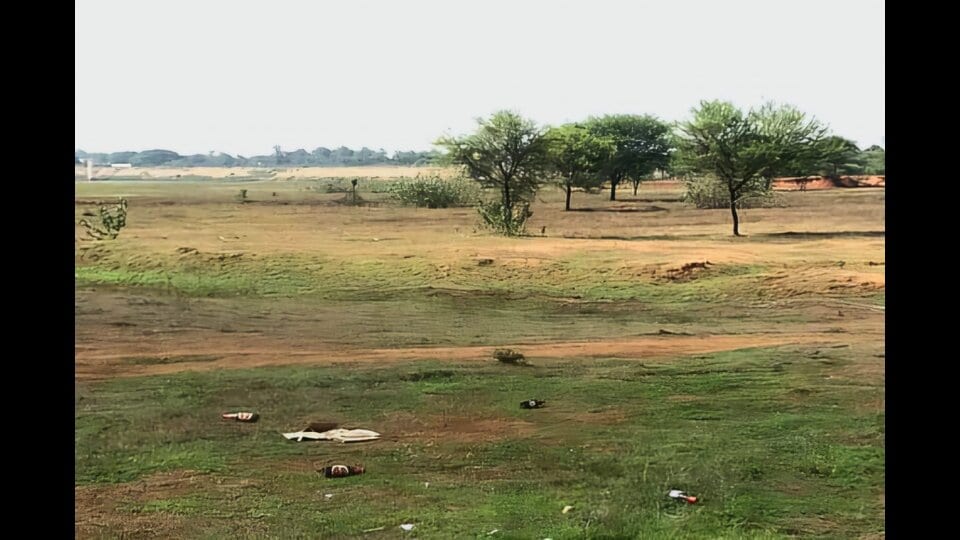
The grasslands are also wintering grounds for migrant bird species from Europe, Central Asia and Himalayas including several species of raptors. The Lesser Florican, a critically endangered endemic bustard was sighted in Hesaraghatta after 100 years in 2011, according to birders. The notification brings cheer to environmentalists and bird watchers who frequent the grasslands and have been campaigning to save it from mindless tree planting and change of land use. Conservation India, a Bengaluru based initiative ran a campaign to save the grasslands from tree planting in 2013.
“Whereas the Government of Karnataka considers that it is desirable to declare the area, situation, limits and extent of which are specified in the schedule below, to be a “Greater Hesaraghatta Grassland Conservation Reserve” for its ecological, faunal, floral and geo-morphological importance, and for the purpose of protecting, propagating and developing grassland and wildlife therein or its environment and to protect the important catchment area around Hesaraghatta, which is one of the sources of water for Bengaluru city,” the notification dated February 25 states.
During the 18th meeting of the State Board for Wildlife held on October 7, 2024 under the chairmanship of Chief Minister, Government of Karnataka, it was resolved to declare the land belonging to the Government in villages viz., Byatha, Kodihalli, Kakolu, Mattukoru, Channasandra, Sonnenahalli, Dasenahalli, Hesaraghatta, Ivarakondapura, Hesaraghatta Grass Farm 1 and 2 of Yelahanka Taluk of Bengaluru Urban district as Greater Hesaraghatta Grassland Conservation Reserve, the notification adds. Around 133 bird species have been spotted at the grasslands.
Hesaraghatta grasslands act as an important catchment area for reviving groundwater levels, which would benefit groundwater recharge and improve groundwater table, which would in turn benefit thousands of farmers of surrounding villages, the notification said.This is a large catchment of the Arkavathy River and Thippagondanahalli reservoir catchment and also acts as an important catchment area for the nearby Hesaraghatta lake and reservoir, which will improve the water security of Bengaluru and help in fulfilling many of the sustainable development goals, it adds.
The grassland and the scrubland near the lake are also home to smooth-coated otters, 13 species of amphibians, 111 species of butterflies, which include the Lilac silverline (sighted after a century in Bengaluru and only at Hesaraghatta grasslands) and 395 other insect species .
The Bangalore Development Authority (BDA), in 2013, planted around one lakh saplings here. Using bulldozers, several thousands of pits were dug for the plantation work which was eventually stopped.
“Now therefore, in exercise of the powers conferred by section 36(A) of the Wild Life Protection Act-1972, the Government of Karnataka hereby declares that Land specified in the schedule I and whose boundary description are mentioned below, shall be comprised within the Conservation Reserve and further declares that the said area shall be conservation reserve and called as “Greater Hesaraghatta Conservation Reserve” from the date of publication of this notification,” the notification states.
Grasslands are often overlooked because trees are sparse on grassland landscapes. But, grasslands and savannahs represent some of the world’s richest and most diverse ecosystems. “Grasslands and savannahs provide a home for a quarter of the world’s population and habitat for thousands of highly specialised plants and animals. Many species gather in vast numbers, graze on the varied grasses, and can be found nowhere else on Earth,” according to Worldwide Fund for Nature. Less than 10% of grasslands and savannahs are protected, and climate change compounds the impacts on these landscapes with many experiencing seasonal shifts, and some places like the Mongolian Steppe facing warming three times higher than the global average.
Debadityo Sinha, Lead –– Climate & Ecosystems, Vidhi Centre for Legal Policy, said the move to recognise Hesaraghatta is a welcome step. “Grasslands store nearly one-third of global terrestrial carbon and play a crucial role in building climate resilience against droughts, heatwaves, and wildfires. They are vital for the livelihoods and food security of many communities and serve as habitats for several threatened species, including the Great Indian Bustard, Finn’s Weaver, wolves, and hyenas. Grassland ecotourism is also emerging as an important way to support local economies,” Sinha said.
Unfortunately, our laws fail to recognise grasslands as critical ecosystems, unlike forests and wetlands. They are often misclassified as ‘wastelands’ and converted for agriculture, real estate, industry, or tree plantations—leading to the loss of these irreplaceable landscapes. Any effort to recognise and protect grasslands is a welcome step
Bengaluru-based photographer Mahesh Bhat said that Bengaluru needed another big green space following the city’s extreme growth over the last two decades. “Bangalore as a city has grown over the past 21 years or longer by leaps and bounds. It has become a megapolis. It is imperative for us as society of which government is a part of to make sure citizens get clean air, water and there is biodiversity around us. These are fundamentals. This can be only made by open spaces. We have only one large green space in the south of the city which is Bannerghatta national park and the city has not been able to come up with another green space which is say as big as Cubbon Park. Therefore, to keep Hesaraghatta which is 5,600 acres and the second largest contiguous green space for Bangalore is imperative for ecological security,” said Bhat, who along with other citizens has been at the forefront of saving Hesaraghatta.