Underlining the importance of human rights and bodily integrity, Chief Justice of India (CJI) NV Ramana on Sunday lamented that police stations pose the “highest threat” to citizens’ rights.
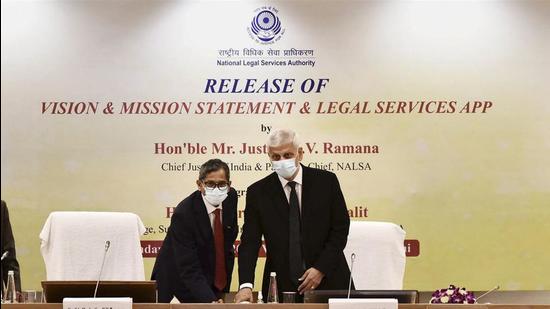
“The threat to human rights and bodily integrity is the highest in police stations...Going by recent reports, even the privileged are not spared third-degree treatment,” said the CJI as he spoke at the release of National Legal Services Authority’s legal services app and vision statement in New Delhi.
Despite constitutional declarations and guarantees, Justice Ramana rued, lack of effective legal representation at the police stations is a huge detriment to arrested people.
“To keep police excesses in check, dissemination of information about the constitutional right to legal aid and availability of free legal aid services is necessary,” said the CJI while imploring the NALSA to actively carry out nationwide sensitisation of police officers.
Justice Ramana further emphasised that access to justice is an unending mission which will succeed only if judiciary can obviate obstacles like lengthy, painstaking, and expensive formal justice processes.
“If, as an institution, the judiciary wants to garner the faith of the citizens, we have to make everyone feel assured that we exist for them. For the longest time, the vulnerable population has lived outside the system of justice,” he asserted.
According to the CJI, it is imperative to bridge the gap of accessibility to justice between the highly privileged and the most vulnerable. He said the digital divide has not helped the cause of easy access to justice. Rural and remote areas suffer from lack of connectivity.
{{/usCountry}}According to the CJI, it is imperative to bridge the gap of accessibility to justice between the highly privileged and the most vulnerable. He said the digital divide has not helped the cause of easy access to justice. Rural and remote areas suffer from lack of connectivity.
{{/usCountry}}“Accessing justice in India is not merely an aspirational goal. We need to work hand in hand with various wings of the government to make it a practical reality,” said justice Ramana, adding that he has already written to the government about the urgent need to bridge the digital chasm on a priority basis.
Justice Uday U Lalit, who is the executive chairman of NALSA, said that law colleges must adopt the nearby talukas for spreading awareness about legal aid.
“We are impressing upon bar councils and law colleges, and they must adopt one or two talukas around them, so that students can be given practical training to be part of a large contingent of para-volunteers. They will impress on people about their rights of legal aid,” Justice Lalit said at the same event.
To further the accessibility of legal aid, Justice Lalit opined that it is essential that the services of post offices must be utilised owing to their well-established networks.
“If we are to reach the remotest areas of the country, it must be through post offices. Post offices will spread awareness about legal services”, he said.