
 E-Paper



HistoriCity: India’s great language churn is something to cherish, not spurn
Multilingualism could be the key to our future success as Indians, each of us knowing at least two or more languages

 Prefer HTon Google


India’s 36 states and union territories together are home to 22 official languages. In terms of population, Hindi, a modern language, is the most spoken as it is the link language in at least 10 states in north and central India. Bengali and Marathi come next followed by Telugu, Tamil, Gujarati and others. In a country seized with a selective interpretation of democracy i.e majoritarianism or rule of the majority, political conflicts over imposition of Hindi are not new and neither are the lessons that we need to relearn and remember.
The Basics
Just as homo sapiens evolved over many millennia so did their languages. People living in close knit societies and regions developed their own languages; this is also illustrated by each generation of teenagers forming their own lingo by changing the meaning of existing words, for instance ‘sick’ which now also means ‘cool, and ‘crazy’ instead of just being unwell.
Most modern Indian languages have been classified into four families. Austric (Nishada), Dravidian, Sino-Tibetan and Indo-European (Aryan). Interestingly, central Indian region contains languages that belong to three of these families, which shows how the process of osmosis may have happened over a long period of time.
Also Read: Hindi, and its role in the unified future of India
Classical literary works in north Indian history like Abhijnanasakuntalam, Malavikagnimitram and Meghadutam among others show that the language of the ruling class (Brahmins and Kshatriyas) was Sanskrit while most other people spoke one of the Prakrits or local languages. Pali was the most widely spoken language, and its older versions are used in the Buddhist canon (Theravada) as well as Ashokan inscriptions. Ardhamagadhi was said to have been the language of Mahavir, the 24th Jain Tirthankar, who was born in Magadha in modern Bihar.
The Indus Valley Civilisation also known as the Harappan Civilisation (2500-1700 BCE) had both a language and a script: both remain undeciphered. It is believed that the there was considerable interaction between the Aryans or the central Asian peoples who flowed unceasingly into the Indian subcontinent. According to academic consensus, Dravidian languages and early Indo-Aryan intermingled prior to the Mauryan period and Tamil words are found in the Vedic corpus (1500B CE). For example: ulūkhala- ‘mortar,’ kuṇḍa ‘pit,’ khála- ‘threshing floor,’ kāṇá- ‘one-eyed,’ and mayūra ‘peacock.’
Which is older, Tamil or Sanskrit?
They are largely coterminous with each other, both providing evidence of their usage and existence since at least 3rd-5th BC. This question loaded with power and pride can be addressed scientifically but science alone will not be enough to accept that there were other languages older than both. In fact, those older languages are now less recognised because they have lost political power and therefore are either dead or dying. Many local languages and scripts that existed in ancient India have either disappeared or devolved unrecognisably into other forms.
However, while Tamil, which was once the predominant maritime language in south and southeast Asia, has survived and is thriving, on the other hand, Sanskrit has been long dead. Ironically, Sanskrit died because the ruling elite deprived everyone else from learning it, and therefore from acquiring knowledge. In fact, the Bhakti tradition, particularly in north India was an attempt to democratise religion, restricted to Sanskrit mantra-chanting priesthood into vernacular poetry, and defying the priestly claim that Sanskrit was the language of Gods.
G N Devy, author and cultural activist, wrote in his work on non-Sanskrit languages, The Being of Bhasha, “The Barbarians do not have knowledge, the Romans have it. Those who speak or recite Sanskrit have knowledge; those who speak Prakrit have no knowledge. Those who speak English have knowledge, those who do not have no knowledge worth the name. Such is the political context of every knowledge system.”
Script and language
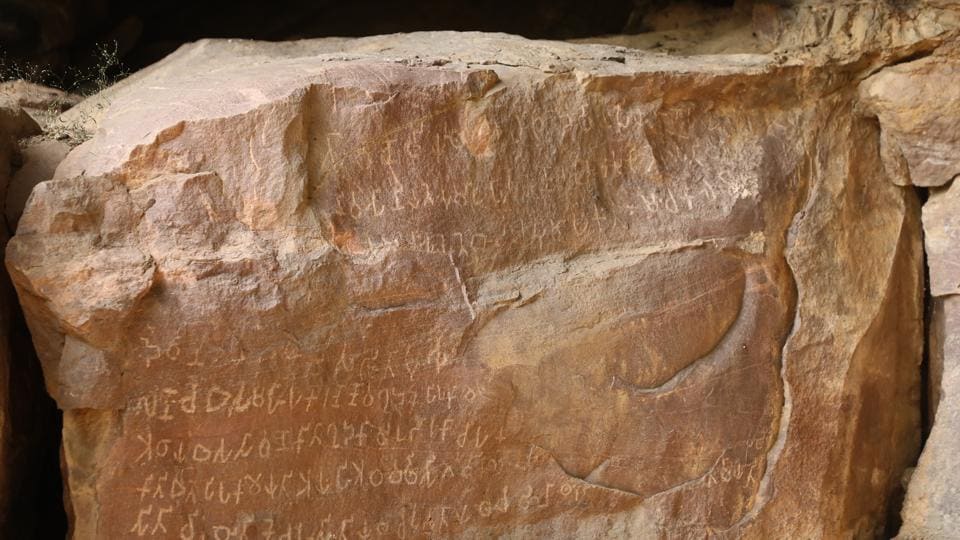
Script is a system of writing down symbols for sounds while language is a set of spoken words that contain meaning. The earliest written records of state policy in the Indian subcontinent go back to the Mauryan emperor Ashoka’s period (268-232 BCE). He issued directives, appeals, and warnings in at least four scripts and three languages. In Aramaic and Greek for the north-western regions where Greek influence was strong and in various local languages or Prakrits that were written in Brahmi and also in Kharoshti scripts for undivided Punjab and other areas of modern Pakistan. After the Harappan seals, Ashokan edicts, first decoded by James Prinsep, remain the earliest written evidence of the prevalence of many languages. It shows how multilingualism is an inherent characteristic of India.
Also read: Losing our tongue: The rise and fall of languages
The edicts found in southern India (Karnataka and Andhra Pradesh) were written in the northern form of Prakrit, and contain reference to kingdoms such as the Cholas, the Pandyas, and Keralaputra in present day Tamil Nadu, southern Karnataka and Kerala. This has helped in drawing the territorial boundary of the Ashoka’s empire to present day Karnataka in the south and Kandahar and Shahbazgarhi in the northwest. Mauryan India was a rich, diverse, multi-religious, and multi-lingual society, and while Ashoka became all-powerful, he too had to contend without winning over certain territories.
Sanskrit versus Prakrit
Devy wrote, “Ashoka’s inscriptions are among the earliest samples of recorded Prakrit. There has been no doubt about their historic value and their own historicity. But some of the Buddhist scriptures were written even before these inscriptions. The Pali tripitika on the more philosophical side and the Jataka stories on the more popular side, have a very clearly defined historical place in Buddhist literature. The Mahavamsa offers a good example of versified history written by monks in Sri Lanka. The Jaina history of literature is even more properly preserved. The Jaina canons, with 45 agamas, 11 angas and 12 upangas, were arranged by Devadhi Ganin in the year 454 CE.”
Also read: Lok Sabha extends translation services to 6 more languages
In the post-Mauryan period, we continue to see the use of Brahmi script all the way up to the Gupta period after which it is gradually replaced by an early form of Sanskrit. As the language of the court and ruling classes, Sanskrit works often appear to imply social hierarchy, pejorating the vernacular and working classes. However, as mentioned earlier, with growing heterodoxy in all forms including languages, poet-saints challenged these depictions. In the 16th century, Vaishnavite Saint Eknath asked, “if Sanskrit was made by Gods, was Prakrit born of thieves and knaves? Let these errings of vanity alone. Whether it is Sanskrit or Prakrit, wherever the story of God is told it is essentially holy and must be respected. God is no partisan of tongues. To Him Prakrit and Sanskrit are alike. My language, Marathi, is worthy of expressing the highest sentiments, and is rich-laden with the fruits of divine knowledge.”
The popularity of Ramayana and Ram
So far, the generally accepted chronology of the diffusion of the Ramayana is as follows: Valmiki’s was composed in the period 500 BCE –300 CE , Kamban’s Tamil Ramayana in the twelfth century, Hemchandra’s Trishashthi Shalaka Purusha Caritra (Lives of Sixty-three Great Men ) or the Jain Ramayana in the 12th century, Krittivas’s Bengali Ramayana in the 14th century and Tulsidas’s Ramayana in the 16th century in Awadhi Hindi. This is not an exhaustive compilation, only an indicative one. In the Jain tradition alone, there are at least 15 Ramayanas that are preserved with reverence and care.
Also Read: Beyond the News: Fresh row over Urdu, UP’s forgotten second official language
Leaving aside the first Jain Ramayana—Pauma Cariya by Vimalasuri, which is undated—the rest are from the 7th to the 17th centuries. A rich and representative range of India’s diversity, the hundreds of Ramayanas that exist or have existed in the past, including in Persian and Urdu, came into being through different languages. Its various versions that still prevail among the tribes of Odisha, Chhattisgarh, Madhya Pradesh and Jharkhand show us without multi-linguism, the Ram Katha would not have become Hindus’ most loved epic.
Multilingualism could be the key to our future success as Indians, each of us knowing at least two or more languages. Too many Indian languages have already become extinct; 600 more are endangered according to Devy, who also led the People’s Linguistic Survey of India (2010). Some like the Nihali, spoken among less than 200 people around the Tapti river, is nearly extinct. In a diverse country like India, it would be foolhardy for politicians to divide people over languages. We have had expression in ancient Prakrit, Tamil and Sanskrit, Persian and Arabic, and the regional and or vernacular, and of course the so far unscripted tribal and nomadic languages. These along with English have churned with each other, and continue to intermingle. To impose one over the other is to miss the essence of co-existence and co-creation.
--
HistoriCity is a column by author Valay Singh that narrates the story of a city that is in the news, by going back to its documented history, mythology and archaeological digs. The views expressed are personal


