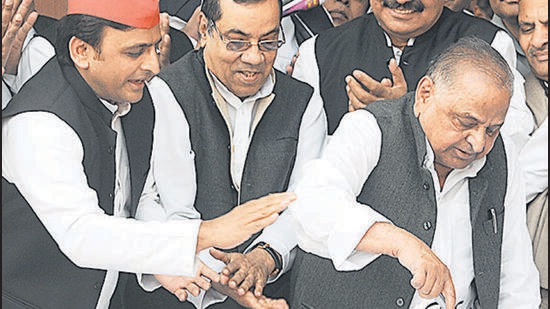
He often met visitors in the plush drawing-room of his Vikramaditya Marg residence, which was colloquially referred to as White House for it was large, white and, over the decades, a Lucknow landmark with “Netaji” in residence for 36 unbroken years. The room had a massive window overlooking lush lawns with seasonal blooms and trees. On the walls were portraits of socialist leaders from years gone by -- Ram Sewak Yadav, Ram Manohar Lohia, Madhu Limaye, Chandrashekhar, Jayaprakash Narayan, Raj Narain, Janeshwar Mishra, and Ram Saran Das.
Mulayam Singh Yadav during his birthday celebration at party headquarters in Lucknow on November 22, 2017. (HT file photo)
Next to them sat Mulayam Singh Yadav – three-time chief minister of Uttar Pradesh, patriarch and undisputed leader of the Samajwadi Party – the tallest of socialist stalwarts from the heartland in terms of political reach and success.
Mulayam headed what was possibly the biggest political family in the country, ruling it with an iron fist in a velvet glove. It all matters, internal or political, he had the final say – though he often made others believe that their word counted too. And his home in Lucknow bore witness to an unprecedented and epochal political journey of several highs and some lows.
Mulayam first moved into 5 Vikramaditya Marg as a firebrand 43-year-old leader of Opposition in the Uttar Pradesh assembly in 1982. He eventually moved out in 2018, when a Supreme Court verdict directed all former chief ministers to leave their official bungalows. It has been lying vacant since then.
It was from here that he fought his first battle for the chief minister’s chair in 1989 against Ajit Singh, who was the preferred choice of then prime minister VP Singh. It was here that he spent a year of political isolation after police fired at kar sevaks in 1990, and it was from here that he floated his own Samajwadi Party on October 4, 1992.
The following year, Mulayam became chief minister again, this time not as a member of the Janata Dal, but as the sole leader of the SP, in alliance with the Bahujan Samaj Party. Though the two fought bitterly after breaking up violently in June 1995, Mulayam managed to remain in power or be the prime challenger for the next two decades as Uttar Pradesh politics revolved around him and his party.
At the same time, his maiden election to the Lok Sabha in 1996 catapulted him to the Centre as defence minister, making the SP a national player despite its regional nature.
In 2012, when the party won the Uttar Pradesh assembly elections independently, a wily Mulayam, knowing his younger brother Shivpal would resist the elevation of his son, handed over his political legacy to Akhilesh Yadav. Throughout the handing-over process, he gave conflicting signals until Akhilesh was firmly ensconced on the chair.
That’s when the story began to unravel – as all stories must – with a family feud between uncle and nephew on one side, and a rising Bharatiya Janata Party, riding on Brand Modi, on the other. And that’s why the SP, twice defeated soundly in a state whose politics it once dictated, now faces its biggest challenge as Mulayam, 82, breathed his last on Monday morning.
In 2013, when asked about his grooming in politics, Akhilesh quipped, “One learns by watching the guru from behind the door.” It was a reference to his father, with whom he shared a unique relationship. Mulayam, on the one hand, felt guilty that he could give little time to his son when he was growing up because he was so caught up with politics. On the other, he knew that politics was hard work for anybody – even for a second-generation leader that Akhiesh would become.
“My political ride was on a roller-coaster as I was struggling against all odds. The going was tough in the initial days as the upper caste was dominating the state. I, belonging to a backward caste, had no political background,” Mulayam told HT sometime in early 1990s.
In 2012, the day he handed over the baton to Akhilesh, he said: “I am the proud father of a chief minister.”
But the party now faces an enormous challenge. In Mulayam’s death, the SP has lost its most-connected leader who personally knew people in every block in every district of the state. The party is up against the formidable political machine of the BJP, which has fused religious mobilisation with caste-based outreach to create a new electoral constituency and the popularity of Prime Minister Narendra Modi. Moreover, the party is struggling to shed the perception that it only works for some communities, is focused on patronage networks and cannot re-imagine its old-style caste politics to include development for all.
Prof Manoj Dixit of Lucknow University believes Mulayam’s had no impact or role in the BJP’s resurgence as he remained inactive in politics for some years now. “However, SP is bound to suffer as it loses its brand Mulayam. Every inch of the party was built by him. Now, lots will fall apart including the loyalists, the family. But then, there will be a resurgence of new SP, a party of the 21st century after Akhilesh will get its full control,” he said.
With Mulayam’s death, Akhilesh has lost his father, and the SP its patriarch. A new era of challenges begins.

 E-Paper