
 E-Paper



House of Kuki priest demolished in Imphal
A Kuki priest's home in Imphal was demolished by militants after his family fled due to ongoing ethnic violence, highlighting ongoing tensions in Manipur.

 Prefer HTon Google


The house of a Kuki priest, the last to vacate the Kuki-dominated area of New Lambulane in Imphal, was razed by unidentified militants two days ago, people familiar with the matter said.
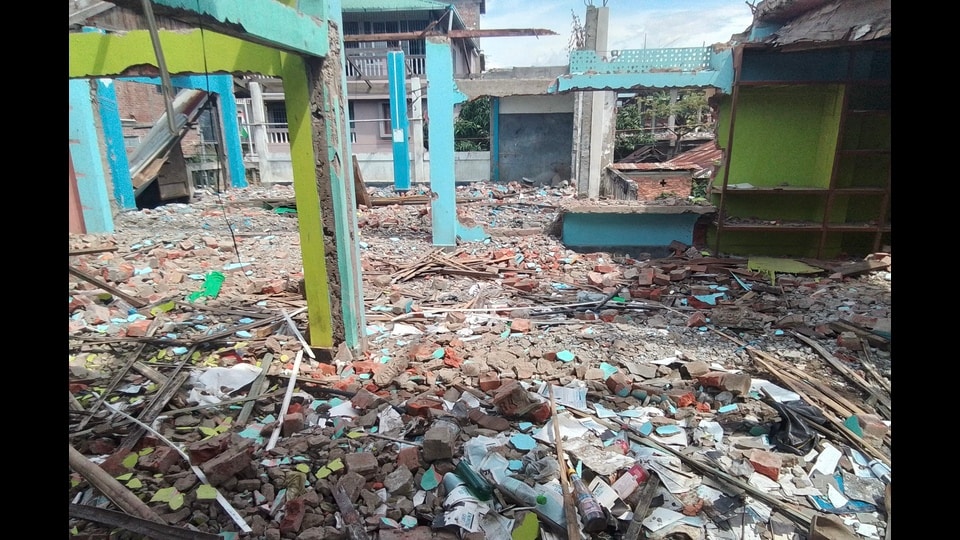
The priest, S Prim Vaipei, and his family of nine, resided in their two-storey home under tight security for months even after all Kukis fled the Imphal valley within a week of the ethnic clashes breaking out in the first week of May last year.
On September 1 last year, however, the Assam Rifles moved them out on the advice of the state government.
Then two days ago, Vaipei’s son Samuel received photos of rubble from the spot that their house stood.
“A friend, who is from a neutral community, sent a picture of our house that has been reduced to rubbles. Some of our friends who live in the area confirmed our house was razed but they could not give any information on how it happened,” Samuel Vaipei, 42, said.
He accused “militant groups from the other community” of demolishing the family’s house.
“Only our house has been targeted because it belongs to my father, a prominent person from our community, who was settled in Imphal. How can a house in the middle of the city be reduced to rubbles?” he asked.
In the 16 months of the ethnic violence, properties owned by both Kukis and Meiteis have been targeted as part of the violence, forcing the communities to withdraw to their respective strongholds — the Meiteis in the valley and the Kukis in the hills. Even after the houses were abandoned, they have been set on fire and vandalised.
New Lambulane — a Kuki dominated society until last year — is in the heart of the city, less than five km from the offices of the chief minister and the police chief.
The area is also heavily guarded by police to ensure that the abandoned houses are not targeted — a common modus operandi adopted by both communities.
Rev S Prim Vaipei, 78, who is now living in Darjeeling, blamed the police and state administration for failing to protect his house.
“Until September 1, the security forces were guarding our houses. We had refused to leave because we are one of the oldest Kuki families in the valley,” he said.
Recalling the events leading up to his departure from Manipur, he said, “I remember the evening of September 1, when I stepped out to check the security guards outside. Suddenly, I saw hordes of security personnel hurriedly entering our society. A senior officer in that group advised us to get inside their vehicles immediately. There were reports of armed mobs coming to our society. I could not even go upstairs to collect my belongings. We were taken to Motbung (Kangpokpi) at an Assam Rifles relief camp under heavy security passing Imphal in a convoy of police vehicles.”
The elderly priest said that earlier this year, a friend from a neutral community told him that the house was occupied by civilians.
Vaipei said, “That neutral person in Imphal was unsure if the people residing in my house were civilians or militants. I think this was sometime in January or February. I told my friend to go to my house and tell them to read the message at the entrance. I am not sure, if they did. After completing the house in 2000, I had written a line near the door. It said — Whoever enters this house, may the peace of God be with them.”
There was no immediate response from Manipur DGP Rajiv Singh or the chief secretary to HT’s request for comment.
Ethnic violence between the Meiteis and the tribal Kukis have roiled the state for the last year. The violence has claimed at least 230 lives so far and displaced at least 50,000 people.


