India imposed one of the harshest lockdowns in the world on March 25, 2020, to prevent the spread of Covid-19. A sudden closure of businesses and drying up of incomes forced a large number of workers and their families to go back to their homes, often in difficult circumstances. While images of poor workers walking on highways captured the most brutal aspect of the reverse migration, it was not the only disruption to usual migratory patterns. Many white-collar workers moved
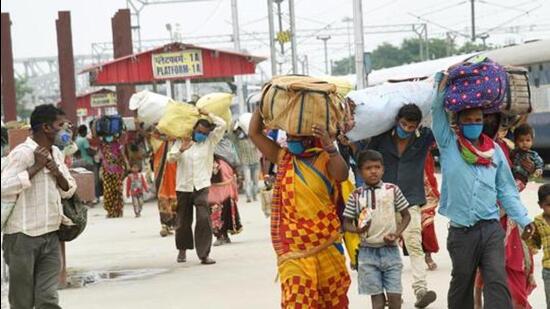
India imposed one of the harshest lockdowns in the world on March 25, 2020, to prevent the spread of Covid-19. A sudden closure of businesses and drying up of incomes forced a large number of workers and their families to go back to their homes, often in difficult circumstances. While images of poor workers walking on highways captured the most brutal aspect of the reverse migration, it was not the only disruption to usual migratory patterns. Many white-collar workers moved places once work-from-home arrangements freed them from the need of staying in big cities. Students studying outside their homes had to come back or postpone their moves.
How did the pandemic affect migration in India in the ultimate analysis? This question might never be answered because the 2021 census, which might have captured the pandemic’s impact on migration, has been delayed. The decadal census, which seeks migration-related responses is the most robust source of migration statistics in India. Had the census been held on time, it would have captured most of the migration in the post-pandemic period.
However, recently released data of the 2020-21 Periodic Labour Force Survey (PLFS) offers a glimpse into the pandemic’s impact on migration. Limited though the survey’s findings are, they confirm the intuitive reasoning and anecdotal accounts of the pandemic’s impact on migration. Here are four charts that summarise this.
Initial government estimates of migration are not very off the mark
By September 2020, which was almost six months after the first lockdown, government estimates put the number of migrants at around 10.5 million. While replying to a Lok Sabha question on September 14, 2020, the labour ministry said around 6.3 million people had taken the Shramik Special trains between May 1 and July 9. The same answer put the number of people who had returned to their home states at 10.5 million.
PLFS 2020-21 covers the period from July 2020 to June 2021. Anybody whose current place of residence is different from the usual place of residence (place of stay for six months or more) is considered a migrant. PLFS asked whether migration took place before or after March 2020, which is the cutoff for the lockdown. Because the PLFS is a survey, it only generates a share of migrants in the population and the estimated number has to be extrapolated using population projections. Applying the National Commission on Population’s projections gives an estimated number of around 12.4 million migrants who moved places between March 2020 and June 2021.
To be sure, PLFS also shows another 9.2 million visitors who moved for at least 15 days during the pandemic, but did not stay at a place for more than six months.
Headline numbers on migration hide disruption in migratory patterns due to the pandemic
This is the most important fact to keep in mind while looking at migration statistics. Had it not been for the lockdown’s disruption, migration would have fallen drastically . The biggest example is that of migration for marriage, which is the single biggest reason for migration in India. The share of migrants due to marriage fell from 73% to 29% in the period before and after March 2020.
On the other hand, migration drivers that would have got a boost during the pandemic, such as job losses and migration due to health reasons, saw a big proportional increase.
Post-pandemic PLFS numbers show a big jump in reverse migration
PLFS questions are designed to identify whether or not a migrant is a reverse migrant. This can be done by checking whether the migrant has stayed at his current place of residence historically. The share of migrants who reported being reverse migrants is disproportionately higher among those who migrated after March 2020. A further disaggregation of these statistics also shows urban to rural migration. It increased sharply after the pandemic -- and 78% of it was reverse migration after the pandemic compared to 28% earlier.
Did reverse migration help mitigate the pandemic’s economic distress?
Answering this is difficult. This is because migration related responses are only a small fraction of the overall responses in the survey and subjecting this data to necessary cross tabulation will render it statistically insignificant, or unfit for extrapolation to the real world. With this caveat in place, PLFS does offer a glimpse into why reverse migration might have looked like a sensible strategy, although it may not have worked ultimately.
One way to do this is to look at the post-pandemic employment status of erstwhile employed migrants who reported moving for work before and after the pandemic. While the data does not show any significant change in employment status of pre- and post-pandemic migrants, it does capture a higher tendency to fall out of the labour force among those who did not migrate after the pandemic, which is in contrast to a higher unemployment rate among migrants who moved for work after the pandemic. When read with the larger trend of most post-pandemic migration being urban to rural, it does point towards persistence of business closures even after the hard lockdown ended.
One Subscription.
Get 360° coverage—from daily headlines
to 100 year archives.
Archives
HT App & Website