
 E-Paper



How new insights into Indus Valley were unlocked
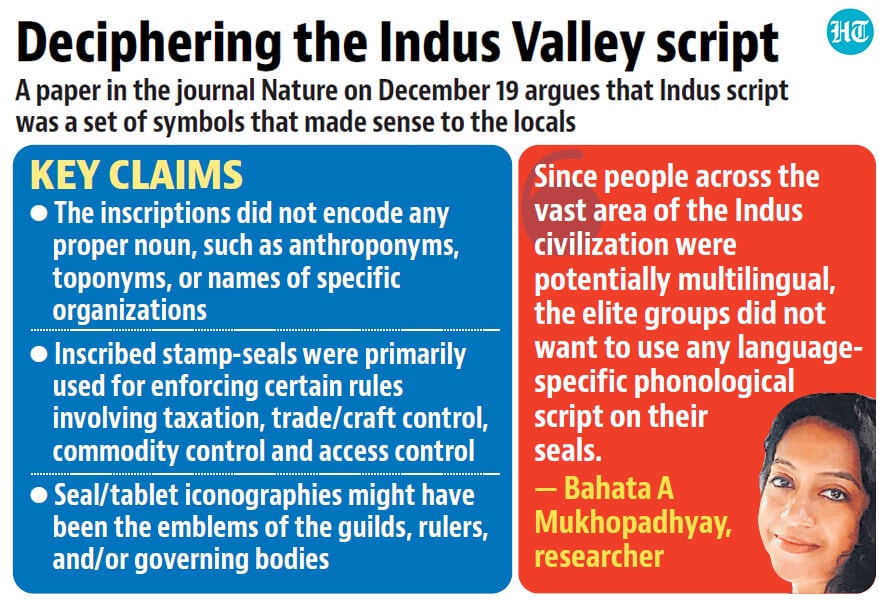
The elite groups in the region did not want to use any language-specific phonological script on their seals.

 Prefer HTon Google


An encounter with a Cambridge mathematician at a Bengaluru dinner party led software engineer Bahata Ansumali Mukhopadhyay to decode the arcane script of the Harappan civilization, shedding light on the mercantile culture during this Bronze Age civilization. That was almost a decade ago, and it is thanks to that chance meeting that the world now knows about the commercial activities of the ancient race.
Mukhopadhyay, 42, published her third paper in the peer reviewed journal, Nature Group journal on December 19, arguing against the widely-held idea that the Indus Valley script essentially consisted of religious texts or names of people and places and that the inscribed stamp seals and tablets were mainly used as tax stamps and licenses for ancient commerce. Mukhopadhyay’s paper states that the Indus Valley’s growing economy needed a standardised measurement system and a “mercantile script” to control commerce — one that could be understood universally across the distant settlements of the civilization.
Also read: New evidence suggests Harappan civilisation is 7,000 to 8,000 years’ old
“Across the ancient world, all writing systems were invented from the needs of accounting and commercial administration. Since people across the vast area of the Indus civilization were potentially multilingual, the elite groups did not want to use any language-specific phonological script on their seals. The way modern traffic symbols remain intelligible to both literate and illiterate people of different speech communities, Indus script’s signs were also mostly language-agnostic symbols which encoded names of various taxed commodities, licensed commercial activities, tax rates, license fees, license slabs etc by using certain cultural symbols,” said Mukhopadhyay, speaking on the phone from her home in Bengaluru.
For example, the plant-like trident symbol used in the inscriptions, which possibly encoded some plant-based commodity and related tax name in Indus seal-inscriptions, was also found in Early Harappan graffiti long before the use of the Indus script. “The commodity name or tax name related signs were often preceded by various strokes that encoded different tax rates. The inscribed seals were found to be used near fortified gateways where incoming and outgoing commodities were monitored, measured, weighed, and taxed,” she added.
Soft clay tags were stamped by the inscribed Indus seals and these stamped tags were then attached to merchandise packages so that designated officials regulating the commerce of Indus settlements could identify and distinguish between the merchandise on which taxes had been paid. “Identical references of mercantile tax seals are found in Kautilya’s Arthashastra written in 400 BC. Miniature inscribed tablets bearing seal-like inscriptions were used as commercial licenses or permits of goods. The reverse sides of these tablets contained certain numerical and metrological expressions that possibly recorded certain standardized license-slabs and license-fees. This is functionally comparable to modern licensing systems,” Mukhopadhyay explained.
“People have been trying to decipher the Indus script forever. It is one of the biggest unsolved mysteries in the world of archaeology. This has led people to come up with all kinds of theories. That it contains Vedic mantras. That is contains Tantrik mandalas. But then comes a scholar who argues that probably this is no script – these are just symbols, a set of emoji that made sense to the locals,” says writer and mythologist Devdutt Pattanaik. “With this paper it seems to all come together. This is not speculation – this is based on a rigorous use of design thinking which makes it unique and path-breaking, especially as it done by an independent researcher, an Indian lady, a software engineer, with no agenda other than pure knowledge. Her findings also show that the Indus Valley world was not necessarily the world of poets but (also) of accountants and auditors.”
Serendipitous encounter
Mukhopadhyay met Cambridge mathematician Dr Ronojoy Adhikari at a dinner party in Bengaluru in 2014 that got her interested in deciphering the Indus script. “Empirical objective decoding methods have helped to decipher other ancient scripts such as the Greek Linear B script whose underlying language and nature was not known earlier, and I thought why not apply similar rigour to analyse the Indus script,” she said. She was soon so caught up by her pursuit that Mukhopadhyay quit her regular job at Infor Inc. a New York headquartered software company, and proceeded to spend the next 10 months trying to crack the Indus’s written symbols.
“I started with certain right questions. I understood what the script can decode and what it cannot encode. It cannot, for instance, encode the names of people and places so I tried to study what were the requirements of the ancient societies which gave rise to writing as a form of communication. In this process, I also read a lot of junk. For instance, someone told me the Polynesian script had some similarities with the Indus script so I read Polynesian history of languages and I learnt it was not at all true.”
Margaret Fox’s The Riddle of the Labyrinth: The Quest to Crack an Ancient Code and the Uncovering of a Lost Civilisation on the decoding of the Greek Linear B script, served as a guide map for Mukhopadhyay. “The methodical way that the scholars approached the decoding of Greek Linear B script intrigued me, and though the same methodology may not have helped me, I tried to apply the same rigour to my work,” she said.
Mukhopadhyay also read copiously on the decoding of the Persian Behistun inscriptions, Mesopotamian archaeology, Egyptian archaeology and hieroglyphs and various excavation reports. “I had certain questions and the questions had to be answered in an interdisciplinary way.
Linguist Dr Peggy Mohan who has also been trying to reconstruct the language structure and grammar of the Indus Valley language family, is full of praise for Bahata’s approach and her latest paper on Indus script. “There are a lot of people with all kinds of linguistic credentials who are working on deciphering the Indus script, but I find Bahata’s approach more interesting. For, it is difficult to believe that writing in Indus era was for literature which in those days was in memorised form. The Indus Valley times times was meant to record literature. The Indus Valley Civilization was concerned with precision and when you are precise, you tend to note down important information. And who makes notations? Traders, goldsmiths who need exact documentation and licenses. For example, to attest to whether gold is 18 carat or 22 carat or 24 carat. They would use hallmarks. Like today’s QR codes, which are meaningful without being ‘language’. A QR Code contains important information for a specific purpose. So Bahata’s hypothesis that Indus symbols were used for commerce is very convincing.”

Bahata’s approach uses lateral thinking. She saw unfinished seals and found that they were being made in a workshop alongside the tools that were being used for gold smithing. These Indus symbols do not represent phonetic sounds. Think of it: when you give your clothes to dhobis, they mark them with notation that a layperson can’t read, but it is important information, and designed for a specific purpose. It is not a story. Bahata has to have a chance to do more of this work and I hope that a research institute or university supports her so that she is able to spend all her creative time and energy on this.” says Dr Mohan adding that Mukhopadhyay should now build further on her thesis.


