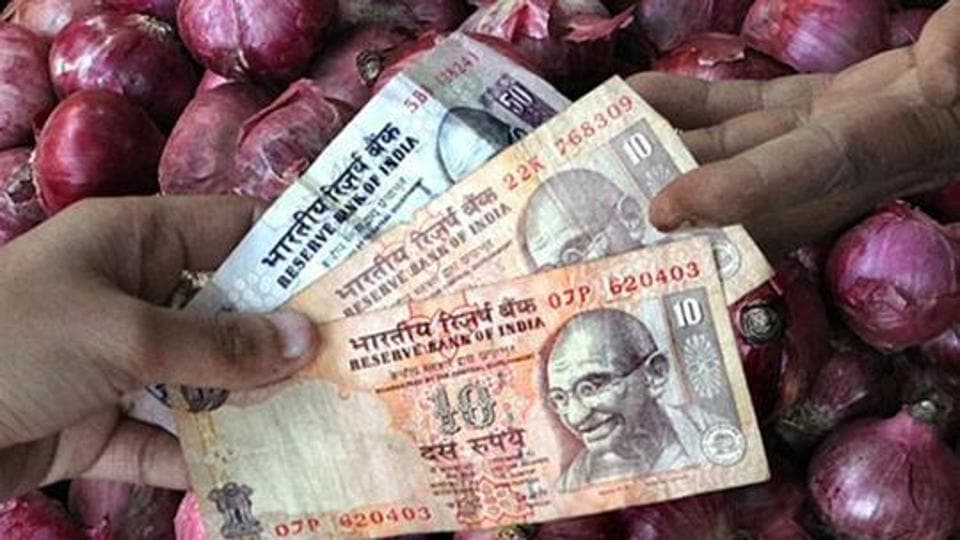
Two sets of inflation numbers released this week show divergent trends in wholesale and retail inflation. While retail inflation, as measured by the Consumer Price Index (CPI), came down to 7% in May from its April print of 7.8%, inflation linked to the Wholesale Price Index (WPI) increased to 15.9% in May from its April value of 15.1%.
Retail inflation has risen recently but it is still below the levels seen during UPA II (HT Photo (Representative Image))
On June 8, the Monetary Policy Committee (MPC) of RBI increased its inflation forecast – the MPC tracks CPI -- for fiscal year 2022-23 to 6.7%; one percentage point more than what it projected in April 2022. This means that inflation is going to breach the 6% upper limit of RBI’s target band this year. How bad is the inflation problem in India? Here are five charts which answer this question.
Retail inflation has risen recently but it is still below the levels seen during UPA II
While the CPI print for April 2022 reached an eight-year high, inflation has been significantly higher in the past. Data under the present CPI series -- it has annual inflation numbers since January 2012 -- shows that retail inflation was consistently above the 7.9% mark between February 2012 and January 2014. If one looks at the data for Consumer Price Index for Industrial Workers (CPI IW) there was another phase of high inflation -- it was continuously more than 7.8% between July 2008 and November 2011 -- before the phase after January 2012 which is captured in the current CPI series. As far as wholesale prices are concerned, the current situation is relatively worse. According to the spliced WPI series given in the Centre for Monitoring Indian Economy’s (CMIE) database, the May WPI reading is the highest since the March 1995 value of 17.2%. What makes the latest WPI spike even worse is that this is the first time since April 1983 -- the earliest period for which data is available in this series -- that WPI has grown in double digits for 14 consecutive months.
International commodity prices are much below their historic peaks at the moment
A lot of the inflation at the moment is being attributed to international commodity price pressures. This also means that inflation could increase further if international commodity price pressures were to harden. How bad are international commodity price pressures? As far as oil is concerned, India’s crude oil basket (COB) price seems to pretty close to its highest levels ever. According to data from the ministry of petroleum, India’s COB was priced at $121.95 per barrel on June 14. This is the fourth highest COB price when compared to monthly average prices since April 2000, the earliest period for which data is available from the ministry of petroleum.
“The market would remain volatile and clearly there is the risk that prices will move higher” amid low inventory buffers, Toril Bosoni, head of the oil market division at the IEA said in a Bloomberg TV interview. A further increase in petroleum prices could generate more tailwinds for inflation.
To be sure, wider commodity price pressures are still not as bad as petroleum prices. The Bloomberg Commodity (BCOM) Index – it measures the price of a broad basket of commodities including energy, grains, industrial metals, precious metals, sugar, coffee, cotton and livestock – was at 129.1 on June 14. The BCOM Index was at much higher levels in the immediate aftermath of the global financial crisis of 2008.
India’s inflation problem is better than what advanced countries are facing, but weaker labour markets could be a factor
India is not the only country facing an inflation problem at the moment. Not only has inflation crippled the economies of neighbouring countries such as Sri Lanka, and to a large extent Pakistan, even advanced countries are witnessing an unprecedented run in prices. Annual CPI growth in the US, for example, was 8.5% in May, and it has shown a sharp increase in the post-pandemic period. Has India been more successful in containing inflation than advanced countries, as was suggested in a research note by Soumya Kanti Ghosh, the chief economist at SBI?
While it is difficult to answer this question with complete objectivity, an important caveat needs to be kept in mind while comparing the inflation problem in India and the US. Because countries such as the US gave a huge fiscal stimulus after the pandemic, their economies, and labour markets in particular, are in a stronger state than in India, where monetary policy did the heavy lifting in dealing with the pandemic’s economic impact. As discussed in these pages on June 14, data from the 2020-21 Periodic Labour Force Survey (PLFS) shows that the pandemic has left long-term scars on India’s labour market. Even a comparison of monthly unemployment rates in the US with the CMIE unemployment rates for India shows that the former have come down at a faster pace than the latter. This suggests that India’s relatively better inflation performance could also be a result of weaker demand to some extent.

 E-Paper