The final order of the Delimitation Commission for the union territory of Jammu and Kashmir has created a political controversy in the erstwhile state. While political parties based in Kashmir have criticised the recommendations, the Bharatiya Janata Party (BJP) has welcomed the report. At the crux of the debate is whether the newly drawn assembly constituencies (ACs) will tilt the balance of power in favour of the non-Muslim voters in Jammu and Kashmir. Here are four charts which try to
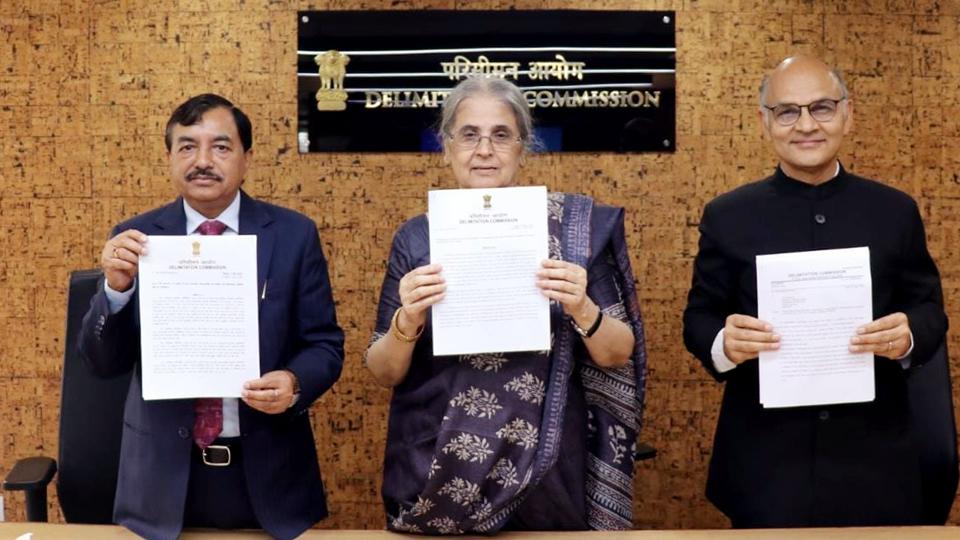
The three members of the Delimitation Commission have signed off on the final order for restructuring the assembly seats in the Union Territory (ANI)
But all of Jammu is not Hindu majority unlike uniformly Muslim majority Kashmir
Both the Jammu and Kashmir regions have ten districts each. While Kashmir is uniformly Muslim dominated – Muslim population is more than 94% in all districts – Jammu displays sub-regional religious diversity as well. Of the ten districts in Jammu, only four are Hindu majority. Muslim population in these districts varies from 7% in Jammu to 10.8% in Udhampur. This underlines the need for caution in mechanically interpreting an increase in the share of ACs in Jammu region as an increase in the share of Hindu dominated ACs.
And there is large diversity in religious composition even within districts
What makes the estimation of religious reconfiguration due to delimitation even more difficult is the fact that there is significant variation in religious composition of population even within districts, especially in the Jammu region. Because the delimitation process has redrawn AC boundaries at the patwari circle level of administrative units, it is difficult to ascertain the exact change in religious composition of the electorate. Publicly available census data only gives religious composition at the sub-district level, which is a bigger administrative unit.
A district-wise breakup of the BJP’s 2014 assembly election performance in the erstwhile state of Jammu and Kashmir underlines the problem of mechanically drawing a one-to-one correspondence between district-wise religious population shares and the BJP’s probability of success. For example, the BJP’s district-wise seat share remained at 50% in three out of ten districts of the Jammu region even though the population share of Hindus increased from 28% to 40%. Similarly, the BJP won all the seats in Samba and Kathua districts but could only win two-third of the seats in Udhampur district, even though the latter has a higher population share of Hindus than the other two.
Reconfiguring religious composition of the electorate might not be only political fallout of the delimitation process
To be sure, reconfiguration of religious composition of the electorate at the AC level is not the only change the delimitation process will bring to electoral competition in Jammu and Kashmir. The new recommendations have also created nine Scheduled Tribe (ST) reserved ACs which did not exist in the pre-delimitation assembly. Six of these ST reserved ACs are in the Jammu region while three are in the Kashmir region. The seven SC reserved ACs in the Jammu region have been preserved in terms of numbers, although their AC boundaries are likely to have changed. While the creation of ST reserved ACs seems to be in keeping with the larger region-wise population share of STs – it is 13.6% in Jammu and 3.3% in Kashmir -- it could alter political competition if the BJP can strike an alliance with a new political force claiming to champion the interests of Muslim STs (they are 94% of the overall ST population in Jammu and Kashmir). The three districts in Jammu region which are going to have ST reserved ACs are Poonch, Rajouri and Reasi. The BJP’s performance was the worst in these districts in the 2014 assembly elections.
Last word: there are more nuances to estimating the impact of this delimitation than the immediate political binary that suggests itself.
Get the latest India News, breaking headlines and real-time updates from across the country. Stay informed about politics, government policies, crime, weather and major national developments.
Get the latest India News, breaking headlines and real-time updates from across the country. Stay informed about politics, government policies, crime, weather and major national developments.
Home/India News/How will delimitation change electoral politics in Jammu & Kashmir?
{{^htLoading}}
Advertisement
{{/htLoading}}
SHARE THIS ARTICLE ON
{{#usCountry}}{{/usCountry}}
Hindustantimes wants to start sending you push notifications. Click allow to subscribe