The bells of London pealed and the guns thundered to salute the crowning of Queen Elizabeth II.
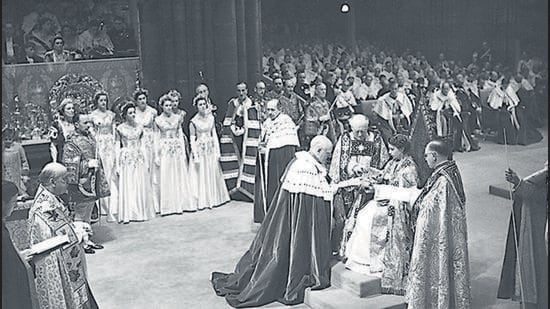
A great concourse in Westminster Abbey cried “God save the Queen” as they watched the Archbishop of Canterbury, Dr Geoffrey Fisher, place on her head St. Edward’s Crown, the symbol of the British monarchy. Outside, beneath grey skies, the cry was taken up by millions who had watched her progress to the ancient Abbey and waited to see her emerge again as the crowned Queen.
Later, the Queen thanked her people for their “ loyalty and affection.”
She ended a worldwide broadcast on her Coronation Day with these words: “As this day draws to its close, I know that my abiding memory of it will be not only the solemnity and beauty of the ceremony but the inspiration of your loyalty and affection.”
“I thank you from a full heart. God bless you all.”
Earlier, she pledged: “Throughout all my life and with all my heart I shall strive to be worthy of your trust.”
A congregation of more than 7,000 waited at the Abbey since early morning for the Queen’s arrival.
They heard her approach in State, heralded by a swelling roar of cheers along the route, while a massed orchestra in the Abbey played softly. Then through the west door of the Abbey along the blue carpet leading to the Coronation theatre before the altar, the stately procession began.
First came the Abbey beadle bearing his golden staff of office. Behind him came churchmen in scarlet cassocks and sombre black. Then in a great multi-coloured stream, the heralds in medieval tunics, the court officials and the standard bearers.
{{/usCountry}}First came the Abbey beadle bearing his golden staff of office. Behind him came churchmen in scarlet cassocks and sombre black. Then in a great multi-coloured stream, the heralds in medieval tunics, the court officials and the standard bearers.
{{/usCountry}}Slowly the colour moved across the golden carpet of the Coronation theatre in the centre of which the golden throne, upholstered in rose, stood in a raised dais.
Prime ministers of the Commonwealth stepped aside into their allotted places giving way to the Archbishops of York and Canterbury in their pointed mitres and gold-embroidered robes.
The Indian and Pakistani Prime Ministers, Mr Jawaharlal Nehru and Mr Mohammed Ali Jinnah, walked side by side in the procession into the Abbey. Behind them surrounded by heralds in bright medieval tunics came the Duke of Edinburgh, a burgundy robe trimmed with ermine billowing around his naval uniform.
Amid this rich and multi-coloured scene the Queen appeared like a gold and crystal figure, supported by her maids of honour. A bishop walked on either side. As she entered the clear voices of 40 schoolboys rang out in the cry of Vivat Regina. There was a great crash of the organ and then the 400-voice choir echoed the salute.
The Queen walked steadily, her hands clasped in front, her face tense and serious. As the cries of “Vivat” soared upwards she seemed to tremble for a second, her hands unclasped, but quickly she clasped them again.
As she reached the Chair of Estate, her arms dropped to her side and the maids withdrew. For a moment the Queen knelt in prayer, then took her place on the chair, while the regalia was placed on the altar. The moment had come now for the recognition. Once more her maids of honour escorted her to a corner of the theatre beside the Coronation Chair. There she stood alone as the Archbishop of Canterbury declared: “Sirs, I here present unto you Queen Elizabeth your undaunted Queen: wherefor all you who are come this day to do your homage and service. Are you willing to do the same?”
A great cry of “ God save Queen Elizabeth “ rose from the assembly, echoed twice by the Choir. Four times from each side of the theatre the Archbishop asked the question and each time the thunderous cry came back.
Then he bowed to her and she returned to the Chair of Estate.
Sitting upright in her chair the Queen next took the oath speaking her only words of the entire ceremony.
“Will you solemnly promise and swear to govern the peoples of the United Kingdom of Great Britain and Northern Ireland, Canada, Australia, New Zealand, the Union of South Africa. Pakistan and Ceylon and of your possessions and other territories to any of them belonging or pertaining according to their respective laws and customs?” the Archbishop asked.
“I solemnly promise to do so,” she said in a clear voice.
Afterwards, her maids of honour gathered around and escorted her into St. Edward’s Chapel to prepare for her triumphal drive through the streets of London.
As the Queen reappeared from the Chapel, arrayed now in a purple robe, crowned and carrying her sceptre in one hand and the cross-topped orb in the other, a fanfare of trumpets blared out and the Abbey rang with the national anthem: “ God save the Queen.”
The rain streamed ceaselessly down, until dignitaries riding in open carriages were so wet that they had the hoods put up, almost hiding them from view.
The Commonwealth Prime Ministers were each escorted by troops from their own countries except Mr Nehru who was escorted by British police.
India’s Prime Minister, Mr Nehru, drove from Buckingham Palace to the Abbey in a Royal Clarence and a pair of horses in the carriage procession of Commonwealth Prime Ministers. He was in Indian ceremonial dress, wearing an achkan and churidar and with him was his daughter, Mrs Indira Gandhi.