
 E-Paper



HT This Day: Nov 6, 1956 -- Approach of superior might deprecated
Mr Nehru made a moving call today to the delegates to the ninth session of U.N.E.S.C.O. to “ pay heed to the collapse of conscience and morals “ in the world where Panch Shila had become “ mere words without meaning to some countries who claim the right of deciding problems by superior might.”


Mr Nehru made a moving call today to the delegates to the ninth session of U.N.E.S.C.O. to “ pay heed to the collapse of conscience and morals “ in the world where Panch Shila had become “ mere words without meaning to some countries who claim the right of deciding problems by superior might.”
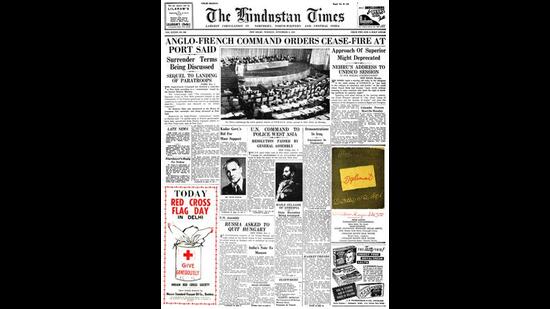
Speaking with great feeling at the opening session, the Prime Minister referred to “ the dread tramp of armed men and the thunder of bombs “ and drew the attention of the delegates to events in Egypt and Hungary.
“Human dignity and freedom have been outraged there and old colonial methods have been revived.”
Mr Nehru spoke in deliberate measured tones to declare that it appeared that great countries thought that the only reality was force and violence, and fine phrases were merely the apparatus of diplomacy.
Calling for admission of China to U.N.E.S.C.O., the Prime Minister declared that the organization would not be able to function adequately if one-fourth of the human race was kept out of it. He expressed the hope that U.N.E.S.C.0 would turn its attention to the needs of underdeveloped countries.
The one-month session was inaugurated by Mr J. Z. Muniz, retiring President of U.N.E.S.C.O., who declared that the organization must condemn the principle of aggression and affirm at “ this sad hour in world’s history “ its belief in the moral values of mankind.
Making a direct reference to events in the Suez area. Maulana Azad, who leads the Indian delegation, said the Anglo-French action had left the impression that even today the safeguarding of international peace and future of mankind was considered to be less important than the achievement of narrow national or commercial objectives. It seemed inconceivable that the two countries should have behaved as if the U.N. and the Security Council did not exist.
Maulana Azad’s address, which was read by Mr Saiyidain, Secretary, Union Education Ministry, because of his indisposition, called the attention of U.N.E.S.C.O. to “ its special task of Working for better mutual understanding and appreciation of the two conflicting systems and ideologies which are rivals for the allegiance of man.”
Seldom before has the Capital seen such a fully representative international gathering in such strength as this morning in Vigyan Bhawan where the conference is being held. Eminent educationists, scientists and sociologists comprised the delegations to the conference. Flags of 77 member-States fluttered in bright sunshine in the early November breeze outside the main hall while the blue U.N. E S.C O. flag and India’s Tricolour flew atop masts at the entrance.
Soft fluorescent light from the glass ceiling illuminated the hall, while the stage, where Mr Nehru, Maulana Azad, Mr Muniz, Dr Luther Evans, Director-General of U.N.E.S.C.O., Dr Mudaliar, Chairman of the Executive Board, and other officials sat, was flood-lit. Cabinet Ministers and members of the diplomatic corps were among the visitors.
Cine-cameras whirred and cameras clicked as the delegates. distinguished in their diverse national costumes, entered the hall. Here were, among others, representatives of Saudi Arabia in their flowing white gowns and a delegate of the Holy See in a pink robe. A bell rang heralding the opening of the session; photographers retired, and a hush fell on the bustling hall.
Over 200 delegates were present, including representatives of other U.N agencies and non-governmental organizations. The hall was not packed as it might have been, if the trouble in the Middle East and Eastern Europe had not held up many delegates. Sixteen countries, including Hungary, Iraq, Israel, Libya, Belgium, Chile and Finland, are not attending the conference. France, Italy, the Lebanon, Turkey, Egypt, Spain and Mexico are not fully represented.
Dr Evans read out messages, from Dr Julian Huxley and Mr Jaime Torres-Bodet.
The plenary session elected a nine-nation credentials committee with Czechoslovakia as chairman.


