
 E-Paper



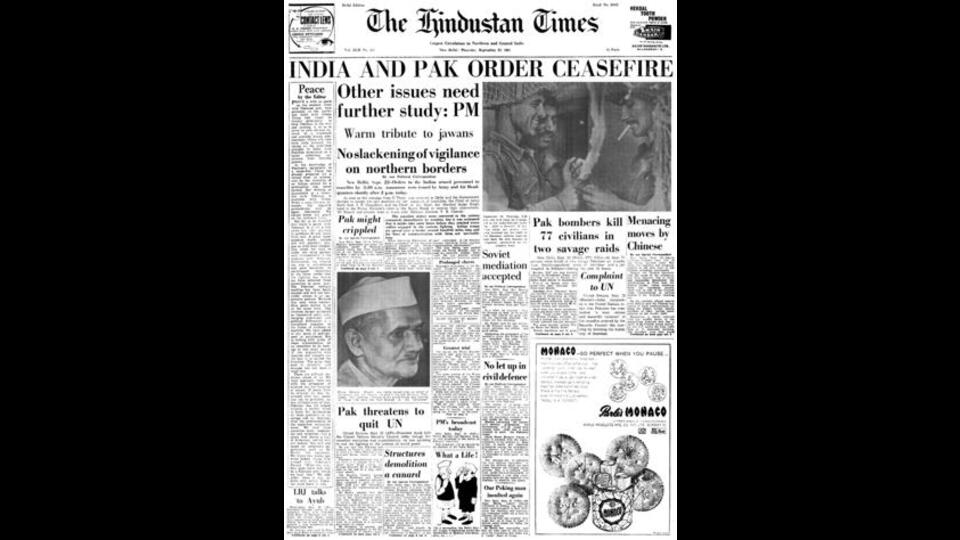
HT This Day: September 23, 1965 -- India and Pakistan order ceasefire
Orders to the Indian armed personnel to ceasefire by 3-30 a.m. tomorrow were issued by Army and Air Headquarters shortly after 2 p.m. today.

 Prefer HTon Google


Orders to the Indian armed personnel to ceasefire by 3-30 a.m. tomorrow were issued by Army and Air Headquarters shortly after 2 p.m. today.
As soon as the message from U Thant was received in Delhi and the Government decided to accept the new deadline for the cessation of hostilities, the Chief of Army Staff, Gen. J. N. Chaudhuri, and the Chief of Air Staff, Air Marshal Arjan Singh, went to the Prime Minister’s room in the South Block to receive their instructions. Mr Shastri had already been in touch with Defence Minister Y. B. Chavan.
The ceasefire orders were conveyed to the various commands immediately by wireless, but it was estimated that it might take some hours before they reached every soldier engaged in the current fighting. Indian troops I are spread over a border several hundred miles long and the lines of communication with them are inevitably long.
While informing Parliament of India’s acceptance of the Security Council’s ceasefire call, Prime Minister Shastri made it amply clear today that what the Government had agreed to was a “simple ceasefire.”
As in response to U Thant’s appeal last week, India, the Pane Minister stated, had accepted the ceasefire without any preconditions but there were “other matters” mentioned in -the Security Council resolution which required “consideration subsequently.”
The Lok Sabha was packed when the Prime Minister rose to read his carefully drafted statement. He was cheered several times during the 15-minute speech.
Prolonged cheers
Pakistan’s acceptance of the Security Council’s directive was communicated to New Delhi only shortly before Mr Shastri made the statement. In this connection the Prime Minister disclosed the interesting fact that early this morning India had received a communication from New York calling upon it to order a “unilateral ceasefire” in fulfilment of the Security Council resolution. “This, of course, was entirely impossible” and the UN Secretary-General was duly informed. However, the sub sequent report announced the Pakistani acceptance.
There were prolonged cheers when “on behalf of Parliament and the country” the Prime Minister paid “our warmest tributes to our armed forces” He was visibly moved when he referred to those who have lost their beloved on the battle field” He said they had made a contribution to the preservation of India’s independence
Greatest trial
The nation, the Prime Minister remarked. had gone through its greatest trial. The whole world knows now that the people of India-Hindus, Muslims. Sikhs, Christians, Parsees and others constitute a united nation with a determined common will and purpose”
The latter portion of the Prime Minister’s statement was devoted to assessing the Chinese threat India, he told the House, viewed with “grave concern” the Chinese activities on the border and armed intrusions into Indian territory.
India had advised China to give up its present belligerent postures and he hoped that even at this late hour China would respond to this call and prevent a major crisis “We do not, however, know what the Chinese will do next. We have to remain vigilant all along the frontier” he declared.


