
 E-Paper



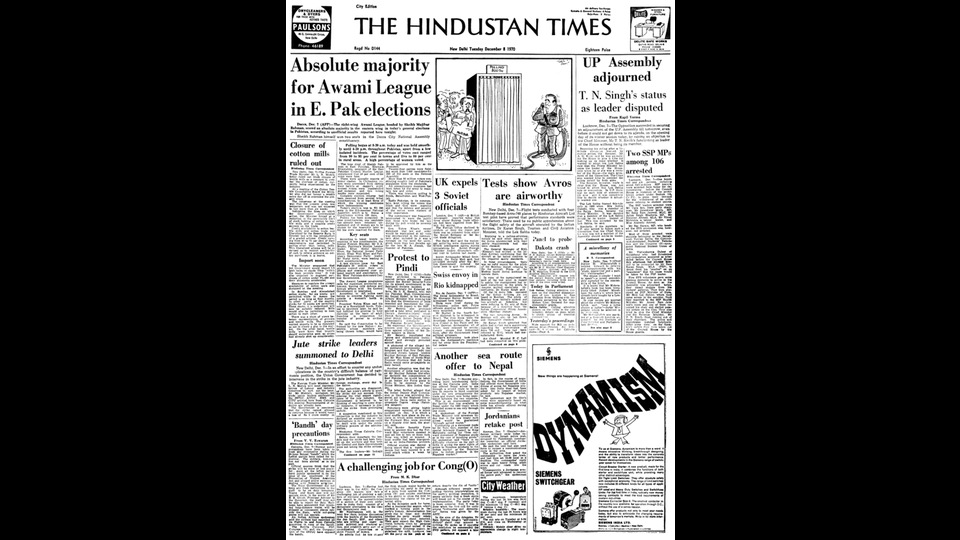
HT THIS DAY: December 8, 1970 — Absolute majority for Awami League in East Pak elections
The lone rival of Sheikh Rahman in East Pakistan, Khawaja Khairuddin, president of the East Pakistan Council Muslim League, complained that 30 per cent of the votes were fake

 Prefer HTon Google


Dacca- The right-wing Awami League, headed by Sheikh Mujibur Rahman, scored an absolute majority in the eastern wing in today’s general elections in Pakistan, according to unofficial results reported here tonight.
Sheikh Rahman himself won two seats in the Dacca City National Assembly constituency.
Polling began at 8-30 a.m. today and was held smoothly until 4-30 p.m. throughout Pakistan, apart from a few isolated incidents. The percentage of votes cast ranged from 90 to 95 per cent in towns and five to 80 per cent in rural areas. A high percentage of women voted.
The lone rival of Sheikh Rahman in East Pakistan, Khawaja Khairuddin, president of the East Pakistan Council Muslim League, complained that 30 per cent of the votes were fake.
There were sporadic reports of minor clashes. In Chittagong, voters were prevented from casting their ballots at daggers point, women voters were manhandled and molested and two voting booths were suspended.
Complete election returns had been received from several tribal constituencies, in at least three of which the winning candidates were Independents.
Today’s election was to fill 290 seats in the 313-member National Assembly, which is to frame a Constitution within 120 days.
Polling has been postponed in nine constituencies, one candidate has already been returned uncontested and 13 women are to be chosen by the Assembly later to fill the seats reserved for them.
Key seats
According to latest trends in counting in key constituencies, the former Foreign Minister, Mr Z. A. Bhutto, Pakistan’s Muslim League leader, Khan Abdul Qayyum Khan, the National Awami Party jeacer, Khan Wali Khan and Pakistan’s Democratic Party leader, Mr Nurul Amin, were leading in their constituencies.
A key election issue for East Pakistan’s 30 million voters is greater control over their own affairs and resentment over alleged neglect and exploitation by the West Pakistan-dominated Central Government.
The Awami League programme calls for maximum provincial autonomy, leaving only defence and foreign affairs with the Central Government in Islamabad.
According to AP, police used batons to disperse fighting mobs outside a women’s booth in Karachi.
President Yabya Khan cast his vote at a Rawalpindi booth. Talking to newsmen later, he said he had fulfilled his promise to hold elections on the basis of adult franchise in preparation for transfer of power to civilian hands.
He said the Constitution to be framed by the new National Assembly, whose members are being chosen today, would have to be approved by him as the President.
Twenty-four parties were fielding more than 1,600 candidates for 290 of 313 seats in the National Assembly.
More than 50 million voters constituting roughly half of Pakistan’s population form the electorate. All precautionary measures had been taken by the army to maintain law and order.
There was intensive polling in Sindh, Baluchistan and West Punjab.
Radio Pakistan, in its commentary, kept telling the voters that Islam and God were supreme and that the defence and security of the nation were matters of vital importance.
The commentary was frequently interrupted to warn the public that those who broke the law during the poll would be severely dealt with.
Gen. Yahya Khan’s recent statement that law and order would be maintained at all costs was incorporated in the commentary. Also included in it was a message on the need for unity, given more than two decades ago by the late M. A. Jinnah, the founder of Pakistan.


