Bihar chief minister Nitish Kumar never fails to recall during his ongoing Nischay Yatra how women narrated to him the woes they faced due to liquor when he was canvassing for his party in the 2015 assembly polls.
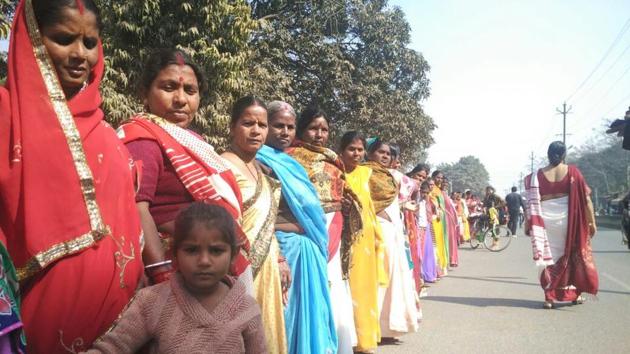
Backed by the popular demand, Kumar enforced total prohibition on April 5, 2016. Today, as the state went for a record-breaking human chain for addiction-free Bihar, women, with a population of 4,96,19,290, once again held the centrestage. Women were also key to Kumar’s success in the assembly elections.
Reports coming from different parts of the state suggest that women constituted a major portion of the human chain.
In most districts, school girls turned up in large number for the human chain. In Vaishali, Muzaffarpur, East and West Champaran districts, women from the lower strata actively participated in the event.
The government had left no stone unturned to ensure their participation. More than six lakh self-help groups (SHGs), which form the backbone of the state’s prohibition drive, worked overnight to ensure maximum participation.
“We used the reach of SHGs and Jeevika to the hilt to mobilise women in large number,” said Kanchan Gupta, state president of JD (U) women’s cell.
{{/usCountry}}“We used the reach of SHGs and Jeevika to the hilt to mobilise women in large number,” said Kanchan Gupta, state president of JD (U) women’s cell.
{{/usCountry}}Kumar had realised long time back that development of the state was not possible without empowering women.
The JD(U)-led Grand Alliance government has created a virtual constituency of women that gives an additional support to the government. To empower women, the government has initiated several women-centric schemes like the Mukhyamantri Nari Shakti Yojana, Akshar Anchal Yojana, Mukhyamantri Balika Cycle Yojana, Jeevika, Mukhya Mantri Kanya Suraksha Yojana, to name a few.
The state government has earned brownie points by announcing 50% reservation for women in civic bodies and also providing 35% quota in government jobs.
Women-centric schemes, coupled with other measures, have worked wonders. The literacy rate among women has gone up from 33.12 % (2001 census) to 51.50% (source: Census 2011).
To add to this, the prohibition drive has brought smiles on the faces of women, both in rural and urban Bihar.
“The nuisance on roads, with people drinking and driving, ogling at women, passing lewd comments, is gone. This is the best thing to have ever happened to Bihar,” said a school teacher, requesting anonymity.
Prohibition has now crossed state boundaries and touched an emotional chord with women, who constitute roughly half the active Indian voters.
It is for this reason that women groups from Jharkhand, Madhya Pradesh, Punjab and Uttar Pradesh had invited Kumar to make his political point in pursuit of his national ambition.