A black, sooty layer has been quietly spreading across the sandstone walls of Humayun's Tomb, one of Delhi's iconic Unesco World Heritage sites, and a new scientific study says the cause is unambiguous. It's Delhi's air.
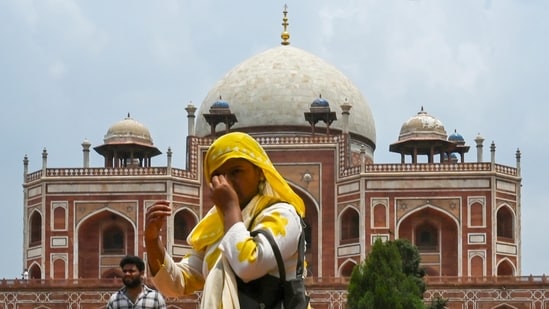
The study, conducted jointly by IITs at Roorkee and Kanpur and published in the International Journal of Architectural Heritage, found that years of exposure to polluted air have formed patches of black crust on the tomb's red sandstone, and that this crust is now accelerating the monument's decay, according to news agency PTI on Sunday.
The researchers collected black crust samples from different parts of the tomb and analysed them for chemical composition, mineral content and microscopic structure using laboratory techniques.
What exactly is this black crust?
According to the study, the crust is mainly made up of gypsum, a mineral formed when sulphur dioxide in polluted air reacts with calcium-rich dust and moisture.
Once that gypsum layer forms, it doesn't stay clean. It traps soot, dust and tiny metal particles from vehicle emissions, construction activities, road dust, biomass burning and industrial pollution, gradually forming a dark coating on the sandstone.
{{/usCountry}}Once that gypsum layer forms, it doesn't stay clean. It traps soot, dust and tiny metal particles from vehicle emissions, construction activities, road dust, biomass burning and industrial pollution, gradually forming a dark coating on the sandstone.
{{/usCountry}}Researchers stressed this isn't just cosmetic staining; chemical reactions that form it gradually weaken the sandstone, making it more vulnerable to weathering and long-term deterioration, the study said as per PTI.
The study also found the damage is not uniform across the monument. The thickest black crust developed in rain-sheltered parts of the monument, where pollutants accumulate over long periods, while more exposed surfaces had comparatively thinner deposits because rain naturally washes away some of the pollutants.
Not an isolated case, not first in Delhi
The Humayun's Tomb findings echo an earlier study by essentially the same team of researchers, who examined the Red Fort's sandstone and published it in the journal Heritage in 2025 in collaboration with Italy's Ca' Foscari University of Venice and the Archaeological Survey of India (ASI).
Black crusts on the Red Fort, the researchers wrote, mainly comprised gypsum, bassanite, weddellite, quartz and microcline, and the crust ranged from 55 to 500 micrometres thick, gradually developing into dendritic crusts that eventually caused the stone to exfoliate, the BBC reported.
The researchers in that case also pinned down the pollution timeline. They found the annual average concentration of PM2.5 near the fort was always above 100 micrograms per cubic metre between 2021 and 2023 — nearly 2.5 times India's National Ambient Air Quality Standard — while PM10 often crossed three times the limit.
Taken together, the two studies suggest that it is a pattern affecting Delhi's Mughal-era sandstone heritage, from the Red Fort to Humayun's Tomb, and potentially others built from the same Vindhyan sandstone, such as Qutub Minar and Safdarjung's Tomb.
What the researchers recommend
The Humayun's Tomb study's authors said their findings could help authorities plan conservation measures and recommended periodic removal of the black crust using scientifically tested conservation methods, continuous monitoring of pollution around the monument, and evaluation of protective coatings before their use.
They also suggested reducing pollution at the source through cleaner transport and lower-emission fuels to slow the formation of the damaging deposits, PTI reported. The Delhi government has been moving in that direction for some years now, including the recent EV policy.
How other cities have handled it
Delhi isn't the first city to grapple with this black crust.
Conservators at the Duomo di Milano, the cathedral in Milan, Italy, use a sulfate-reducing bacterium. Athens in Greece took a more drastic approach at the Acropolis, where the European Commission's regional development office says original sculptures vulnerable to pollution-driven crust were moved indoors to the Acropolis Museum and replaced outdoors with exact casts.
For Delhi's monuments, researchers recommend regular maintenance, protective coatings and then monitoring.
Humayun's Tomb, built in the 16th century by Empress Bega Begum in memory of Mughal emperor Humayun, is regarded as India's first grand garden tomb.
The red sandstone and white marble monument introduced several architectural features that later influenced Mughal monuments, including the Taj Mahal.