
 E-Paper



Committed to tri-service integration to maximise combat capability: IAF chief
“The strength of each service needs to be taken into account and synchronised to increase the net combat capability of the nation,” Chaudhari said during his customary press briefing ahead of the 89th anniversary of the IAF on October 8


Indian Air Force chief Air Chief Marshal Vivek Ram Chaudhari on Tuesday said that the air force was fully committed to tri-service integration to maximise the country’s combat capability, its concerns about the theaterisation model have been factored into the planning process, and hoped that the new structures will cater for joint planning of operations at all levels.
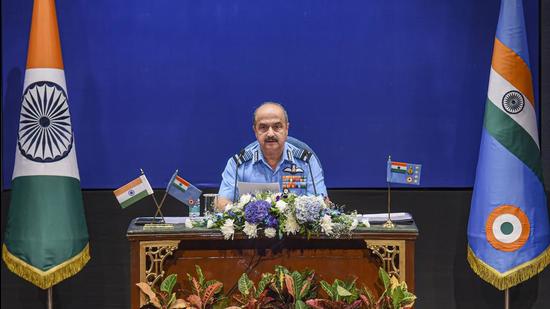
“The strength of each service needs to be taken into account and synchronised to increase the net combat capability of the nation,” Chaudhari said during his customary press briefing ahead of the 89th anniversary of the IAF on October 8.
“The doctrines of each service also need to be kept in mind while redesigning our structures.”
He said each service has its own strength and the rationale behind theatre commands is to capitalise on those strengths. “IAF is very keen on integration among the armed forces. Joint planning and execution of operations by the three services will result in maximum increase in our net combat capability, which is the need of the hour,” said Chaudhari, who took over as IAF chief on September 30 after Air Chief Marshal RKS Bhadauria retired.
The new IAF chief’s comments on jointmanship are significant as they come against the backdrop of some concerns flagged by his predecessor about the theaterisation model a few months ago.
In July, Bhadauria argued that it was critical to first get the joint structures right, even as chief of defence staff (CDS) General Bipin Rawat gave out details of the theaterisation plan to achieve jointness and brushed aside the reservations revolving around asset split, leadership, and dilution of the powers of the service chiefs.
IAF is fully committed to integration and jointmanship, and the points articulated by his predecessor basically focused on the fact that the structures and the processes have to cater for future warfare, Chaudhari said.
“That is the key element of restructuring [the armed forces] into theatres… All our concerns have been taken into account, and deliberations and discussions are underway on this subject. We are hopeful that the ultimate structures that emerge will cater for joint planning and execution of operations,” IAF chief said.
The current theaterisation model, a long-awaited military reform with the full backing of the government, seeks to set up four new integrated commands for synergy in operations --- two land-centric theatres, the Air Defence Command and the National Maritime Theatre Command.
Bhadauria had earlier differed with Rawat’s assessment that IAF was “a support arm,” and countered the CDS’s statement, saying air power has “a huge role to play” in any integrated battle area.
Responding to a question on the perception that IAF was a support arm, Chaudhari said air power had multiple roles to play in any conflict, ranging from offensive strikes to air transportation and support to the army and maritime forces.
“If you examine any global conflict carefully, air power has played multiple roles. There are various roles for every air force, and it is true for IAF too. Our capability, training and equipment cater for executing multiple roles simultaneously,” he said.
Chaudhari said no service could succeed in battle without the support of the other two services. “To be able to go singularly into any battle is not possible. We need the support of the other two services. It is true for all services. It is not that just IAF is a support arm, the army also at times has to support IAF in air operations.”
The creation of theatre commands could take two to three years, with senior officers from the three services being assigned key responsibilities to finalise the joint structures.
Defence minister Rajnath Singh recently said that discussions on the creation of joint commands and their implementation were progressing well and fast, indicating that differences between stakeholders on the theaterisation model were being addressed, and India was on course to set up theatre commands.
Responding to a question on the border row with China in the Ladakh sector, Chaudhari said IAF was aware of the People’s Liberation Army Air Force’s (PLAAF) deployment at three airbases across eastern Ladakh. He said China had scaled up infrastructure across the contested Line of Actual Control (LAC) but it would not affect air operations and IAF was fully prepared for any eventuality.
He said that China had developed airfields in the Tibet Autonomous Region along with hardened shelters for aircraft but “they have a huge penalty of high altitude.” “Their (PLAAF’s) capability to launch missions from high altitude airfields will remain a weak area,” he said.
IAF chief said there was nothing to fear about Pakistan-China collusion, with the only concern being dissemination of information of western tactics and western technology from Pakistan to China. “The two-front threat always remains in focus for us. We are prepared in terms of training and equipment to handle a two-front contingency,” Chaudhari said.
The count of IAF’s fighter squadrons has reduced to around 30 compared to an optimum strength of 42 units. He said it was unlikely that IAF would be able to deploy 42 fighter squadrons in the next 10 to 15 years. He said the induction of new fighters and the phasing out of older ones would result in IAF achieving 35 fighter squadrons in the next decade.
IAF is looking at buttressing its force levels in the coming 10 to 15 years with 83 LCA (light combat aircraft) Mk-1A fighters, 114 multi-role fighter aircraft to be made in India and 120 advanced medium combat aircraft (AMCA - India’s homegrown fifth-generation fighter programme), he said.
Chaudhari said IAF was likely to induct by the year-end the first unit of the S-400 Triumf air defence missile systems ordered from Russia for ₹39,000 crore in October 2018. India is buying five S-400 missile systems capable of destroying a variety of aerial threats, including enemy fighter jets and missiles, at a range of 400km.


