
 E-Paper



In Centre’s 2-page order on letting migrants travel, there is 1 operative word
The home ministry approval is primarily aimed at the 14 lakh people who have been housed in 38,000 relief camps set up by the government and non-profit sector, the official said, referring to reports that millions of people could travel from cities to villages.

 Prefer HTon Google


The Union home ministry order that sanctioned inter-state travel is only designed to let people who are stranded reach home, a top government official told Hindustan Times. “The operative word is stranded”.
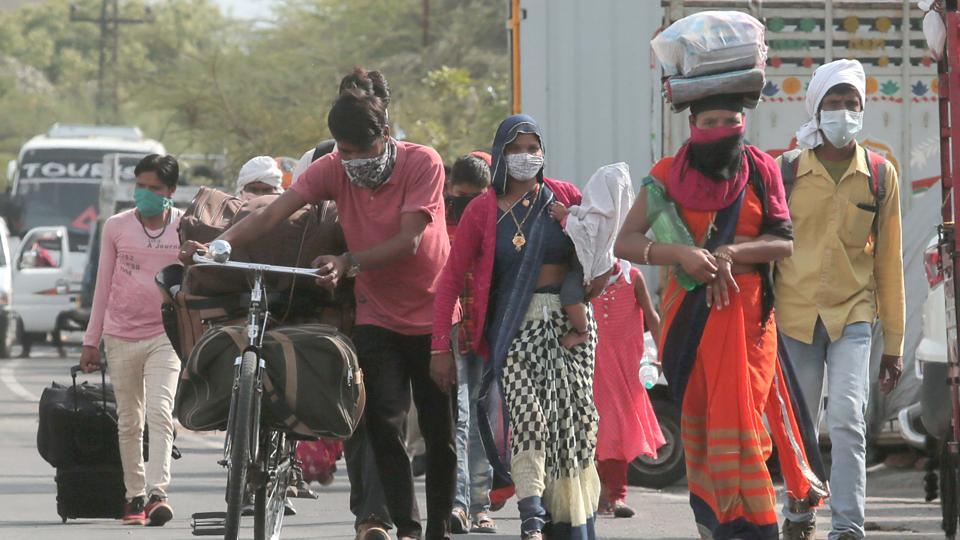
The home ministry approval is primarily aimed at the 14 lakh people who have been housed in 38,000 relief camps set up by the government and non-profit sector, the official said, referring to reports that millions of people could travel from cities to villages.
He said the order made it clear that it was for “migrant workers, pilgrims, tourists, students and other persons” who are “stranded at different places”.
“If a worker is at home in, say Delhi or Gurugram where he works, it should not be counted as stranded,” the official said.
Click here for the complete coverage of the Covid-19 pandemic
The fine print was indicated to state chief secretaries at their video conference with Cabinet Secretary Rajiv Gauba last week. The Centre did not explicitly spell it out in Wednesday’s formal order to give the states leeway to work out the procedures in accordance with the ground situation.
But it is important that the states make sure that the situation is not allowed to turn into a free-for-all at any point.
“Because if the situation appears to be getting out of hand, the Centre can change the rules again,” the official, who heads one of the empowered committees set up by the central government, said.
The warning from the top government official comes after the Union home ministry relaxed its lockdown to permit migrant workers, students, tourists, pilgrims and others stranded in other states to go home.
Click here for the latest updates from the coronavirus outbreak
The relaxation came days before the end to the 40-day national lockdown on May 4. In the next phase, the Centre is expected to lay emphasis on revival of economic activity in the country’s green zones that haven’t reported Covid-19 patients, ease restrictions in the orange zone but keep the ban on movement of people intact in the red zones and its containment zones.
It was in this context that the Centre had decided against running special trains to ferry the migrant workers or others. Instead, Union home secretary Ajay Bhalla’s order made it clear that the journey home would have to be made in buses.
It is a logistical nightmare to organise the large number of buses that would operate from one state to another. This is particularly the case since a bus can not be allowed to carry more than 25-30 passengers in view of the social distancing norms.
But in the face of a clamour from states to run special trains, the government is open to revisiting this condition. It hasn’t, however, taken a decision yet. One challenge would be to prevent people from pulling the chain between stations and getting off closer to their home.
The idea of requiring people to travel in buses, a government official said, was to discourage people from travelling long distances.
“The lockdown is going to be eased in a few days and the migrant workers should be able to get back to work in the green zones,” the official said.
He explained that it would be unrealistic to expect economic activity to restart in the absence of the migrant workers who constitute. It was a point that had been underlined by Prime Minister Narendra Modi also when he had, during one of his many interactions with chief ministers, asked them to take care of the migrant workforce who may be natives of another state.
There was, the official said, an added advantage of letting only migrants in relief camps returning home.
“They have been living in the state’s relief camps and have been monitored by state health authorities…. Since there haven’t been any reports of an outbreak of the disease in the relief camps, it is reasonable to expect that workers, by and large, in these camps are free of infection and the chance of the disease spreading through them in the rural belt is minimal,” he explained.
This is why the central government did not order the state governments to place the migrants in state quarantine facilities but allowed home quarantine. Besides, given the awareness of the disease in all parts of the country, it is reasonable to expect that there would be social pressure on the migrant returnees to stay in self-isolation.


