E-Paper



India, EU to step up def cooperation, stress open Indo-Pacific with eye on China
Security and defence cooperation was among the three focus areas for Von der Leyen’s visit, the others being trade and investment and connectivity initiatives

 Prefer HTon Google


NEW DELHI: India and the European Union (EU) on Friday agreed to work on a security and defence partnership to jointly counter common threats and, with an eye on China, focused on ways to ensure a free, open and peaceful Indo-Pacific built on international law and respect for sovereignty.
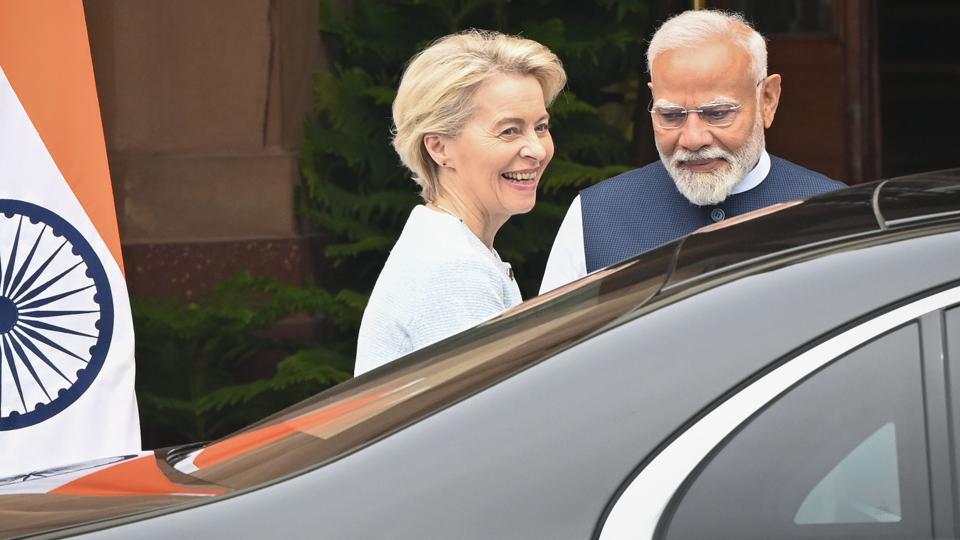
Prime Minister Narendra Modi and European Commission President Ursula von der Leyen said they would “explore a security and defence partnership” even as the two sides tackle traditional and non-traditional threats to safeguard trade and sea lanes of communication, according to a joint leaders’ statement issued after their talks.
Security and defence cooperation was among the three focus areas for Von der Leyen’s visit to India, the others being trade and investment and connectivity initiatives. Von der Leyen travelled to India with 22 of the 27 members of the EU College of Commissioners, underscoring the European bloc’s efforts to ramp up ties with India amid uncertainty created by the policies of the Donald Trump administration in the US.
Also Read: PM Modi, Ursula Von der Leyen set target for concluding India-EU FTA within 2025
Modi and Von der Leyen expressed satisfaction at growing India-EU cooperation in defence and security, including joint military exercises and collaboration between the Indian Navy and the EU’s maritime security entities, and reiterated their commitment to global security, including maritime security, the leaders’ statement said.
“They emphasised the need to deepen collaboration in counterterrorism and to strengthen international cooperation to combat terrorism, including cross-border terrorism and terrorism financing in a comprehensive and sustained manner,” the statement said.
The EU welcomed India’s interest in joining defence industrial projects under the bloc’s Permanent Structured Cooperation (PESCO) initiative and to engage in negotiations for a Security of Information Agreement, which is expected to facilitate the exchange of information on sensitive and defence technologies.
“Our growing cooperation on issues related to defence and security is a symbol of our mutual trust. We will take forward our cooperation on cyber-security, maritime security and counter-terrorism,” Modi said at a media interaction with Von der Leyen.
Also Read: Why New Delhi and Brussels must reset bilateral ties
“Both sides agree on the importance of peace, security, stability and prosperity in the Indo-Pacific region. We welcome the EU’s decision to join the Indo-Pacific Oceans Initiative. We will work together on triangular development projects for sustainable and inclusive development in the Indo-Pacific region and Africa,” he added.
Von der Leyen said Europe sees India as “a pillar of certainty in an increasingly uncertain world” at a time when “authoritarian states are getting bolder, ignoring borders and threatening peace at sea”. She added, “Now is the time to step up our security and defence cooperation on land, at sea and in space.”
She described the Indian Ocean as a “lifeline for global trade” and said: “Ensuring its security is vital, not just for India but for the whole world.” The two sides should expand joint naval exercises and deepen cooperation in protecting undersea cables for data connectivity.
Von der Leyen also listed the possibility for cooperation in military hardware. “India is looking into diversifying its military supply and access to new capabilities, so does Europe. So, both India and the EU can be partners on this topic,” she said.
The leaders’ statement said the two sides will work to promote a free, open, peaceful and prosperous Indo-Pacific “built on international law and mutual respect for sovereignty and peaceful resolution of disputes underpinned by effective regional institutions”.
While the statement made no reference to China, officials from both sides privately acknowledged shared concerns about Beijing’s increasingly assertive actions across the Indo-Pacific, especially in the South China Sea, and the need for joint efforts to protect maritime trade routes.
Von der Leyen announced the proposed security and defence partnership while delivering a speech at an event organised by the magazine India’s World, and said it will build on work already being done by the two sides in areas such as maritime security. The partnership with India would be on the lines of the EU’s similar initiatives with Japan and South Korea.
It will bolster joint efforts to counter common threats such as “cross-border terrorism, maritime security threats, cyber attacks or the new phenomenon we see: attacks on our critical infrastructure”, Von der Leyen said.
“This is not only about stability in our respective regions. But it is also a key part in strengthening our economic security and ultimately our prosperity. And this is why security should be a core part of our new strategic partnership with India,” she said.
India and the EU conducted their first joint naval exercise in the Gulf of Guinea in October 2023, and this was followed a month later by the posting of the first military attaché at the EU mission in New Delhi. The EU currently has military attachés in fewer than 15 countries.
In February 2022, the EU launched a coordinated maritime presence in the northwestern Indian Ocean to ensure a European naval presence in the Indo-Pacific. Besides regular maritime security dialogues, a joint team from India’s armed forces and the external affairs ministry visited Brussels for the first time in 2024 for talks on security issues.
Ahead of Von der Leyen’s visit, the two sides were working on other building blocks to intensify defence and security cooperation. This includes a new strategic dialogue on foreign policy issues, the elevation of security and defence talks to the level of the defence secretary, closer collaboration on homeland security issues and the posting of an EU liaison officer at the Indian Navy’s Information Fusion Centre-Indian Ocean Region (IFC-IOR), which plays a critical role in monitoring shipping in regional waters.
During her speech, Von der Leyen also raised the impact of conflicts in Europe, the Middle-East, Asia, and Africa. Despite the geographical distance between Europe and India, she cautioned that the fallout of the Russia-Ukraine conflict can impact other parts of the world.
“In Europe, Russia’s goal is to tear Ukraine apart. And we should be clear about what is at stake here. A failed Ukraine would not only weaken Europe...But a failed Ukraine would also intensify the challenges in other parts of the world. Not least in this region,” she said, with an eye on China.
The leaders’ statement said the situation in West Asia and the war in Ukraine were among the international issues discussed by Modi and Von der Leyen.
“They expressed support for a just and lasting peace in Ukraine based on respect for international law, principles of the UN Charter and territorial integrity and sovereignty. They also reiterated their commitment to the vision of the two-State solution with Israel and Palestine living side by side in peace and security within recognised borders, consistent with international law,” the statement said.