E-Paper



India in first league of AI nations: Vaishnaw at Davos
Vaishnaw’s remarks came after IMF MD Kristalina Georgieva outlined IMF’s newly created Index of Preparedness

 Prefer HTon Google


Minister for electronics and information technology (MeitY) Ashwini Vaishnaw pushed back against the suggestion that India belongs to a second tier of AI nations, at the World Economic Forum panel titled ‘AI Power Play, No Referees’. His remarks came after IMF managing director Kristalina Georgieva outlined IMF’s newly created Index of Preparedness, which groups countries into those that “make it happen”, those who “watch it happen”.
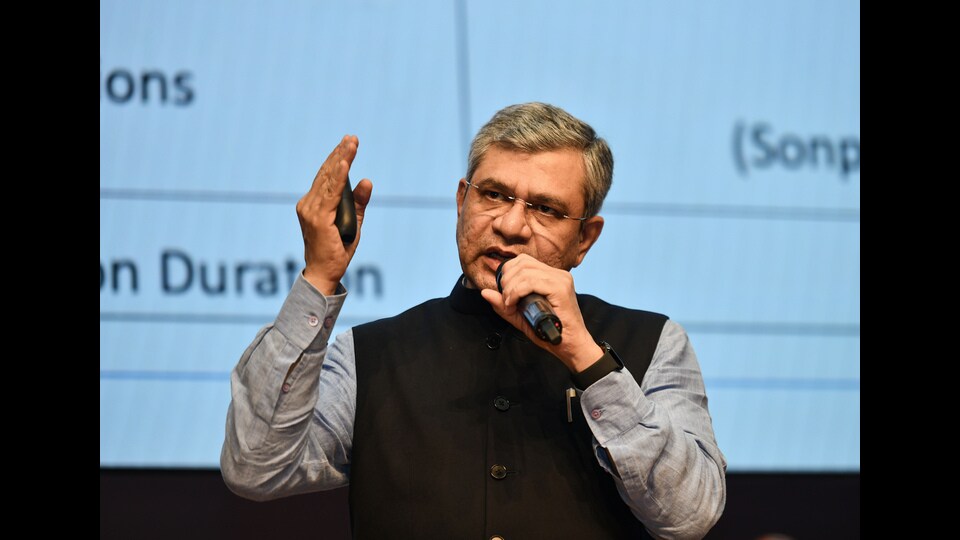
Georgieva named the United States, Denmark and Singapore as the top three countries, and said emerging markets such as Saudi Arabia and India ranked relatively high because of their investments in technology, placing India in the higher spectrum due to its long-standing focus on IT. Responding to a question on whether India, seen as part of a second grouping, would need to align more closely with the US or China, Vaishnaw said India clearly belongs in the first group because it is working across all five layers of the AI stack.
“Actually, clearly in the first group. And the reason for that is, there are five layers in the AI architecture… We are working on all the five layers, making very good progress in all the five layers,” he said. The five layers of AI architecture are application, model, chip, infrastructure and energy. The government describes the AI stack as a five-layer system, designed to take AI into sectors such as healthcare, agriculture, education and public services.
Vaishnaw said India is likely to become one of the biggest suppliers of AI-driven services globally, and argued that returns in AI come from enterprise-level deployment and productivity gains rather than from building very large models alone. According to him, nearly 95% of AI use cases can be addressed using models in the 20 to 50 billion parameter range, many of which India already has and is deploying across sectors.
“ROI (return on investment) doesn’t come from creating a very large model. 95% of the work can happen with models which are 20 billion or 50 billion parameters,” Vaishnaw said.
The minister said India is prioritising what he described as “AI diffusion,” making AI available widely to students, startups and researchers through subsidised computing. Under the IndiaAI Mission, India is developing 12 indigenous AI models, with making about 40,000 GPUs available at subsidised rates, expanding data centre capacity, and using nuclear energy as a stable and round-the-clock power source for AI infrastructure.
At another panel titled ‘Can India Become the Third Largest Economy in the World?’, Vaishnaw said India will become the world’s third largest economy within the next few years, calling it a certainty driven by a decade of “transformational change” built on public investment, inclusive growth, manufacturing and simplification.
He said India can maintain strong growth of 6 to 8% with stable inflation, supported by welfare schemes, wider access to banking, and a reduction in poverty. However, he warned that rising debt levels in rich countries could pose risks to the global economy.
Vaishnaw said the government is pushing major reforms with the Centre and states working together, including simplifying GST, changing labour laws, opening the nuclear energy sector to private companies, and removing old and complex rules to make it easier to do business. He added that India has become a trusted partner in global manufacturing, including in semiconductors, and is expanding exports and trade agreements to stay resilient during global economic uncertainty.
He also underlined the need for a “techno-legal approach” to regulation, especially to tackle deepfakes and bias. “You have to create technical tools and technologies to counter the harmful effects… detecting deep fakes with the accuracy which can be taken to a court and be properly judicially checked,” Vaishnaw said.
MeitY last year released draft amendments to the IT Rules, 2021 that would require all AI tools and major social media platforms to prominently label AI-generated content. The draft framework requires companies offering AI generation tools to embed permanent watermarks or metadata identifiers on all synthetic content, with visible labels on at least 10% of images and videos and audio identifiers during the first 10% of playback.
‘Autumn Davos’ in India
He added that there was now a suggestion to host a World Economic Forum-style meeting in India. “There is a suggestion that, now time has come when we should be having a World Economic Forum in India… kind of Autumn Davos in India,” Vaishnaw said, calling it a sign of growing global recognition of India.
As India looks to host the AI Impact Summit next month, Vaishnaw in Davos outlined plans spanning AI deployment, chip manufacturing, infrastructure and skilling. He said the upcoming AI Impact Summit will focus on three priorities, namely measurable impact through productivity gains, accessibility for India and the Global South, and safety through guardrails and a domestic regulatory stack, with participation from global leaders, investment announcements and the rollout of India’s AI models.
Vaishnaw said India is building a roadmap in semiconductors from 28 nm to advanced nodes by the early 2030s, is seeing growing momentum in deep-tech startups, and has confirmed large investments in AI infrastructure and clean energy to support the ecosystem.
Meetings with IBM and Meta
During the Davos meetings, Vaishnaw met Arvind Krishna, chairman and chief executive officer of IBM. The two discussed collaboration in advanced chip technology, including 7 nanometre and 2 nanometre chips, and steps to strengthen India’s semiconductor talent pool, said the minister in a post on X.
The minister also met Joel Kaplan, Meta’s chief global affairs officer. Discussions focused on the safety of social media users from deepfakes and AI-generated content, and Meta briefed the minister on its efforts to protect users.