Prime Minister Narendra Modi on Thursday led the nation in paying tribute to the heroes of the 1971 India-Pakistan war and marking 50 years of victory in the third war with the neighbour that led to the liberation of Bangladesh and is globally recognised as a glorious and unforgettable chapter in India’s military history.
Pakistan’s unconditional surrender involving 93,000 soldiers was the biggest in the world after the Second World War.
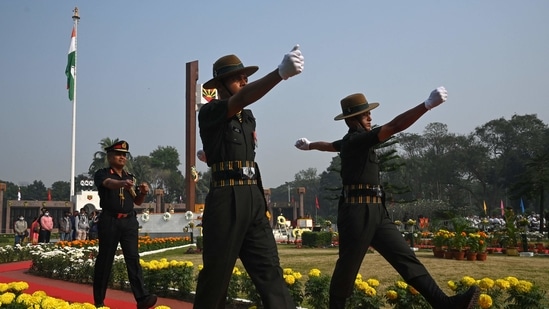
A solemn ceremony was organised at the National War Memorial at India Gate to commemorate the golden jubilee of the war that gave India a new generation of heroes and forever altered the history and geography of south Asia. It also marked the culmination of the year-long Swarnim Vijay Varsh Celebrations of the spectacular victory achieved under the leadership of then PM Indira Gandhi and army chief General (later Field Marshal) Sam Manekshaw.
“On this special day of Vijay Diwas, I had the honour of paying my respects at the National War Memorial and merging into the Eternal Flame, the four Vijay Mashaals which traversed across the length and breadth of the country over the course of last one year,” the PM wrote on Twitter.
The ceremony was attended by defence minister Rajnath Singh, army chief General Manoj Mukund Naravane, Indian Air Force (IAF) chief Air Chief Marshal Vivek Ram Chaudhari, navy chief Admiral R Hari Kumar and other top military officials. Late chief of defence staff (CDS) General Bipin Rawat, who was also scheduled to attend the event, was killed in a helicopter crash last week along with 13 others.
{{/usCountry}}The ceremony was attended by defence minister Rajnath Singh, army chief General Manoj Mukund Naravane, Indian Air Force (IAF) chief Air Chief Marshal Vivek Ram Chaudhari, navy chief Admiral R Hari Kumar and other top military officials. Late chief of defence staff (CDS) General Bipin Rawat, who was also scheduled to attend the event, was killed in a helicopter crash last week along with 13 others.
{{/usCountry}}As a part of the Swarnim Vijay Varsh celebrations to commemorate the war’s golden jubilee, the PM — exactly a year ago on December 16, 2020 — lit the Swarnim Vijay Mashaal from the eternal flame at the National War Memorial along with four flames that later travelled across the country.
“Since then, these four flames have traversed across the length and breadth of the country, including to Siachen, Kanyakumari, Andaman and Nicobar Islands, Longewala, Rann of Kutch, Agartala etc (before returning to Delhi). The flames were taken to key battle areas and also to the houses of gallantry award winners and veterans of the 1971 war,” the government said in a statement.
Modi on Thursday merged the four flames with the eternal flame at the war memorial during the reception ceremony of the Swarnim Vijay Mashaals.
Families of the 1971 war heroes appreciated the government’s gesture to celebrate the golden jubilee in a big way. Mukesh Khetarpal, the brother of one of India’s greatest war heroes 2/Lieutenant Arun Khetarpal, said it was humbling to see that even after 50 years, the country still remembered the heroes, including Arun.
Arun is among the only 21 Indian soldiers decorated with the Param Vir Ckakra (PVC), India’s highest wartime military honour, for their wartime heroism in independent India’s history.
Arun was only 21, and commissioned in Poona Horse only six months before the war began, when he destroyed seven Pakistani Patton tanks in the Battle of Basantar fought exactly 50 years ago on December 16, 1971.
Rajnath Singh recalled the courage and sacrifice of soldiers in the war. “On the occasion of Swarnim Vijay Diwas, we remember the courage and sacrifice of our armed forces during the 1971 war. The 1971 war is the golden chapter in India’s military history. We are proud of our armed forces and their achievements,” he said.
Singh also unveiled a commemorative stamp marking the golden jubilee. December 16 is celebrated as Vijay Diwas every year to mark Pakistan’s surrender and India’s decisive victory. The 13-day war ended on December 16 with the creation of Bangladesh, and the Indian Army taking 93,000 Pakistanis as prisoners of war. “The 1971 war was commenced with Pakistan launching pre-emptive strikes on a large number of IAF bases... Offensive action by the Indian armed forces led to the capture of Dhaka, surrender of around 93,000 Pakistani soldiers and the emergence of Bangladesh as an independent Nation,” the defence ministry said in a statement.
On December 12, the defence minister said the atrocities committed on the people of then East Pakistan were a threat to entire humanity and it was India’s responsibility to liberate them.
He was referring to the barbarism carried out by the Pakistan army under Operation Searchlight, a crackdown to crush the voices of self-determination.
He said that the 1971 war was among the most decisive wars in the world after the two World Wars. “This war tells us that the partition of India on the basis of religion was a historic mistake. Pakistan was born in the name of one religion but it could not remain one. After the defeat in 1971, it is continuously fighting a proxy war…We won in a direct war and the victory will be ours in indirect war as well,” he added.