
 E-Paper



India notches MIRV tech success in Agni-V firing, Pakistan failed three years ago
India successfully conducted the first flight test of domestically developed Agni-V missile with Multiple Independently Targetable Re-entry Vehicle technology.

 Prefer HTon Google


Three years ago, Pakistan attempted to develop the multiple independently targetable re-entry vehicle (MIRV) technology using 2.750 km Shaheen III missile with each warhead hitting the ground at the separation of two kilometres but as per DRDO top brass failed miserably.
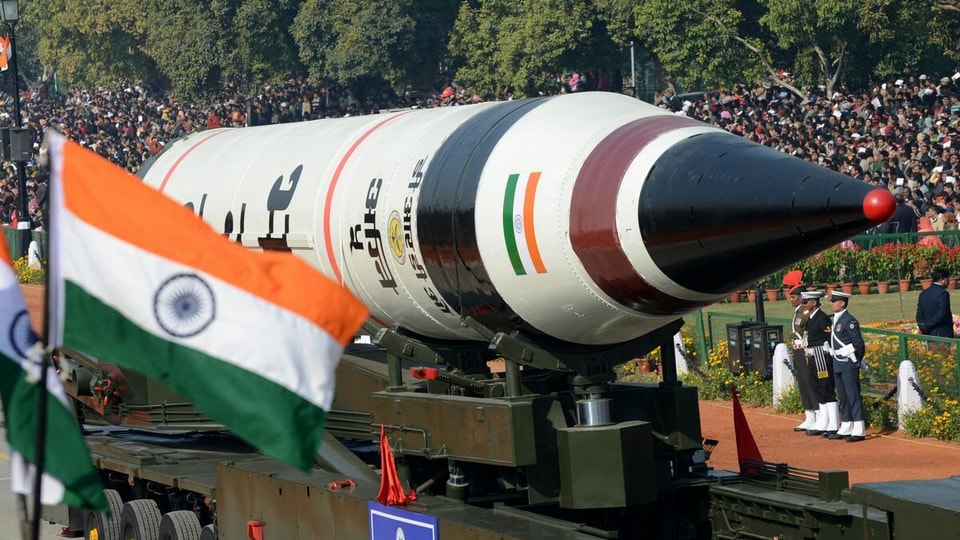
On Monday evening, India test-fired Agni-V missile with three MIRVs over a distance of over 3000 km though the range of the missile is 5000 km. The name of the missile is key to MIRV as the warhead separates in space and the missile re-enters the atmosphere resembling a fireball (Agni) due to friction at a speed of some six kilometres per second. Each warhead comes down at different speeds and hits the ground with some 200 kilometres separating the point of impact. The key to MIRV is re-entry as this is a critical phase as the warhead may disintegrate if it is not made of carbon composites.
With India already having test-fired the 3700 km range K-4 submarine-launched ballistic missile, the successful test of Agni-V reveals that India’s nuclear missile arsenal is ready to deter any adversary and work is already on to develop the Agni-P generation of versatile missiles.
Pakistan and its big brother China will use the Agni-V test to ensure that Islamabad does not sign the Fissile Material Cut-off Treaty (FMCT) citing asymmetric conventional force levels with India. But the Agni-V MIRV is to deter expansionist China, which still covets parts of Indian territories after militarily occupying Tibet in 1950 using brutal force. Fact is that the PLA had stationed its two spy ships of Xiang Yang Hong class to monitor the Agni V test with Hong 01 crossing the Malacca Straits on March 7-8 night after India issued a NOTOM for test trials on March 7. The Hong 01 is currently stationed 500 km west of Vizag while sister ship Hong 03 is outside Maldivian EEZ to monitor the impact of the tested Indian missile in the South Indian Ocean.
The Indian decision to test fire MIRV equipped Agni-V is largely due to the fact that China has been rapidly developing intermediate-range nuclear ballistic missiles as it has never been part of the now virtually defunct Intermediate Range Nuclear Forces Treaty between US and Russia in 1987 . Due to multiple warheads, the Agni V cannot be intercepted by anti-missile shields as each nuclear warhead has different velocities and separate targets.
Even though India has issued NOTAMs for March 15-16, authoritative sources say that no more test firings are planned as the objective has been achieved and project handlers have returned to headquarters. The project directors will now examine the trajectory and other variables of the missile as recorded by Indian ballistic missile tracker INS Dhruv to make any operational changes if required. Mission Divyastra is a success.


