India is now “rubbing shoulders” with developed nations in space technology, Indian Space Research Organisation (Isro) chairman V Narayanan said on Saturday, commending the successful International Space Station (ISS) mission of astronaut Shubhanshu Shukla.
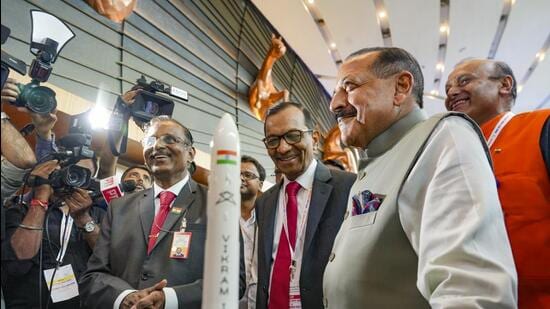
Speaking at the National Space Day 2025 event, Narayanan hailed the expedition as a major achievement for the space agency. He also gave credit to the three other astronauts, Prashanth Nair, Angad Prathap and Ajit Krishnan, for their contributions.
“One of the major achievements we have is sending our own Gaganyatri to the ISS. It was the idea of the Prime Minister (Narendra Modi) to send one of the Gaganyatris to ISS before sending them through our rocket... We should give credit to Shukla for his achievement. But, I say all four are equal and on par with us,” Narayanan said.
He also highlighted key milestones for Isro, including the Aditya L1 mission, SpaDex docking, the 100th launch with GSLV-F15 and the Nasa-Isro Synthetic Aperture Radar (NISAR) missions.
“A country that was 60 years behind the advanced space-faring nations, today we are rubbing shoulders with developed nations,” Narayanan said. He also noted the significant technological leap from India’s first launch vehicle with a 17-tonne carrying capacity to a 40-storey-tall launch vehicle capable of carrying 2,600 tonnes.
{{/usCountry}}“A country that was 60 years behind the advanced space-faring nations, today we are rubbing shoulders with developed nations,” Narayanan said. He also noted the significant technological leap from India’s first launch vehicle with a 17-tonne carrying capacity to a 40-storey-tall launch vehicle capable of carrying 2,600 tonnes.
{{/usCountry}}The event, themed “Aryabhatta to Gaganyaan: Ancient Wisdom to Infinite Possibilities,” brought together key figures from India’s space community.
Addressing the audience, astronaut Shubhanshu Shukla said India is in a “golden period” for space missions and called for a collective effort to realise future ambitions. “To realise our ambitions, we need the whole nation to bring them into reality... This excitement for India is present all over the world and is not limited to Isro. It is our job and duty to perform,” he said.
Prashanth Nair shared similar sentiments, noting a global admiration for India’s space programme. “We are not looking too far when people from the Japanese space stations, SpaceX, European Space Agency (ESA) would be flying with us in the Gaganyaan. We bring creativity and something totally different to the world,” he said.
Echoing their views, Angad Prathap emphasised the need for human space flights to achieve superpower status. “We have a government today that is supporting the space sector. Human space missions are a culmination of multiple missions... One of the key things that is stopping us from becoming a superpower is human space flight. Let’s work together towards it,” he said.
Ajit Krishnan concluded by highlighting India’s growing global reputation. “India is going places. When we go abroad, I see everybody looking up to us. We have a solid roadmap in front of us to achieve what is planned for 2047,” he said.
Union minister of state for science and technology Jitendra Singh said the National Space Day commemorates the successful Chandrayaan 3 landing, which highlighted that “India is no longer a follower, it beckons others to follow.”
He also shed light on the genesis of the Gaganyaan mission, which was first conceptualised in 2018. “We made a religious promise to each other that we won’t utter a word about this until the Prime Minister announces the decision from the ramparts of Red Fort. Because when the PM announces it from there, it becomes a declaration of intent and the whole world notices it,” he said.
Singh also revealed that the Axion-4 mission, in which Shukla participated, was an invitation to India, not the other way around. “They now started valuing Indian talent and capabilities. They feel that our voices, when they go there, add value to their mission,” he said.
The minister said India’s space technology played a significant role in Operation Sindoor, the country’s strategic response to Pakistan after the Pahalgam terror attack. He claimed that this “display of capacity” was achieved only in the last ten years, adding, “The opportunity to test such warfare technology comes rarely, and Operation Sindoor gave us that opportunity to test it in Pakistan’s land.”