E-Paper



‘India on track to achieve 2030 energy target’
India aims to achieve 500 GW of non-fossil fuel electricity capacity by 2030, having already met 50% of its power goal, according to Energy Minister Joshi.

 Prefer HTon Google


India is confident of achieving the target of 500 GW of installed electricity capacity from non-fossil fuel sources by 2030, Pralhad Joshi, minister of new and renewable energy said at the curtain raiser of the eighth assembly of International Solar Alliance on Wednesday.
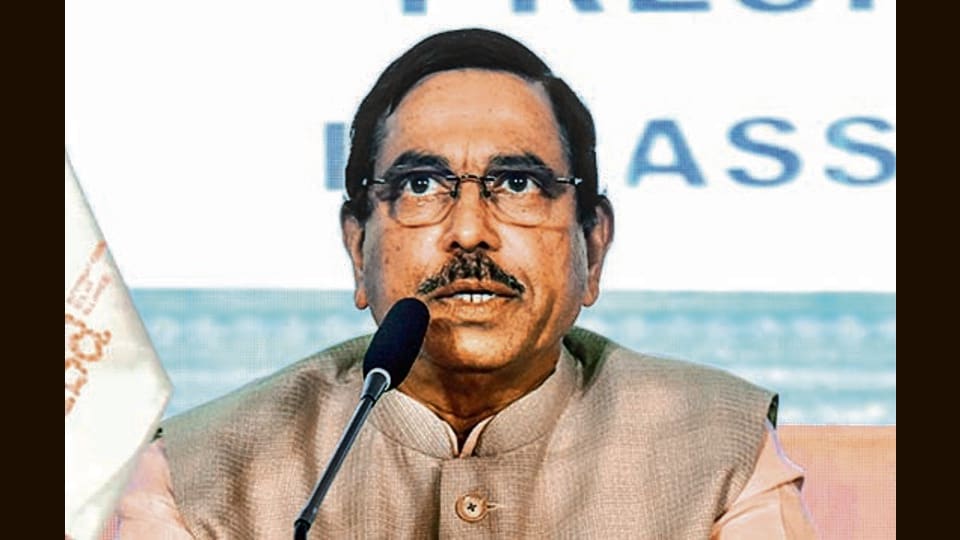
Responding to a question on what would be India’s update to its nationally determined contribution, Joshi said India has already achieved one of its NDCs which was to achieve about 50% of the cumulative electric power installed capacity from non-fossil fuel-based energy resources by 2030.
According to data from the ministry of new and renewable energy, India’s total power capacity as of June 30 was 484.8 GW, with 242.04 GW (49.92%) from thermal/coal, 8.78 GW (1.81%) from nuclear, and 234 GW (48.27%) from renewable sources.
“Our goal is to achieve 500 GW by 2030. We are on track.We have 162 GW in the pipeline presently. I am confident that we will achieve that goal,” Joshi said.
Santosh Kumar Sarangi, Secretary, MNRE said there is a discussion among stakeholders on whether India can increase its installed capacity from non-fossil sources. “That is under discussion. Our NDC has two parts--to reduce emissions intensity and to increase capacity from non-fossil sources to 50% by 2030. The second one has been achieved. The emission intensity target remains as is till 2030. There is a discussion among stakeholders on capacity target from non-fossil sources. A call has to be taken on that,” he said.
India’s three quantitative NDCs for 2030 period include: to reduce emissions intensity of its GDP by 45% by 2030, from 2005 level; to achieve about 50% cumulative electric power installed capacity from non-fossil fuel-based energy resources by 2030, with the help of transfer of technology and low-cost international finance including from Green Climate Fund (GCF) and to create an additional carbon sink of 2.5 to 3 billion tonnes of CO2 equivalent through additional forest and tree cover by 2030.
HT reported on Wednesday that India has finalised its first national adaptation plan which is likely to be unveiled ahead of or at the UN Climate Meeting (COP30) at Belem, Brazil, those aware of the matter said. The national adaptation plan and an update to India’s nationally determined contribution (NDC) for the 2035 period are currently under review and expected to be taken up for Cabinet approval very soon, those aware of the matter said.
“The most important thing India needs to do by COP30 is communicate its adaptation strategy and NDC 3.0 . In the leadership vacuum created by USA’s withdrawal from the Paris Agreement all countries have to come together to uphold multilateralism. Enhanced ambition in India’s NDC is critical to create a positive momentum and deliver on the COP30 action agenda,” said Vaibhav Chaturvedi, senior fellow at Council on Energy, Environment and Water (CEEW).
An observer said, the Brazil cop holds immense importance in view of South-South solidarity and hence it is also an important platform for India. This is especially in view of the US withdrawal from Paris Agreement; backtracking on several key climate policies and the ongoing tariff negotiations with several countries.
Further, MNRE officials said on Wednesday the US tariff negotiations did not impact India’s solar module sector. “Our solar module exports are not very huge. Our domestic consumption of modules has been very high because of utility scale solar projects that we have been doing. For schemes like PM Kusum, PM Surya ghar our domestic demand has been very high,” Sarangi said.
“As far as promoting solar sales is concerned we have a production linked incentive scheme through which we are supporting domestic solar manufacturing and until now we have 100 GW of domestic solar module manufacturing and 27 GW of cell manufacturing,” he added.
Diversifying solar supply chains will be key as China continues to be the dominant player, holding a substantial majority across all stages of solar panel production, officials said.
“The private sector including India, EU and others must have wider supply chain diversification in the interest of competitiveness,” said Ashish Khanna. Director General, ISA.
Further, he added that ISA has an association with member and non-member countries. “Any Chinese company can join our platform. We have shared our priorities with the Chinese embassy. The onus is on the Chinese government to take a call on ISA membership,” he added.
“Owing to its clear vision and the consistent policies, India achieved its renewable energy targets five years ahead of the schedule, crossing the 50% mark in overall installed electricity capacity from non-fossil resources. Today with approximately 125 GW of solar capacity, India is the world’s third largest solar producer. This progress shows how the national ambition can translate to meaningful change at the local level. It is because our success story is more than just numbers; it is about the people. We have seen firsthand how decentralised solar transforms lives, bring light to rural homes, powers local health centres and gives new tools to our farmers. With PM Surya Ghar - Muft Bijli Yojana, more than 20 lakh households are benefiting from solar power,” Joshi said at the ISA curtain raiser.
ISA is a global initiative launched in 2015 by India and France at COP21 in Paris. It has 124 Member and Signatory Countries. The Alliance works with governments to improve energy access and security worldwide and promotes solar power as a sustainable transition to a clean energy future.