
 E-Paper



Coronavirus spread slowed by a month of lockdown: Govt
Thursday marked the 30th day of a national lockdown, a tough measure to halt the spread of the disease that has killed at least 185,000 people across the world and infected about 2.7 million.

 Prefer HTon Google


Medical experts and government officials steering India’s battle against Covid-19 said on Thursday that the country’s prophylactic measures have led to a reduction in the disease’s doubling rate, while allowing the ramping up of testing and the bolstering of health care preparedness.
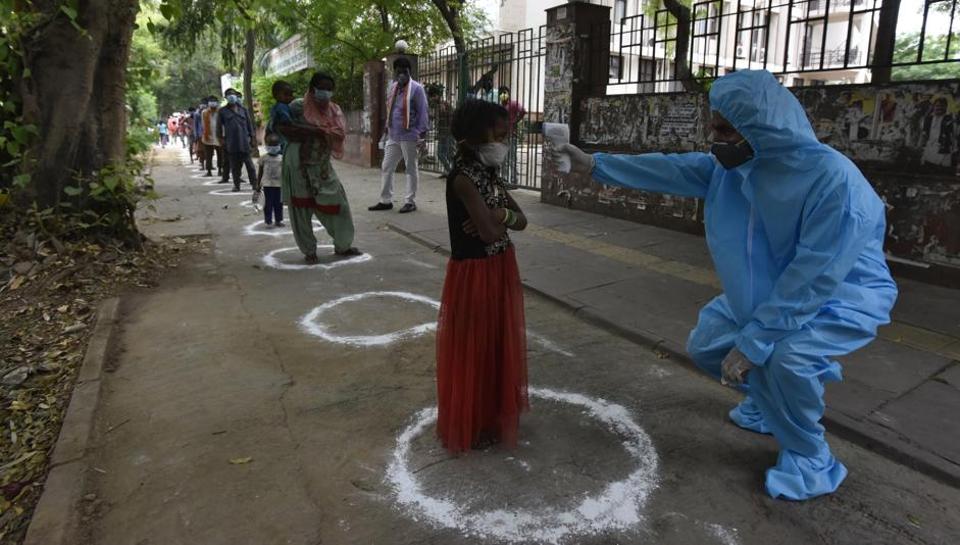
Detailing India’s evolving strategy against the pandemic, environment secretary CK Mishra, All-India Institute of Medical Sciences (AIIMS) director Dr Randeep Guleria, and Indian Council of Medical Research (ICMR) director general Dr Balram Bhargava stressed that the focus has been on expanding the testing base, tracing contacts across the community to detect the spread of infection, and scaling up health care infrastructure to prepare for a spike in cases.
They said infections were growing at a slower rate, larger numbers of people were being tested, and more medical facilities were being readied.
Coronavirus outbreak: Full coverage
Mishra admitted that the measures taken so far were not enough, and that efforts need to be further intensified.
Thursday marked the 30th day of a national lockdown, a tough measure to halt the spread of the disease that has killed at least 185,000 people across the world and infected about 2.7 million. In India, 21,700 people have so far been infected by Sars-CoV-2, the virus that causes Covid-19, according to the Union health ministry data till Thursday evening.
Mishra, who is leading one of the 11 Covid-19 empowered groups, said there were several positives in how India had handled the pathogen so far. “The growth of Covid-19 cases has been more or less linear, not exponential; this indicates that the strategies we have adopted have succeeded in containing the infection to a particular level,” he said.
“Despite a 24-fold increase in testing, the percentage of positive cases is not rising. The percentage (4.5%) of positive cases as a ratio of testing is more or less the same as that a month back,” he added, prompting Dr Bhargava to allude to this figure to later say that “curve could be flattening”.
Experts, however, warn that the real curve in question is the one of new cases and deaths, and that the testing percentage may not mean all good news. They suggest that once testing is massively scaled up, the percentage of those testing positive should ideally drop in order to avoid hospitals being overrun by patients.
Mishra said that while the number of tests in the country stood at 14,915 on March 23, the figure rose to over 500,000 by April 22. “Post lockdown, while the number of new positive Covid-19 cases has increased by 16 times, testing has increased by 24 times,” the chairman of the second empowered group, which deals with the availability of hospitals, isolation and quarantine facilities, disease surveillance, and testing and critical care training.
“The facts show that our testing strategy has been focused, targeted and continues to expand; this is an evolving strategy based on our learnings as we go along... As the challenge kept expanding, strategy too kept expanding,” Mishra added.
The number of Covid-19 cases in India rose above the 22,000-mark on Thursday, but the rate at which the grim milestone was crossed – it took about nine days for the tally to double – was a sign that the country may have been able to largely avoid the initial deadly spectre of the pathogen that has ravaged countries across the world.
The World Health Organization (WHO) has, however, warned that the worst is yet to come, with more waves of the infection expected once countries lift lockdowns in difficult decisions to jump-start economic activity.
The environment ministry secretary also shared comparative data from other nations to explain where India stood in its response to the disease. At 500,000 tests, the number of confirmed cases in the US was 80,000. It was 100,000 for Italy, 120,000 for the UK and 80,000 for Turkey at the same point. For India, there were 20,000 cases for 500,000 tests, he said. “India has done better than majority of developed countries, with respect to the percentage of test cases yielding positive results,” he added.
Dr Bhargava, the head of India’s apex biomedical research body, said that the philosophy of India’s effort has been “more labs, more tests and more resources”.
“From about 100 labs at beginning of the lockdown, we have 325 laboratories testing for Covid-19. Our strategy has been to detect the virus and then save lives,” he said.
Dr Bhargava said a supply chain has been created and the Centre has been working with states to ensure required reagents are supplied to testing labs in a timely and calibrated fashion. “The gold standard for Covid-19 testing remains and has remained the RT-PCR test, which detects the virus.”
The RT-PCR detects the virus’s genetic material (RNA) in swabs to diagnose a current Covid-19 infection. India has also deployed rapid tests that detect antibodies in the blood and indicate if a person has been infected in the past and has developed immunity to the virus; they can show results within 30 minutes. However, antibody tests are currently on hold as the government tries to check batches being supplied from China for efficacy of the kits.
Mishra said that the number of dedicated Covid-19 hospitals increased 3.5 times since last month and isolation beds rose by 3.6 times in the same period. “These numbers are increasing, being added continuously... We need to evolve our strategy based on the latest position.”
“Our first goal as regards hospitalisation has been to ensure that the minimum number of people need to come to the hospital, using social distancing, discipline and taking care of the vulnerable such as the elderly and those with co-morbidities.”
“The second goal is to ensure enough infrastructure so that every person who needs to come to hospital is treated well, cured and sent back. Every district in the country is now working towards that.”
Since oxygen support is essential in treating Covid-19 patients, the government is making arrangements to increase beds with adequate oxygen support and intensive care unit (ICU) beds with ventilator support. India currently has 3,773 dedicated Covid-19 hospitals, with 194,000 beds, 24,644 ICU beds and 12,371 ventilators.
A sweeping shutdown across the country has closed schools and colleges, thrown migrant workers out of daily-wage jobs and halted transport and economic activity. The lockdown will remain in place till May 3, but the government is understood to be working on opening some regions and industrial sectors to ease tough restrictions.
Dr Guleria, director of India’s premier government hospital, said the Covid-19 patients are facing a lot of challenges and stigma. “Recovered patients are symbols of victory, but we have stigmatized them, causing a huge problem.”
“Due to the stigma we have attached, patients are not coming forward, they are coming very late when they have severe breathlessness issues, thereby increasing morbidity and mortality,” he said.
“Many of these Covid-19 patients can be saved by just giving them oxygen; if they do not get oxygen, it can trigger various other problems, our strategy of expanding oxygen support is based on this,” Guleria added.
He also expressed the appreciation of the medical fraternity to a new ordinance that make any attacks on health care workers a non-bailable offence in the time of an epidemic, and significantly increases penal action that can be taken against the perpetrators.
But the officials and experts admitted that steep challenges remain across a few states that have become hot spots of Covid-19, with the Union home ministry terming the situations in these regions “especially serious”.
Dr Lalit Kant, infectious disease specialist and former head of ICMR, said: “The incubation period of SARS-CoV-2 is 5-7 days, and the range is 2 to 14 days. Lockdown is essentially a strategy to buy time; by restricting movement of infected individuals who may or may not be symptomatic, we are curtailing the chances of the person infecting large number of people. In various countries, lockdown has been given the credit to flattening the peak of the epidemic.”


