
 E-Paper



India-US join hands to cripple terror industry in Pakistan
The FATF sword is back on Pakistan’s head. PM Modi and Biden have asked global terror financing watchdog to improve standards against money laundering & terror.

 Prefer HTon Google


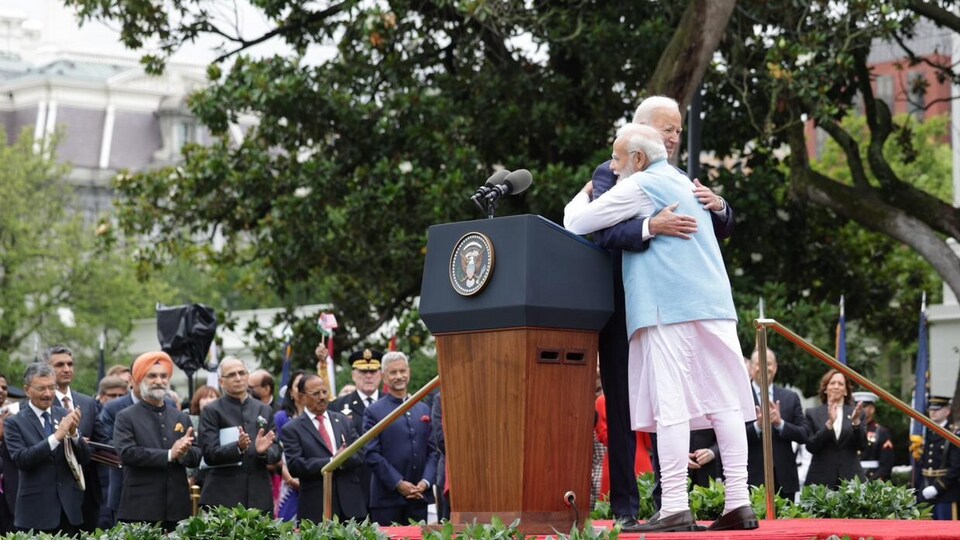
Prime Minister Narendra Modi and US President Joe Biden have pole-vaulted the bilateral ties to new heights and in the process also joined hands to cripple the terror enterprise in Pakistan and its jihadist proxies operating in Jammu and Kashmir.
Buried way down in the joint statement is a paragraph that emasculates the industrial scale terror factories in Pakistan by naming all the proscribed terrorist groups targeting India including Al Qaida, ISIS, Lashkar-e-Toiba, Jaish-e-Mohammed and Hizbul Mujahideen. All these jihadist groups are active in Jammu and Kashmir with sleeper modules in the hinterland.
The two leaders have not only strongly condemned cross-border terrorism but also use of proxies of these proscribed groups to escape sanctions while categorically asking Pakistan to take action against these groups to ensure that no territory under its control (read Pakistan Occupied Kashmir) is used for launching attacks against India.
At a time when Pakistan’s sole mentor China blocked the designation of LeT’s Sajjid Mir, the butcher of 26/11 attacks, at the UNSC, both President Biden and PM Modi called for perpetrators of 26/11 and Pathankot airbase attacks to be brought to justice. Mir, after being declared dead by Pakistan, is currently under protective custody of Pakistan’s deep state with India, US and Israel waiting to punish the rabid jihadist.
However, the joint statement has three very crucial points that will work towards crushing the terror empire in Pakistan. Firstly, by red-flagging the use of drones by Pakistan based jihadists for dropping arms, communication and even planning to drop terrorists across the border, both US and India have put pressure on Islamabad to put an end to this activity and have decided to work together to combat the misuse of drones. Intelligence inputs indicate that rabid JeM is experimenting with the plan to drop terrorists across the border using heavy drones.
Secondly, both India and US will work together to designate Pakistan based jihadists under the 1267 UNSC resolution while sharing counter-terror intelligence and enhancing cooperation between the law enforcement agencies of the two countries.
While China is expected to use its veto to support terrorists in Pakistan from getting globally designated by the UNSC committee, India and US will join hands to debilitate the terror factories in the Islamic Republic with both countries joining hands to prepare the paperwork for UN designation.
Lastly but the most important is reference of the joint statement to the Financial Action Task Force (FATF) to improve its standards to combat money laundering and financing of terrorism.
This means that the US which let Pakistan off the hook from the FATF’s grey list is willing to reconsider to put Islamabad back in the same list if it does not act against terrorists and terror groups in the Islamic Republic. Simply put, the sword of FATF is hanging on Pakistan’s head unless it gets its act together on using terrorist groups to further its political objectives against India, US, and other countries.
While Pakistan predictably has criticized the reference to Islamabad in the India-US joint statement as “misleading and unwarranted”, fact is that the joint communique reveals the irrelevance of Islamic Republic to the larger India-US bilateral ties. Pakistan’s playbook on the use of terrorism to secure political objectives in Kashmir through violence and murder has been thrown into the dustbin by the two natural and powerful allies.


