E-Paper



India seeks ‘strong public action’ on pro-Khalistan groups in UK
National Security Adviser Ajit Doval and his British counterpart Tim Barrow met on Friday. Barrow is on a visit to New Delhi at the invitation of Doval.

 Prefer HTon Google


NEW DELHI: India urged Britain to take “strong public action” such as deportation against Khalistani elements threatening Indian diplomats in the UK during a meeting between National Security Adviser Ajit Doval and his British counterpart Tim Barrow on Friday, people familiar with the matter said.
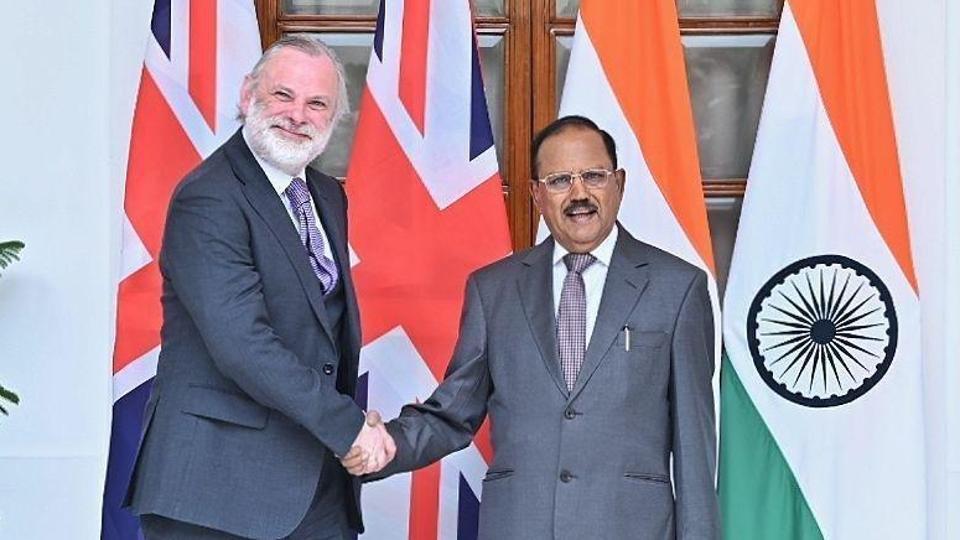
Barrow is on a visit to New Delhi at the invitation of Doval for the India-UK Strategic Dialogue. He is the first senior British official to visit India since Khalistani groups launched a poster campaign threatening senior Indian diplomats and unveiled plans for a so-called “Kill India” rally on July 8.
The Indian side had been expected to raise the activities of Khalistani elements with Barrow, especially in view of reports of possible violence during the rally on July 8, which is being seen as part of a coordinated campaign encompassing Australia, Canada, the US and the UK, the people said.
Also Read: US executive and legislative branch condemn Khalistani violence, assure protection
“The Indian side raised the issue of extremist elements in the UK threatening individual officers of the Indian high commission in London and urged the UK government to take strong public action against these elements, such as deportation or legal prosecution,” one of the people said, declining to give further details.
“The two sides agreed to enhance cooperation to address violent extremism and radicalism. There can be no justification for violent extremism and radicalisation in a democracy,” the person added.
The Indian side has been perturbed by the response of authorities in Canada and the UK to activities of Khalistani elements. Pointing to violence by Khalistani activists outside the Indian mission in London during a protest on March 19, a second person said: “The possibility of violence during the upcoming rally can’t be ruled out. We would like to see action being taken.”
Also Read: Canada not soft on Khalistan elements, terrorists: Trudeau
Images of India’s high commissioner to the UK, Vikram Doraiswami, and a consul general have featured in Khalistani posters seeking revenge for the killing of Khalistani separatist leader Hardeep Singh Nijjar, a designated terrorist, in Canada in June.
The security of Indian officials and diplomatic premises is understood to have figured in the meeting between the two NSAs. British foreign secretary James Cleverly on Thursday criticised attacks on Indian high commission. “Direct attacks on the Indian high commission in London are completely unacceptable,” he wrote on Twitter.
Besides the issue of Khalistani groups, Doval and Barrow, who have regularly engaged in discussions on a bilateral, regional and global agenda, reviewed multi-faceted cooperation between the two sides and explored new areas for technology collaboration, the people said.
Both sides agreed to work closely on counter-terrorism, preventing terror financing and the use of the internet for terrorism, illicit drug trafficking and countering radicalisation. They also agreed to deepen mutually beneficial collaboration in critical and emerging technologies, the people said.
Doval and Barrow held restricted discussions on regional and global issues. They were then joined by their delegations for talks where both countries “reaffirmed their close strategic partnership and agreed to accord maximum priority to further enhancing security linkages”, the first person cited above said.
Barrow, who is accompanied by senior British officials, will also meet other senior Indian interlocutors.
The violent protest outside the Indian mission in London in March, during which Khalistani activists climbed onto a balcony and pulled down the national flag, had become an irritant in bilateral ties. India lodged a strong protest with the UK and Delhi Police registered a first information report (FIR) over a crime committed abroad. The case was later handed over to the National Investigation Agency (NIA).