After a gap of nearly 18 months, the number of active cases of Covid-19 across India has dropped to fewer than 100,000 – a remarkable and encouraging statistic for a country the size of India. With 99,023 active infections across India as of Wednesday morning, the case burden on the country is at the lowest since June 2, 2020 – a time when the first wave of the pandemic was just beginning.
Where India’s active caseload is concentrated
Kerala, a state that has been one of the key regions that have seen a prolonged spell of the outbreak despite declining trends across the country since the second wave, continues to dominate national statistics. With 44,314 active infections, the southern state alone is responsible for 45% of the country’s active caseload. With 11,226 active cases as of Wednesday morning, Maharashtra – India’s worst-hit state –is currently home to 11% of such cases.
Tamil Nadu, with 8,244 active cases, constitutes 8% of the national caseload, West Bengal (7,731 active cases) has 8% of the national tally, and Karnataka (6445) has 7% -- wrapping up the list of the country’s top five biggest states by active cases. Interestingly, Mizoram finds itself on the sixth spot in the country with 3,751 active cases (4% of the national caseload).
Another interesting way of looking at this statistic is to factor in the population of the state. This lets us grasp how prevalent infected people are within a state. In such an analysis, the size of the current outbreak in the country’s North-East comes into context. With 3,147 active infections per million residents, Mizoram has the biggest current outbreak in the country respective of its size. It is followed by Kerala (1,262 cases per million), Ladakh (942 cases per million), Lakshadweep (353 cases per million) and Manipur (209 cases per million). For context, there are currently 74 active cases for every million residents in India. Bihar and Uttar Pradesh have the fewest such infections – 0.3 and 0.4 active cases per million, respectively.
How it was achieved: Seven months of case decline
The drop in active cases has been a result of a consistent decline in daily infections in the country over the past seven months. In the week ended November 30, India reported 8,896 new cases of Covid-19 every day on average. This is the lowest that the seven-day average (a number that denotes a region’s Covid curve) has dropped to since the week ended June 6, 2020. What is even more positive, is that this trend appears to be holding – in the past week, the case curve has dropped 10%.
Rate of vaccination rising again
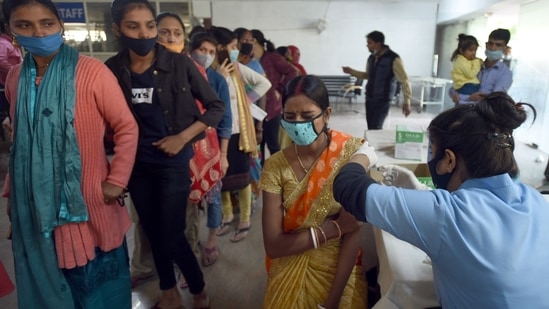
In other good news, the rate of vaccine administration across the country appears to be rising again. In the past week, 8.1 million daily shots have been administered across the country on average. This is a considerable improvement for a drive that has been patchy for long periods – particularly going through a lull in the past month. At its best, the seven-day average of daily doses has touched 9.8 million (for the week ended September 23). For the week ended November 4, this number dropped to an average of 2.9 million— a lull that has been largely attributed to the festive season by government officials.
India has administered a total of 1.24 billion doses of Covid-19 vaccine to 789 million people as of Wednesday morning. Of these, 452 million people have received both doses of the vaccine, while another 337 million people have been partially vaccinated. When these numbers are seen alongside the country’s projected adult population of 940 million (according to the Census of India’s National Commission on Population), this means that 83.9% of people above the age of 18 years have received vaccine shots – 48.1% are fully vaccinated and another 35.8% partially vaccinated.