
 E-Paper



Interim hijab order only for colleges with uniform code: Karnataka high court
The bench in its interim order dated February 10 restrained all the students regardless of their religion or faith from wearing saffron shawls (Bhagwa), and connected matters scarfs, hijab, religious flags or the like within the classroom till further orders.

 Prefer HTon Google


The Karnataka high court on Wednesday clarified that its interim order on February 10 was applicable only for the students of degree and pre-university colleges that have a prescribed uniform, and asked the state government to provide a report on the role of Campus Front of India (CFI) in the hijab controversy.
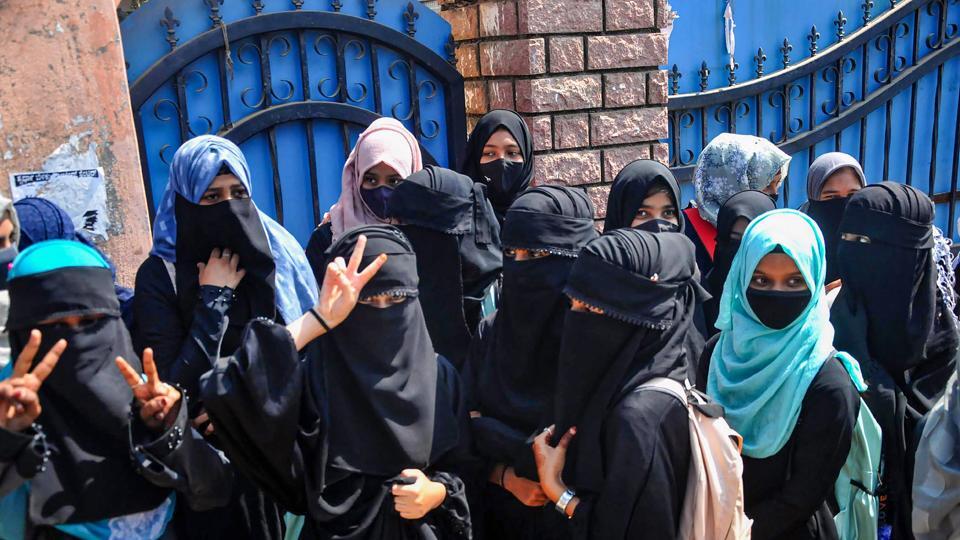
The bench in its interim order dated February 10 restrained all the students regardless of their religion or faith from wearing saffron shawls (Bhagwa), and connected matters scarfs, hijab, religious flags or the like within the classroom till further orders.
“We are making it very clear that whether a degree college or a PU College, if a uniform has been prescribed, that has to be followed so long as the matter is pending before the court,” a bench led by chief justice Ritu Raj Awasthi said.
The court was hearing the petition filed by the student at the government pre-university college in Udupi contesting the ban on hijab in classrooms.
The bench, also comprising justices Krishan S Dixit and JM Khazi, said the order will be applicable only to those colleges where a committee has prescribed a uniform for students.
The clarification came after advocate Mohammed Tahir, who is the counsel for one of the petitioners seeking permission to wear hijab in the classrooms, submitted before the court students of Bhandarkar College of Arts and Science, Udupi, a private college, have moved applications seeking a clarification regarding the extent of the interim order.
Tahir urged the bench for clarity on its interim order saying that every institution was “pushing students outside” the college citing the court order.
The court also made it clear that the interim order related to hijab was confined to students only, when a lawyer appearing on behalf of petitioners from Udupi pointed out that the teachers were also asked to remove their headscarf.
During the hearing, senior counsel SS Naganand, representing the Government PU College for Girls, Udupi, said the students who began the protest were encouraged and supported by CFI, an “extremist organisation”.
The bench then asked about the role of the CFI, to which the counsel said the organisation was coordinating and organising protests in the state. “It is also a voluntary organisation, which is spearheading and drumbeating in favour of students,” Naganand said, adding that state intelligence department would have a report on the organisation.
The bench then asked state’s advocate general Prabhuling K Navadgi if the government was aware of the organisation saying that the CFI appeared in the case without earlier mentions in the hearings. The court directed the state government through the AG to get information on the organisation.
The full bench is hearing the hijab case on a day-to-day basis and made it clear to wind it up by this weekend. On January 1, six girl students of a college in Udupi attended a press conference held by the CFI in the coastal town protesting against the college authorities denying them entry into classrooms wearing hijab.
This was four days after they requested the principal permission to wear hijab in classes which was not allowed. Till then, students used to wear the headscarf to the campus, but entered the classroom after removing it, college principal Rudre Gowda had said. “The institution did not have any rule on hijab-wearing as such since no one used to wear it to the classroom in the last 35 years. The students who came with the demand had the backing of outside forces,” Gowda had said.


